


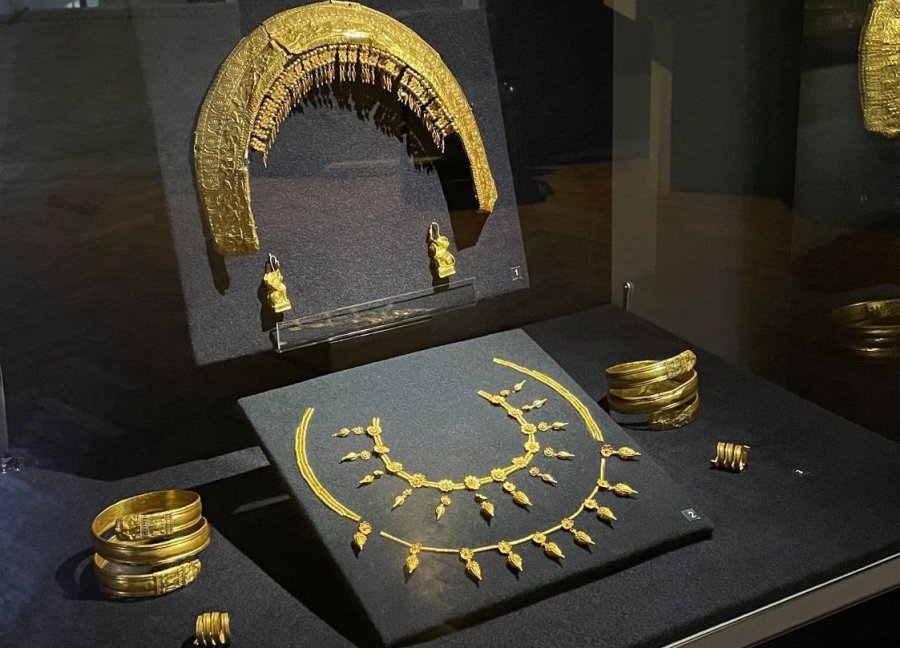
A photo exhibition dedicated to the collection of “Scythian gold” has opened at the Russian Embassy in Washington, with Russia attempting to present the artifacts as its own. The exhibition is titled “Crimean Gold: ‘Civilized’ Europe Robs Russian Treasures” and repeats Russian claims that the artifacts were allegedly illegally transferred to Ukraine.
This was reported by the Russian state-run news agency TASS.
The Russian side links the materials presented at the exhibition to archaeological discoveries made in Crimea. TASS stated that before the occupation of the peninsula, the relevant artifacts were held in four Crimean museums – the Kerch and Bakhchysarai Historical and Cultural Reserves, the National Preserve of Tauric Chersonesos, and the Central Museum of Taurida.
“The exhibition was prepared by the Russian Military Historical Society and is dedicated to unique archaeological finds discovered during excavations in Crimea. For many years, these artifacts were part of the collections of four museums on the peninsula – the Kerch and Bakhchysarai Historical and Cultural Reserves, the National Preserve of Tauric Chersonesos, and the Central Museum of Taurida. Today, these Russian treasures are being illegally held by the regime in Kyiv, which is considering their commercial use. Russia will continue to seek the return of the collection to the Crimean museums to which it rightfully belongs,” the statement said.
The “Scythian gold” collection left Ukraine in 2013, when the artifacts were loaned for the exhibition “Crimea: Gold and Secrets of the Black Sea” at the Allard Pierson Museum in Amsterdam. After the occupation of Crimea, Russia demanded that the exhibits be handed over to it, but the Dutch side rejected these demands.
In 2023, the Supreme Court of the Netherlands ultimately upheld the decision to transfer the collection to Ukraine. The court established that the artifacts were part of Ukraine’s state Museum Fund, rather than the property of individual museums located in Crimea, which is occupied by Russia. After the legal proceedings were completed, the collection was transferred to Ukraine.
Russia has repeatedly used the case to spread claims that Ukraine allegedly “stole” the artifacts. A similar exhibition was previously opened in Moscow, where the Russian side also attempted to portray the transfer of the collection to Ukraine as illegal appropriation.
Ukraine’s Center for Countering Disinformation statedthat Russian exhibition materials baselessly accused Ukraine of “stealing” the artifacts. At the same time, the collection was transferred to Kyiv on the basis of a Dutch court ruling, which recognized it as part of Ukraine’s state Museum Fund.
The Center for Countering Disinformation also emphasized that after the legal proceedings ended, the Russian side had no legal grounds to challenge the decision and instead resorted to propaganda manipulation. In particular, the Moscow exhibition was supplemented with biblical quotations about the inadmissibility of theft, in an attempt to create the impression that the lawful court ruling had been unjust.
Photo: National Museum of the History of Ukraine
Author: Danylo Pievchev