


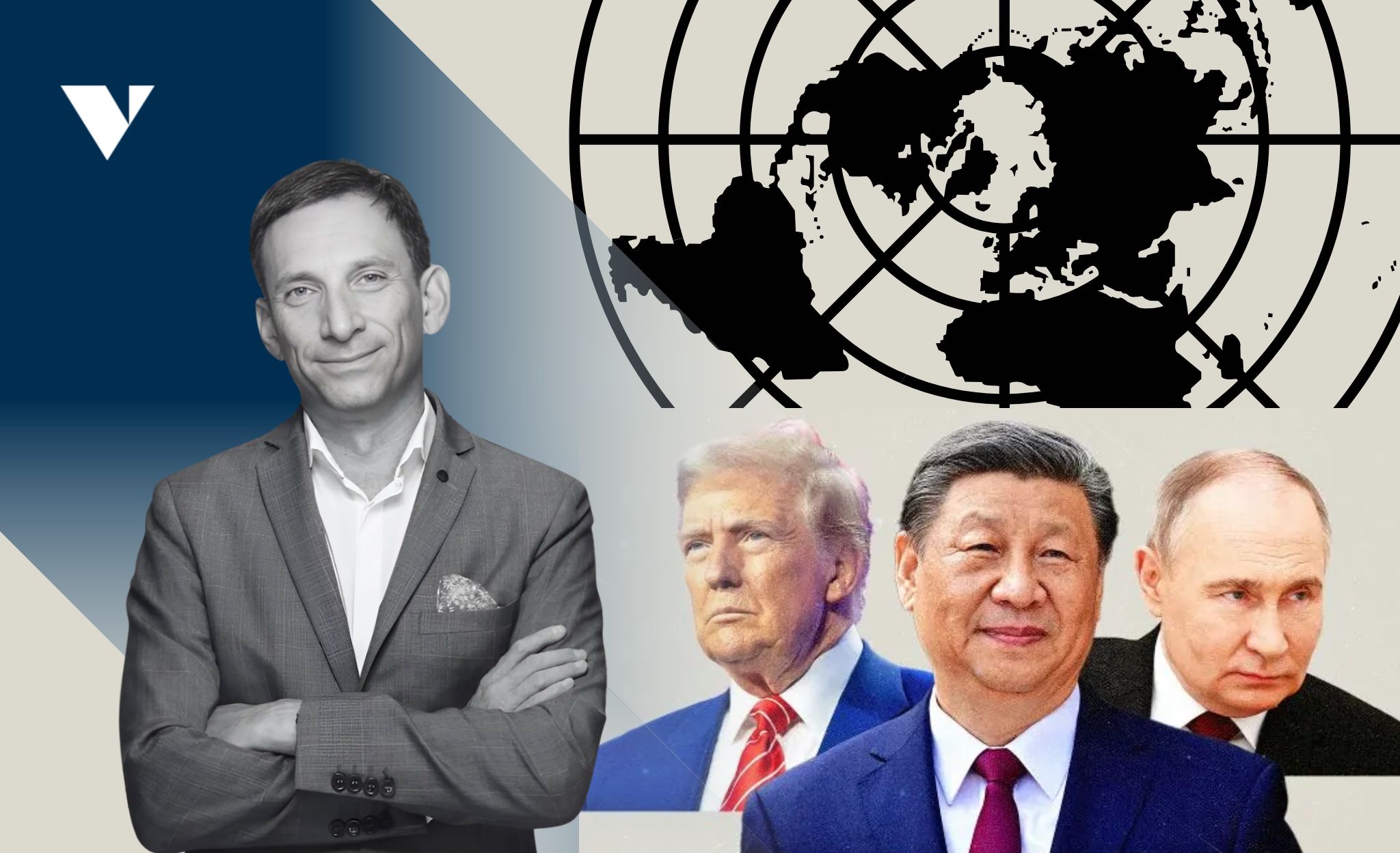
Russian presidential foreign policy aide Yuri Ushakov has said that practical preparations are already underway for a meeting between the presidents of Russia and the United States and the Chinese leader during the APEC summit in Shenzhen, China. So far, however, there has been no comment from the hosts of the meeting. The American president, for his part, has not ruled out the possibility of such a meeting and stressed that he would like to discuss nuclear weapons with his Russian and Chinese counterparts.
Putin has a different goal — the Russian president wants to discuss the situation surrounding the war against Ukraine. But whatever the presidents may plan for the agenda of such a meeting, it can already, without exaggeration, be called historic. Never before have the leaders of the United States, Russia, and China met in this format, and few believed such a meeting could take place amid Russia’s horrific war against Ukraine. That is why experts are already talking about a “world for three,” comparing the possible meeting — if it takes place, of course — to Yalta or Munich.
Yet the meetings in Munich and Yalta were important not simply because the world’s leading political players of the time took part in them. They mattered because joint decisions were made there — decisions that had a defining impact on the future. What, apart from an impressive photograph and declarations about the meeting’s “historic” nature, could we actually get from a summit in Shenzhen?
Probably nothing. The nature of relations between the United States and China, or between the United States and Russia, simply does not allow for any major joint decisions. Xi Jinping’s most recent visit to Washington ended without the signing of any documents; the two sides were unable even to agree on a joint communiqué, something that had traditionally been considered almost mandatory for visits of this kind. Why should we believe that adding Putin to this equation would suddenly make agreement possible?
Putin can talk with Trump and Xi about the Russian-Ukrainian war. But the American president cannot give him what he truly wants — control over Ukraine. Nor can he ensure the complete lifting of sanctions. The Kremlin, it seems, understands this as well. Ushakov himself has already begun talking about the need for dialogue not only with Washington and Kyiv, but also with European leaders. In other words, Moscow has recognized just how unrealistic the plan to “reach an agreement with the White House on Ukraine” is while Europeans continue providing Kyiv with systematic financial and military assistance.
But while Trump at least has a political interest in helping bring the Russian-Ukrainian war to an end — both because it strengthens his image as a peacemaker and because it opens prospects for economic cooperation with Putin — Xi is clearly not someone eager to assume responsibility for the war.
Why would the Chinese leader need that? Why should he be responsible for the terms of settling a conflict in Europe? And what interest would Beijing have in doing so when China already has economic cooperation with Russia and every additional day of war makes that country even more dependent on the People’s Republic of China? China needs neither a Russian victory nor a Russian defeat, nor does it need the role of guarantor of a settlement. And it does not need a discussion about nuclear arms reductions either. Xi Jinping and other Chinese leaders have repeatedly emphasized that for China to participate in negotiations on nuclear reductions with the United States and Russia, their nuclear arsenals would first have to be brought closer to China’s level.
In other words, either China must acquire more nuclear weapons, or the United States and Russia must reduce their arsenals. At the same time, no one today knows the true size of China’s own nuclear arsenal. Despite that fact, Xi is likely to view Trump’s very attempt to initiate a discussion on joint nuclear arms reductions under the cover of a trilateral summit as an unfair game.
I could give many more examples of the absence of shared interests, but I have deliberately focused on the very issues that Trump and Putin themselves would like to place on the agenda of a possible summit. So, as you can see, there will be no “world for three.” Nor will there be any joint agreement on the terms for ending the Russian-Ukrainian war.
Author: Vitaly Portnikov
