


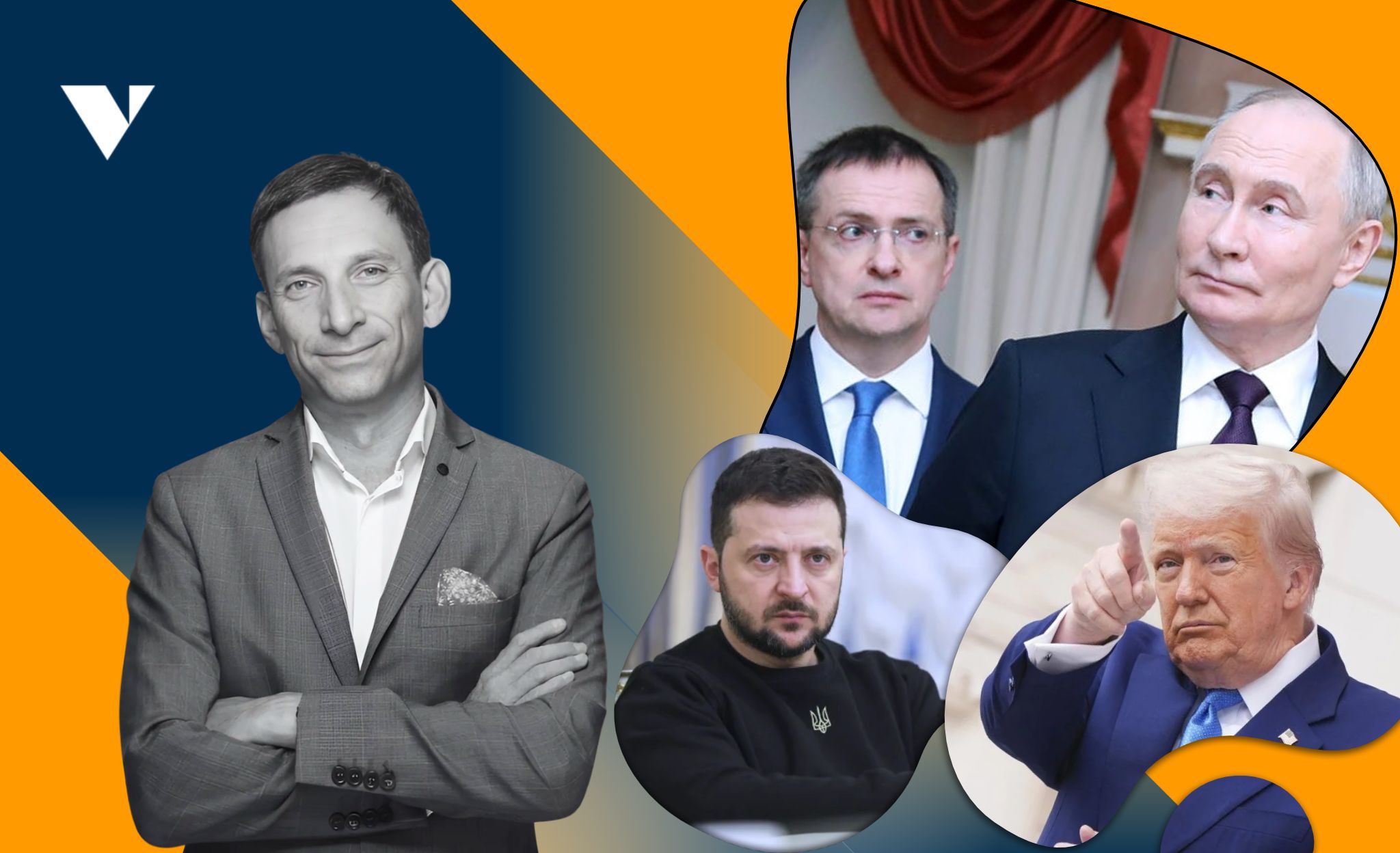
When the resumption of talks between Russia, Ukraine, and the United States was only being arranged, one could hear the argument that Putin’s very agreement to send his officials to the negotiations was already progress after several months without any dialogue. But now that we know the composition of the Russian delegation, it is possible to conclude that we are dealing with the same swindlers who, over nearly five years, have learned how to go around in circles and imitate negotiating activity.
Of course, the head of this delegation, Vladimir Medinsky, has been going around in circles since the winter of 2022. Those negotiations ended with nothing, but Putin continues to make use of the fruits of Medinsky’s work to this day — when he claims that his envoy had already reached an agreement with Ukraine on its de facto capitulation, only for then-British Prime Minister Boris Johnson to arrive in Kyiv and persuade the Ukrainians to continue resisting.
But the main thing about Medinsky is that he has no political influence and no authority. Even in 2022, when Putin’s aide merely suggested the possibility of a ceasefire on the Russian-Ukrainian front, virtually all Russian propagandists attacked him. Could Lavrov himself have faced such insulting criticism? Yet even Lavrov has no direct access to Putin and learns about the president’s key decisions last. Medinsky, meanwhile, learns about such decisions from television…
The other participants in the negotiations are either Foreign Ministry clerks or intelligence officers whose task is simply to assess the enemy’s mood. Such a delegation decides nothing and proposes nothing. This raises the question: why should Ukrainian representatives talk to these swindlers?
Solely so that the White House cannot accuse us of disregarding Trump’s peacemaking initiatives and use that as grounds to deny Ukraine assistance. In essence, Ukraine’s participation in the negotiations is a kind of ritual.
The same is true for the Russians. They are demonstrating that they are prepared to accommodate Washington’s wishes and discuss not only ending the war with Ukraine, but also the security system in Europe and economic cooperation with the United States. But forcing the West to discuss Russia’s “concerns” about its own security is also an obvious fraud. Russia is one of the world’s two largest nuclear powers by arsenal and has launched aggression against non-nuclear Ukraine. Who or what could possibly threaten its security?
Even before these negotiations, when news emerged during the Ukrainian delegation’s visit to the United States about Trump and Putin’s diesel deal, Zelenskyy described the Ukrainian negotiators as a screen for the actions of the U.S. administration. Nothing is changing now. Ukrainian negotiators continue to perform the same function. And one might think there is simply no way out of this disgraceful situation.
But in fact, there is a way out. Criticism of the administration’s actions regarding the Russian-Ukrainian war will only intensify after the midterm elections, and President Trump will no longer be able to ignore that criticism. The attitude toward Russia’s imitation of a peace process will also have to be reconsidered.
I see no point in negotiations without a ceasefire. I see no point in negotiations without Putin’s diplomatic isolation. I see no point in negotiations that produce no result while economic deals do produce results.
Of course, the U.S. president may think otherwise. But if he continues to insist on a model of negotiations without a ceasefire, the United States must help Ukraine both defend itself against Russia and strike Russia effectively. Because in reality, this is the only way to force Putin to agree to genuine negotiations rather than yet another fraud.
Author: Vitaly Portnikov
