


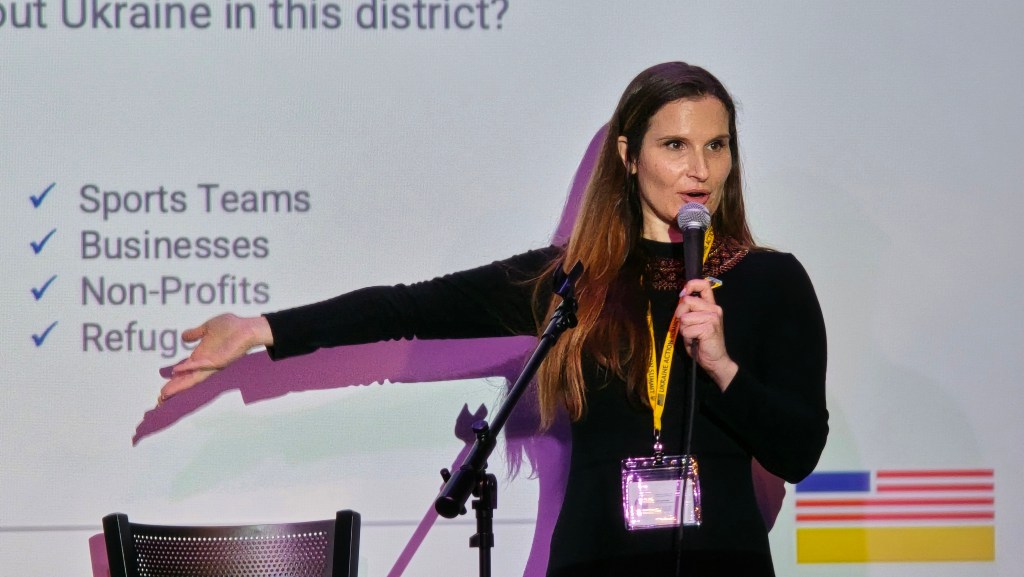
In September 2024, the fifth Ukraine Action Summit, organized by the American Coalition for Ukraine (ACU), took place in Washington, DC. The event brought together more than 500 delegates from 47 states to call for continued military and financial assistance to Ukraine in its fight against Russian aggression. Among the key figures at the summit was Marianne Tretiak, Chair of the ACU Board of Directors and one of the summit's organizers.
Marianna Tretiak belongs to a new generation of Ukrainians in America. Born and raised in Philadelphia, she has never forgotten her Ukrainian roots. Since the beginning of Russia's full-scale invasion of Ukraine, Mariyanna has turned her attention to advocacy work focused on mobilizing support for Ukraine in the United States. She is also the founder of the National Advocacy Committee of the Ukrainian Women's League of America and is actively involved in charitable and educational initiatives.
In her conversation with Vilni Media, she shares her vision of advocacy, the challenges of uniting Ukrainian communities in the U.S., and the importance of American support for Ukraine’s future.
LS (Lukyan Selskyi): Marianna, for the first time in my life, I have been given a role not only as a journalist, but as a participant in events aimed at supporting Ukraine in America. This specific experience as a Summit delegate is significantly different from the one I had in Ukraine, including in the context of meetings with parliamentarians or organizing such events in general. May I ask how you came up with this particular format and at what point did you realize that it was effective and working for the desired result?
МТ (Маріянна Третяк): I was born here in America. I went to school and grew up here. From a young age, we’re taught that every American has a voice and that all our legislators care about what we, as citizens, have to say. That’s how we grew up. I, for example, remember calling my legislators when I was in university to support certain laws. This is part of our lives. Our Ukrainian community truly started advocating at the federal level in the 1940s. Our people made a few big steps in the 1980s, actively discussing the Holodomor with the Committee that was studying it. They even published books with the support of this congressional committee.
LS: So there’s a significant history of creating public influence.
MT: Yes. Ukrainians born here, Ukrainian Americans, have long known how to do this. For example, our Ukrainian Women’s League of America (UNWLA) was very active in highlighting the Holodomor as early as 1933. We wanted everyone in America to know about it. And for legislators, for the Red Cross, to do something. And I think they would be completely shocked to learn how many Americans have now joined us. That’s what I think distinguishes our coalition and advocacy efforts now. We’re joined by ordinary Americans who don’t have a drop of Ukrainian blood, no Ukrainian spouses.
LS: There are Ukrainians by birth and Ukrainians by choice.
MT: Exactly. Ukrainians by choice.
LS: The war brought many Ukrainians to America. Many new ideas, thoughts, and approaches. Often, they are very active. Their worldview and values are often quite different from those who have lived in America all their lives. Is there a sense of division between the "old" and "new" Ukrainian Americans? Or are these interactions strengthened on shared platforms?
MT: Well, look at me. I’m just American. I’m neither old nor new. I think I reflect what we can all be. In our Ukrainian Women’s League, there are those who were born in Ukraine in the 1930s, and there are those born in the 2000s. The idea that we’re different is wrong because we’re all united by one desire: we want Ukraine to win. And we have a voice, and we use it to make that happen.
LS: Recently, I accidentally attended a UNWLA gathering in California. It was touching to see people of different ages, energy levels, and rhythms, but all united and active. It’s no wonder so many members are driving forces behind this Summit. Today, at least the official part of the Summit is over. What are the main conclusions at this moment? Were we able to break through to often very hard-hearted Americans?
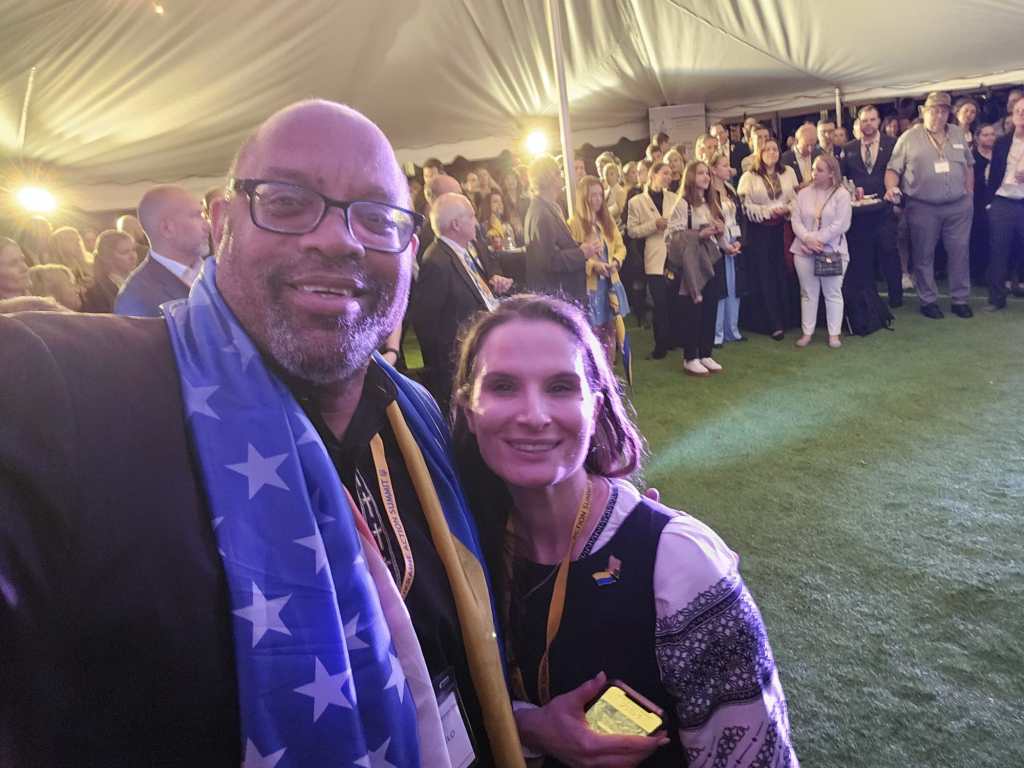
MT: As Ivan Franko said, “Scale down this cliff...”
LS: Yes! And we are all the stonemasons!
MT: And every day, you have to keep breaking. So, we will likely see the results over the next month. Congressmen are now going home, and then there will be elections. But for now, I can say that at the meetings I attended, the words of non-Ukrainian Americans had a very significant impact. When someone comes in and says, “I am Joe America” and advocates for Ukraine, it makes an impression on them. One of the biggest achievements of our summit is a significant increase in such good Americans. And then they go home and tell their neighbors, colleagues, in church or on the street, about what is really happening in Ukraine, not the distorted russian propaganda.
LS: I met one of them at the Summit. John. An American without any trace of Ukrainian roots. His son volunteered to fight for Ukraine and was killed by a russian missile. John has since lost his health and peace of mind; it’s hard to look into his eyes without feeling pain. But he considers it his duty to continue his son’s mission. He was one of us in the delegation. Congressmen listened to him with bated breath.
MT: Their voices carry a special weight. These are what we call Gold Star Parents. And you know, they could be very angry and not support Ukraine because their children didn’t have to go there and fight with us. But these parents keep coming every time and talking about Ukraine. They emphasize that their children were proud to fight alongside Ukrainians. This is a very, very valuable voice.
LS: Do we already know the Summit’s outreach effectiveness? Did the delegates manage to reach everyone they planned to?
MT: Overall, yes, but there are always those who don’t respond to us or are too busy at the moment. Sometimes there’s a problem when not all districts have their Ukrainian residents or activists (constituents). In such cases, we do a “drop-in,” going directly to the office of a particular congressman and asking for meetings and discussions.
LS: I participated in one such drop-in today. It works. We were warmly welcomed! And it’s important that all Summit participants have clearly formulated positions and a list of requests for American politicians.
MT: The first and most important request is for congressmen and senators to support the Stand With Ukraine Act. This is a law that formalizes the partnership between Ukraine and the U.S. It’s about supporting Ukraine now and for the next ten years. The second request is for them to use their voice and status to give Ukraine the opportunity to strike anywhere on the occupier’s territory. And the third is the REPO initiative – transferring russian assets to Ukraine.
LS: Some politicians here say, for example, “the elections are coming soon, we need to wait a bit” or “our senator is old, you should probably talk to the new one when they come in.” This isn’t representative, but it’s what I’ve heard with my own ears. Is the lack of passion in discussing Ukraine becoming a trend?
MT: It all depends on the office. There will always be those who avoid direct answers and resort to diplomacy, but you’ll also hear very frank and brilliant speeches fully aimed at supporting Ukrainians.
At the start of the war, everyone supported Ukraine and wanted it to win. Now, in the states, there is a lot of hidden russian propaganda that ordinary Americans are listening to. They believe that Ukraine no longer needs support. For example, in my conversations with senators and congressmen, I find that they want to support Ukraine, but they’re afraid that their voters won’t back them. At the start of the war, politicians were getting hundreds of calls and letters from Americans demanding that they support us, but now the number of those calling for an end to that support has grown.

LS: Are these organized calls?
MT: Probably, people just see something on the news and start calling. I know that maybe not in Pennsylvania, but in some other states, there were times when for every Ukrainian call, there were twenty anti-Ukrainian ones. That’s why we need to call, write, and visit politicians more, more often. One of our key tasks is to help our Ukrainians become stronger advocates for Ukraine, to build their advocacy muscles through training and education.
LS: I watched with great admiration as Ukrainian activists from all corners of the states gathered in Washington. Some represent different organizations, but others often belong to no groups or parties. Yet they all arrive with one goal. How do you manage to bring so many bright people together under one banner without a clear operational structure?
MT: We have one goal, and that is advocacy. We’re here only to give people support, help them understand how strong their voices can be. All those small and large organizations do a lot of work at home, and we amplify and complement their actions. Additionally, we make their work easier because all those laws need to be known and studied, and it takes a lot of time. If you, for example, are sending medical aid to Ukraine, why should you spend time studying specific legislation? That’s what we’re here for.
LS: How many organizations have joined this Summit?
MT: We organized as a coalition. It includes 30 organizations. And now it’s no longer enough just to call yourself a member. We’ve introduced membership fees to fully support systematic work.
LS: We more or less understand the key events that will happen in the coming months. Primarily, this is related to the elections, which create various milestones. Does the coalition have plans to forecast and plan its activities based on these milestones?
MT: One of our goals is to grow the coalition. Many organizations have applied, and we need to add them. Another goal is to coordinate more advocacy for Ukraine not only in Washington but across America. And we have our leaders who do great work at home, so our task is to nurture and strengthen them.
LS: Does this mean that these leaders could become new politicians who might then go to Congress?
MT: More likely, they’ll become public figures. Whether they go on to become politicians is their private matter. The first and biggest step we can take is to help these people become leaders in their communities, to communicate effectively with their congressmen, and build warm relationships with them—regardless of the party to which that congressman belongs. This is about helping Ukrainians in the U.S., and it’s about helping our Ukraine.
Author: Lukian Selskyi