Overlooking the eastern part of scenic San Francisco Bay are the hills of Hayward, California. In these hills is Garin Regional Park which is part of the East Bay Regional Parks System. Located within Garin Park is “Ukraina Honcharenko”, the former home and resting place of the Ukrainian political émigré Fr. Ahapius (Agapius) Honcharenko and his wife Abina (Citti). The site was dedicated on May 15, 1999 and is listed on the California Historical Landmarks register. The Honcharenkos lived on the property, which totaled 40 acres, for 43 years during the last quarter of the 19th and early part of the 20th centuries. Fr. Honcharenko was the first Ukrainian political émigré to settle in the United States and the founder of the newspaper “The Alaska Herald-Svoboda”, published in Ukrainian, Russian and English in San Francisco from 1868-1872.
Who was Fr. Honcharenko and what were his contributions to Ukrainian life in America?
Early Days
Fr. Ahapius Honcharenko was born Andrii Onufrievych Humnytskyi on August 19 (August 31), 1832. His father Onufrey was the Orthodox pastor in their village of Kryven, Province of Kyiv, Ukraine. Like his father, Andrew’s mother, Evdokia, was a proud descendent of an ancient Ukrainian Kozak family—Bohun. In 1651 during the Ukrainian Polish struggle, Colonel Ivan Bohun had taken command of the Kozak Army at the battle of Berestechko, Ukraine, when Hetman Bohdan Khmelnitsky was abducted by the Tatars.
A child of the middle class, Honcharenko entered bursa (a boarding school for boys) in the fall of 1840 and later the Kyiv Theological Seminary. Early in his life, he was able to witness firsthand the sufferings of ordinary Ukrainian peasants. "While on vacations, I was able to see how the Polish aristocracy treated our Orthodox people and how their servants beat girls with whips," wrote Honcharenko in his Memoirs (published in 1894 by Mykhailo Pavlyk in Kolomyja, Western Ukraine (Galicia)).
Young Andrew tried to avoid this unpleasant scene in the village. In 1853 he graduated from the Kyiv Theological Seminary and donning the garb of a monk, he moved to the Pecherska Lavra (Cave) Monastery in Kyiv to become a novice. It was here that he took the monastic name “Ahapius”. Ahapius was shocked to see the worldliness of the monks. Their lives contrasted sharply with the poverty and sufferings of the village folk with whom the youthful novice came into contact while performing his duties as the assistant of Metropolitan Philaret of Kyiv.
On July 12, 1857 Honcharenko had an eventful meeting in Kyiv with Prince Sergei Trubetskoy, a returned political exile of the abortive Decembrist uprising of 1825. This group of rebels, which had a significant following among the officer corps, had aimed at abolishing those two pillars of the Russian Empire—autocracy and serfdom. Secret societies were formed in both Russia and Ukraine in 1818. These conspirators never came to grips with the political problem posed by Ukraine, but many of their writers expressed sympathy for Ukraine’s heroic traditions—especially the saga of the Kozaks. The Decembrist movement acted as a catalyst in the development of 19th century Ukrainian political and cultural consciousness. His encounter with Trubetskoy inspired Honcharenko to pursue the Decembrist cause.
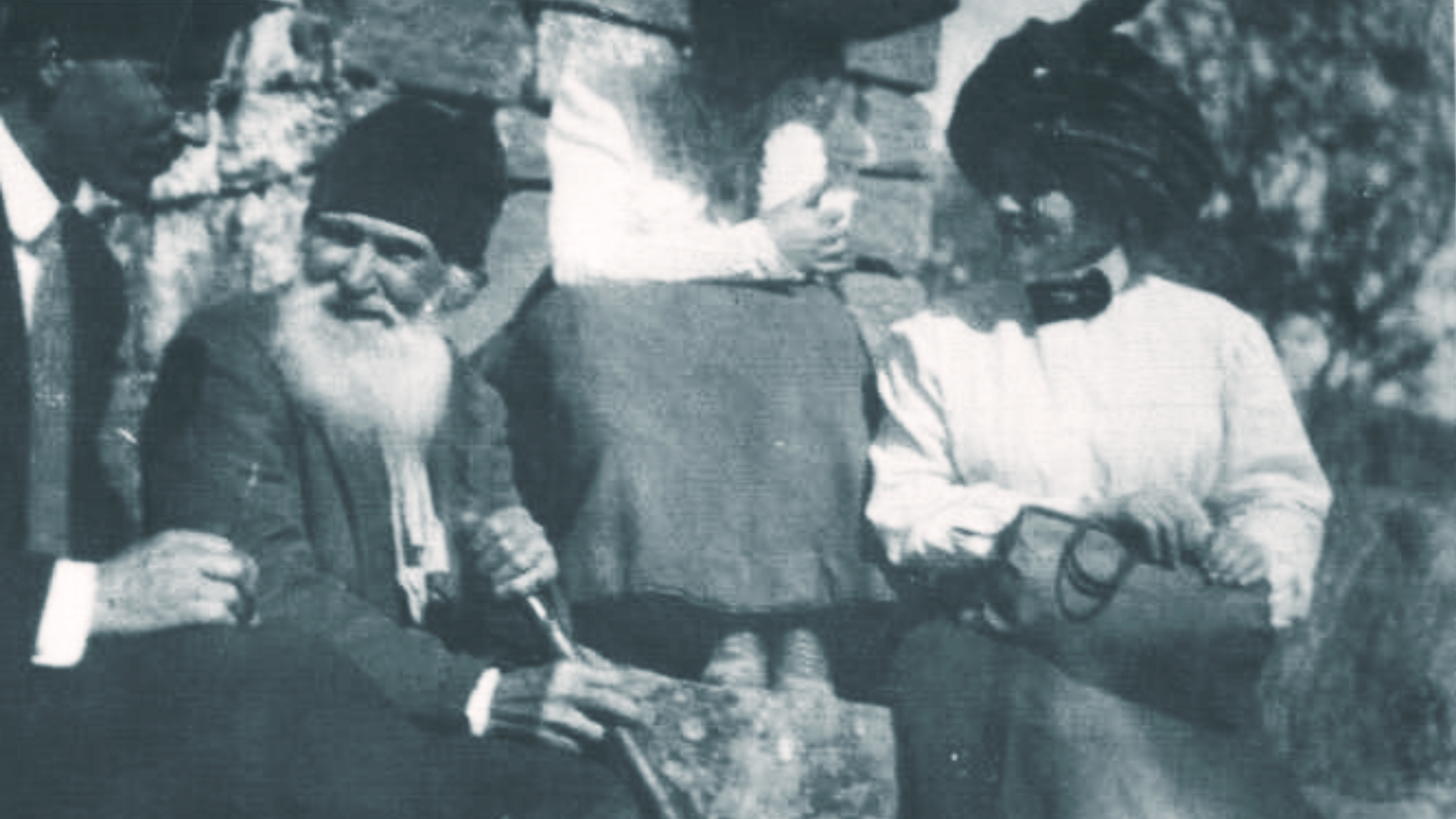
Photo: Ahapius and his wife with guests near their house in Hayward, California
Journey to Greece, Arrest and Escape
The fall of 1857 found Honcharenko in Athens, Greece. The Holy Synod (the governing body of the Czarist Russian Orthodox Church) had recommended that an archdeacon (hierodeacon) be appointed to the Russian consular Church in Athens. Metropolitan Philaret of Kyiv chose his young assistant for the post. Ahapius quickly became absorbed in Greek culture and began to learn the language of the philosophers. While in Athens, he contacted Alexander Herzen and Nikolai Ogarev—two famous Russian political exiles who were publishing anti-Czarist materials in London. Remembering vividly the sufferings and cruel treatment of the villagers near Kyiv, and the immorality and drunkenness within the monastery, Honcharenko started to write articles for these London publications, for "Kolokol" (the Bell).
At noon on February 2, 1860, the Kyiv an archdeacon was invited to join Alexander Petrovitch Ozerov, the Russian Ambassador in Athens, for dinner aboard the ship "Rusalka". After boarding this vessel, Honcharenko was handed a slip of paper informing him that he was under arrest and would be deported to Russia. The "Rusalka" carried the Kyivan monk to Constantinople, where he was thrown into prison with "thieves and drunkards of Russian extraction”. In the twelve days that it took the Russian man-of-war to reach this city, Honcharenko’s friends in Athens had communicated with their contacts in the Ottoman capital.
On February 16th, the young monk was assisted in escaping from prison and he immediately headed for London, reaching there on March 4th. He would remain there some eighteen months. While there, he met Herzen, Ogarev and the Italian political exile, Giuseppe Mazzini. Honcharenko was employed by the British Museum as a classifier and numismatist. He continued writing for Herzen and worked as a printer in the shop of Ludwik Czernetzky. Ahapius earned good money for his work. He managed to financially assist the many Russian refugees who flowed into London during those years of political uncertainty under Czar Alexander II.
Back to Greece and on to the Middle East
Ahapius continued to write articles for the publication “Kolokol". Early in 1861 he began using “Honcharenko” as his pen name and subsequently took the pseudonym as his surname. In late 1861, the Kyivan monk returned to Greece by way of Turkey. He went to visit his uncle, Dmytro Bohun, at Mount Athos in January 1862. Later that month after submitting his request to be consecrated there, he was ordained a priest. From Greece, Fr. Honcharenko journeyed to Jerusalem. When the Russian Consul in the Holy City learned of his presence, Ahapius was threatened with arrest and deportation. The young priest possessed a letter of introduction given to him by Prince Ivan Gagarin, a Russian Roman Catholic. This afforded him the protection of the Patriarch of Jerusalem. At Gagarin's suggestion, the Ukrainian exile taught for a while at a Jesuit school in the Lebanese mountains. He eventually moved on to Alexandria, Egypt, where he found asylum with an Englishman, Sir Samuel Baker.
Fr. Honcharenko opened a small store near the Cairo railroad station. It was here that he experienced the first attack on his life. His Greek assailant confessed that he had been hired by the Russian Consul to "persuade" the priest to leave Alexandria. Ahapius’ Hellenic friends urged him to return to Greece to apply for citizenship. He did so, and became naturalized on June 6, I863. The following year, the Ukrainian emigre travelled throughout the Greek Islands and Eastern cities as an interpreter for two Russian scholars, Iamonsky and Pertzov, who were searching for Slavic relics.
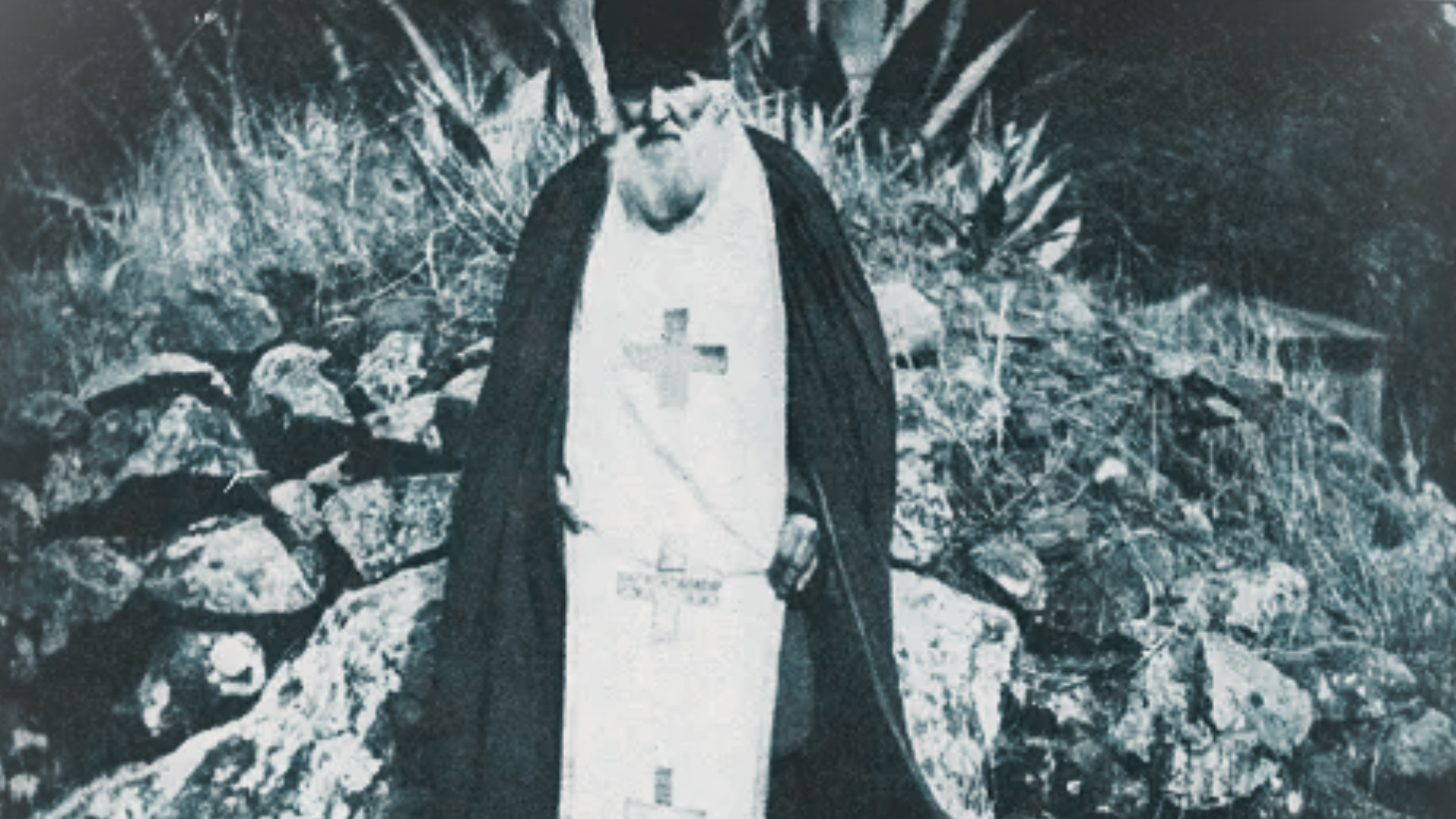
Photo: Father Ahapius during a religious service in the hills of Hayward, California.
Departure for America and a New Life
Honcharenko gradually concluded that it was possible for his people to fully realize their intellectual and cultural potential abroad. Conversations with the influential Russian political exiles in London convinced him that he should emigrate to San Francisco to open a Russian publishing house. The young priest hoped to unite the Slavic people of the Pacific Coast of the United States into a strong organization. He bid farewell to Athens on October 18, 1864. The ship Yarington transported him from Izmir, Turkey to Boston, Massachusetts. On New Year’s Day 1865, the Ukrainian Orthodox priest arrived in America.
The first unofficial Greek Orthodox Church service conducted in America by Fr. Honcharenko on January 6, I865 aroused the interest of local members of that faith. In February, this Ukrainian exile was a guest at a dinner given by the Episcopal Bishop Potter of Trinity Chapel in New York City. At this gathering he learned from the clergymen present that the previous year Orthodox chaplains accompanying the visiting Russian fleet (whose commander was, incidentally, a Ukrainian Admiral, S. Lessovsky) were invited to celebrate their liturgy in the Episcopal Churches of that city. The Russian priests refused on the grounds that Orthodoxy forbid them to serve in Protestant Churches. They said, "we will have no dealings with heretics." Bishop Potter offered Fr. Ahapius the opportunity to celebrate the Liturgy in Trinity Church located on 26th street, New York City. On March 2, 1865 the Ukrainian priest celebrated the first public Orthodox service in the New World.
Honcharenko was thirty-two years old when he first caught the attention of two American newspapers, The New York Evening Post and The New York Times. The New York Evening Post (March 2, 1865) printed a long account of the Orthodox service celebrated in Trinity Chapel, characterizing it with the headline, "Significant and Political Ceremony". The New York Times (March 3, 1865) also devoted several columns to a review of this Liturgy and its significance for Russo-American relations. One paragraph revealed an interesting description of the Ukrainian exile priest.
“The Russo-Greek clergyman, the Rev. Agapius Honcharenko, is an amiable and dignified-looking clergyman of some fifty years of age. He is a Russian by birth, and a graduate of the ecclesiastical academy of St. Petersburgh. The ship Alexander Nevskythat some twelve months ago left this city for Athens brought word to the Grecian capital that there were many from the Orthodox Church in this country without a pastor, and he came on, volunteering his services, accredited by the Metropolitan of Athens and the Holy Synod of the Kingdom of Greece.”
Perhaps Honcharenko's five years of constant travels and his full beard made him appear much older (50) than his actual age (32). More than likely, the cleric himself slightly altered these printed details of his life to camouflage his presence in New York City from the watchful eyes of the Czarist government.
The Kyivan cleric was soon contacted by the Russian Consul in New York City, Baron Robert Osten Sacken, to teach this official the Greek language. Honcharenko's fugitive past remained hidden for the moment. The sharp eyes of the double-headed Eagle (the symbol of Czarist power) soon traced the elusive outlines of Fr. Ahapius’ earlier "criminal" activity. The Baron was asked to have the Ukrainian exile arrested. The Consul refused to initiate this action.
Honcharenko again made the headlines on April 15, I865 as the celebrant of an Orthodox service in St, Paul's Church, New Orleans, La. He officiated at the blessing of this first Greek Orthodox Church in the United States, The Imperial government took determined steps to isolate him from his Greek friends. On May 13, 1865, the Greek Consul in New York City, Kyr Botassi, was paid a visit by the Russian Ambassador, Baron Edward de Stoeckl. The Russians agreed to provide funds for a new Orthodox Church in the City complete with a pastor, Father Nicholas Bjerring. The Greeks were told to sever their ties with Fr. Ahapius, "enemy of Russia". Honcharenko was forced to seek new employment. The American Bible Society hired him to translate the Bible into Arabic and Church Slavonic.
Through his acquaintance with the Italian revolutionary, Mazzini, the Ukrainian made his way to the household of John Citti in Philadelphia, whose home was a meeting place for immigrant Italian patriots. On September 28, 1865,in New York City, Honcharenko married Albina, the daughter of Mr. Citti. Albina Citti became the Ukrainian emigre's life-long companion, and she made important contributions to his publishing work on the Pacific Coast.

Photo on the left: Father Ahapius with his wife Albina, 1910. Photo on the right: Honcharenko on the porch of his home in California.
Onward to San Francisco
The life of the Kyivan exile in New York City was carefully observed by Czarist spies. While busily engaged in Bible translations, he never forgot his earlier plan to open a publishing house on the West Coast. The year 1867 finally convinced him to realize his dream. Negotiations for the sale of Russian America to the United States took place during the winter and spring of that year. On October 18, 1867 the Russian flag was taken down for the last time at Sitka, Alaska. Beginning in 1808, Sitka became the capital of Russian America.
The exact nature of Honcharenko's involvement in the Alaska purchase remains hidden. It is likely that he did contact Secretary of State Seward sometime during I867. The Orthodox priest's first American publications (1868) were initiated at Seward's request. Fourteen days prior to the departure of the Russians from Alaska, Fr. Ahapius and his teacher-wife boarded the steamship America at New York and sailed to the Isthmus of Panama. He and Albina had accumulated a sizable sum of money—$2,500. On their journey westward, a $1,600 Cyrillic type machine was included among their belongings.
A train carried them fifty-seven miles across Central America and then another ship brought them to San Francisco on November 6th.
The Ukrainian exile had considered establishing his publishing house in Alaska, but he feared censorship from the American military authorities in control there. San Francisco, the main port of shipping and communication to and from Russian America, offered a more suitable location. 536 Market Street became the home of the first Russian English newspaper published in the United States, The Alaska Herald (-Svoboda). During the next five years, this Fr. Honchareko’s printing shop was also a gathering place for former Alaskan inhabitants, as well as refugees from Russia and Siberia.
End of part one.
About Author: