


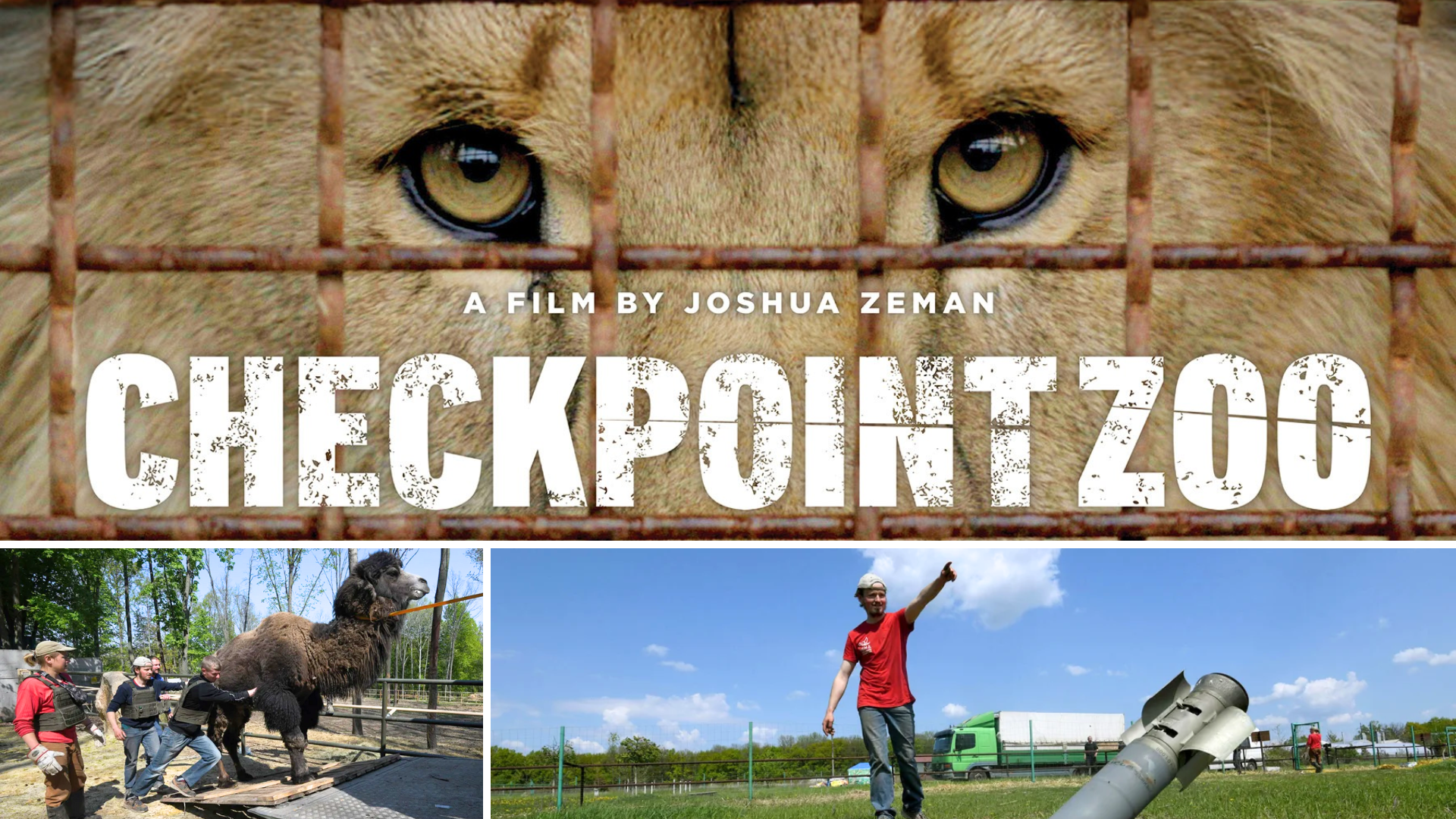
Starting August 15, selected theaters across the United States will begin screening the documentary Checkpoint Zoo—a testimonial film about how animal rights defenders and volunteers from Kharkiv rescued more than 5,000 residents of Feldman Ecopark under constant Russian shelling. Directed by American documentarian Joshua Zeman, the project brought together a team of executive producers, including Leonardo DiCaprio and Jennifer Davisson, to draw global attention to the “invisible” victims of war and to support Ukrainian animal welfare initiatives.
Feldman Ecopark found itself caught between the positions of the Ukrainian Armed Forces and the Russian army on the outskirts of Kharkiv in March 2022. This marked the beginning of a 71-day rescue operation: lions, monkeys, kangaroos, moose, and pumas were transported under artillery fire in private cars, trucks, and military evacuation vehicles. Six people lost their lives, including 15-year-old volunteer Denys Selevin. One powerful scene in the film shows the boy’s father holding his bloodied hands in front of a captured Russian soldier and asking, “How am I supposed to feel about you?”

Zeman first learned about the tragedy after seeing a video online of a chimpanzee named ChiChi wandering around Freedom Square in Kharkiv. “I couldn’t believe that in the 21st century, animals had found themselves at the heart of a major war,” the director says. During his first trip to Ukraine in the fall of 2022, his phone kept sending air raid alerts, while the film crew wore flak jackets and helmets. “Bombs were going off, and we kept filming,” he recalls. Getting to Kharkiv was an adventure in itself: 12 hours of questioning at the Polish-Ukrainian border and a five-day journey with film equipment, trying to convince border guards that the team was going “to film a zoo, not the front line.”
The film was made with contributions from cinematographers from Ukraine, the United Kingdom, and the United States. The soundtrack was composed by British-Ukrainian composer Anne Nikitin, and the credits include over 80 Ukrainian professionals—from drone pilots to translators. One of the film’s protagonists, zookeeper Andrii Tyvaniuk, summarizes the experience with the words: “Not all animals are animals, and not all humans are humans.” Zeman adds, “This is a film about the victims of war who are usually not seen.”
Checkpoint Zoo has already received the Audience Award at the Tribeca Film Festival, as well as honors at the Mill Valley, Hamptons, and Glimmerglass Film Days festivals. CNN called it “beautiful and beyond moving.” After each screening in the U.S., audiences will have the opportunity to participate in discussions and Q&A sessions with the creators and experts.
Ukrainian communities, churches, and student clubs can apply to host their own charitable, non-commercial screenings using a special form available on the film’s official website. The World Congress of Ukrainians serves as an informational partner of the initiative. All funds raised will go toward supporting Ukrainian shelters and animal rehabilitation programs.
According to Ukraine’s Ministry of Agrarian Policy, nearly six million domestic animals died in just the first year of the full-scale war, and the load on shelters in frontline regions increased by 100%. Shelling, forest mining, and the destruction of the Kakhovka Dam have devastated millions of hectares of ecosystems, leading to the mass death of wild flora and fauna. Checkpoint Zoo not only preserves the memory of those who gave their lives for animals but also reminds the world that humanity and compassion remain weapons no missile can destroy.
Author: Diana Khudko