


 Ukraine continues to reshape modern warfare through the development of drones and autonomous systems, while international politics surrounding Russia’s invasion remain tense. In the United States, it was decided to allow certain operations involving Russian oil to continue for another month, citing the needs of the poorest countries. Meanwhile, the European Union warns about the danger of external attempts to undermine European unity.
Xi Told Trump That Putin “May Regret” the War in Ukraine
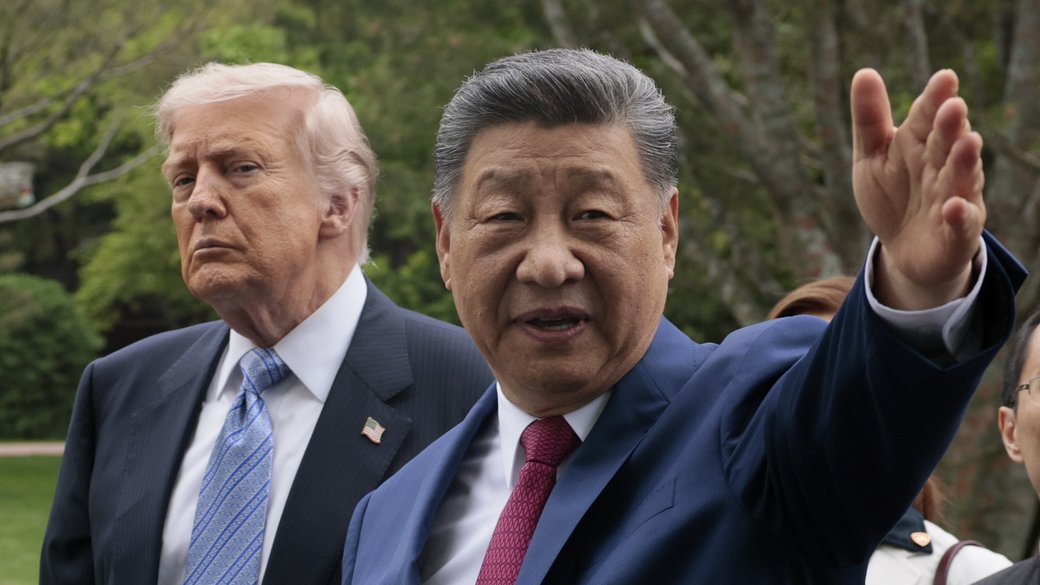
Chinese leader Xi Jinping, during talks in Beijing with U.S. President Donald Trump, reportedly said that Russian leader Vladimir Putin may eventually regret his decision to launch a full-scale war against Ukraine. This was reported by The Financial Times citing materials prepared by the American side after the meeting.
According to the publication’s sources, Xi’s assessment was much more direct than his previous public or private statements regarding Russia’s actions. Previously, the Chinese leader had avoided such wording in contacts with Western partners. The report was published on the eve of Putin’s planned visit to China, where he is expected to meet with Xi Jinping today, May 19.
The Financial Times also reported that during the talks, Trump allegedly proposed that China and Russia cooperate against the International Criminal Court. The White House and the Chinese embassy in Washington declined to comment. Meanwhile, China’s Ministry of Foreign Affairs denied reports of Xi making critical remarks about the war against Ukraine. Foreign Ministry spokesperson Guo Jiakun stated that these reports “contradict the facts and are pure fabrication.”
Ukraine Develops Robotic Warfare and Autonomous Weapons Systems
Ukraine’s Minister of Defense, Mykhailo Fedorov, stated that the future of warfare lies in autonomous systems and robotic weapons. This was highlighted in a major feature by The New York Timesпосвящений to Ukrainian military technologies. Fedorov believes that unmanned and autonomous systems should replace humans on the battlefield as much as possible. According to him, autonomous weapons will become the “new nuclear weapon,” and countries that possess them will be able to guarantee their own security.
Ukraine is actively developing drones and other next-generation systems, using them to strike Russian military facilities and logistics. Fedorov is promoting the Air, Land, Economy strategy, which involves the mass use of drones to exhaust the Russian army and economy. At the same time, disagreements are emerging within Ukraine’s military leadership regarding an excessive focus on robotic warfare. Some commanders emphasize that the realities of the front are still defined by infantry, trenches, and traditional assault operations. Despite this, Fedorov continues to expand Ukraine’s cooperation with technology companies and artificial intelligence developers.
Kallas Explains Why the U.S. and Russia Dislike the European Union
EU’s top diplomat Kaja Kallas saidthat the United States, China, and Russia have a complicated attitude toward the European Union due to the strength and influence of a united Europe. She made this statement during the Lennart Meri Conference. According to Kallas, it is much easier for major powers to negotiate separately with each country than to deal with a unified European bloc. She noted that this is why external actors often try to maintain bilateral relations while simultaneously criticizing the European Union itself.
Kallas emphasized that the main danger for the EU lies in internal disagreements among member states. She warned that some countries may be vulnerable to external influence and act contrary to the Union’s common position. “It is easy to tell each country: my relations with you are excellent, but I don’t like the European Union,” the diplomat said. According to her, division weakens the EU on the international stage and benefits other centers of power. Kallas stressed that maintaining unity remains the key condition for the European Union’s influence.
U.S. Extends Sanctions Waiver for the Sale of Russian Oil
The U.S. Department of the Treasury will extend for another 30 days a sanctions waiver allowing the sale of Russian oil that has already been loaded onto tankers. This was also reported by U.S. Treasury Secretary Scott Bessent. According to him, the decision is necessary to support the most vulnerable countries that depend on energy supplies. He noted that the waiver is intended to help stabilize the global oil market and prevent supply shortages.
Bessent also stated that the decision would limit China’s ability to purchase Russian oil at discounted prices. The U.S. Treasury plans to continue issuing individual licenses for countries that require access to such supplies. As Politicoreports, this is already the second extension of the waiver, although Bessent had previously assured that there would be no further concessions. He later explained the shift in position by citing appeals from more than ten countries with low levels of energy security. According to the minister, without this decision, oil prices could have risen to $150 per barrel.
Ukraine Intensifies Medium-Range Drone Strikes on Russian Forces
Ukraine has significantly increased the use of medium-range drones to strike Russian logistics, air defense systems, and military infrastructure. This was reported by Reuters citing Ukrainian military officials, analysts, and drone technology experts. According to the sources, strikes at distances ranging from 30 to 180 kilometers behind the front line allow Ukraine to destroy radar systems, air defense complexes, command posts, and supply depots. These attacks also open the way for longer-range strikes on oil refineries and military facilities deep inside Russian territory.
Ukrainian military officials note that the number of such strikes has grown substantially in recent months. President Volodymyr Zelensky stated that in April, the number of “medium-range strikes” was four times higher than in February. Commanders of drone units say that new systems allow for more precise targeting and force Russia to move its air defenses further away from the front line. Analysts believe that while these attacks alone cannot turn the tide of the war, they are already significantly complicating Russian offensive operations and logistics. In addition, strikes on Russia’s oil infrastructure have already led to reduced oil production and disruptions at certain refining facilities.
Photo: Getty Images / Evan Vucci-Pool
Author: Danylo Pievchev