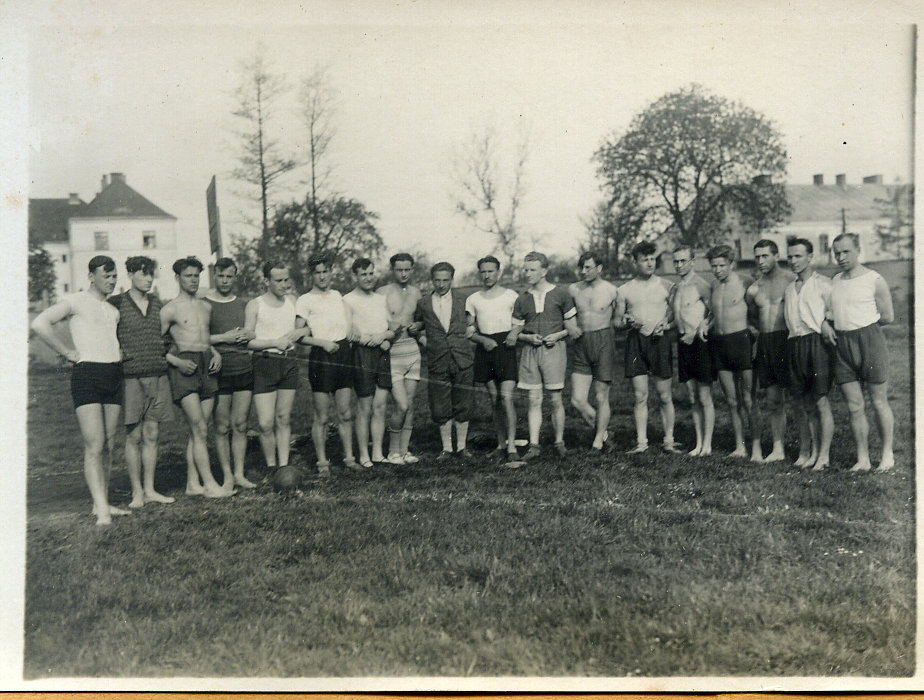
The answer to this question comes from Yurii Starosolskyi. In his unique account, he provides little-known facts about the sporting life of Hero of Ukraine and fighter for Ukraine’s liberation Roman Shukhevych (Taras Chuprynka).
There are three main figures in Yurii Starosolskyi’s story: Jim Thorpe, Roman Shukhevych, and Yurii Starosolskyi himself. The latter recounts fascinating episodes in which he personally took part. That is precisely why his testimony is particularly valuable.
At the same time, another question arises: what could possibly connect Olympic champion Jim Thorpe, Ukrainian freedom fighter Roman Shukhevych, and prominent Plast member Yurii Starosolskyi?
It is not easy to give a direct answer right away. While the relationship between Shukhevych and Starosolskyi can be explained by historical facts, Jim Thorpe’s connection to them seems far from obvious at first glance.
Thorpe was American. Shukhevych and Starosolskyi were Ukrainians. Different countries, different continents, different peoples, histories, languages, cultures, and traditions. In other words, at first glance, there would seem to be nothing connecting them.
There is no information online indicating that they knew one another personally, worked together, or had any other direct connection. I emphasize that for now we are talking specifically about what connected these two Ukrainians with the American. Only afterward will we learn who served as Roman Shukhevych’s model for physical education and sporting inspiration.
And here comes the surprise: I managed to find an interesting and unique document containing little-known information about what connects these three figures and providing an answer to the question posed in the title.
Before moving on to a more detailed exploration, analysis, and search for answers, it is worth getting to know the three protagonists of this article more closely — Jim Thorpe, Roman Shukhevych, and Yurii Starosolskyi.

Jim Thorpe
A legend of American sport and, undoubtedly, of world sport as well. To demonstrate this, I will list the sports in which he participated — not only as an amateur, but also professionally: track and field (running, long jump, pole vault, high jump, discus throw, javelin throw, shot put, pentathlon, decathlon), basketball, baseball, American football, hockey, swimming, tennis, boxing, and archery.
Can you imagine just how versatile an athlete Thorpe was? The sports on this list differ fundamentally in their rules, intensity, technique, and tactics. That is why Jim Thorpe truly was a unique athlete.
It is therefore hardly surprising that Roman Shukhevych and thousands of others admired the American athlete.
Jim Thorpe achieved worldwide fame after winning two events at the 1912 Olympic Games in Stockholm, Sweden. Those Games were special for several reasons: first, they were the last Olympics before World War I; second, they proved exceptionally successful after the troubled Olympic Games of 1900 in Paris, 1904 in St. Louis, and 1908 in London.
In Stockholm, Jim Thorpe captivated everyone with his skill and athleticism. Even then, he became a role model, and later an inspiration for subsequent generations of athletes.
His convincing victories in the pentathlon and decathlon made him an international Olympic sports star. He also became one of the most famous athletes in the United States.
This is what Wikipedia says about Jim Thorpe’s remarkable performance and other, so to speak, adventures in Stockholm: “In Stockholm, Jim Thorpe won two gold medals in the track-and-field pentathlon and decathlon, similar to the modern events, winning 8 of the 15 disciplines and finishing no lower than fourth in the rest. His margin over the runner-up in the decathlon was more than 700 points, while his record score of 8,413 points surpassed the previous record by 998 points and stood for more than two decades. Thorpe also qualified in the high jump and long jump, finishing fourth and seventh, respectively. Thorpe’s achievement appears even more remarkable because before the pentathlon final his athletic shoes were stolen, and he won the gold medal in mismatched shoes of different sizes that he found in a trash bin.”
Thus, Thorpe overcame challenges and obstacles in pursuit of his goal. But these were only, so to speak, unfortunate trials of life. A much more serious ordeal awaited him.
After returning to the United States as a world sports star, Thorpe soon faced devastating criticism from American sports and Olympic officials. He was accused of having received money for participating in athletic competitions. In other words, Americans themselves classified Thorpe as a professional athlete.
This triggered an immediate chain reaction in international Olympic sport. Under the rules of the International Olympic Committee at the time, Thorpe was stripped of his Olympic medals.
Can you imagine the cynicism and racism of this situation? American Olympic officials effectively deprived their own athlete — and with him, their own country — of Olympic medals!
Jim Thorpe lived with this “shame” until the end of his life. He died in 1953. When the IOC reconsidered its decision in 1982 and acknowledged it as erroneous, it was Thorpe’s children who received the restored medals.
American Avery Brundage had also been involved in that decision at the time.
Of course, this is only a very brief account of Jim Thorpe’s life and sporting career. But even this gives us some idea of the man and helps us better understand why Thorpe could have had such a powerful influence on Roman Shukhevych.

Roman Shukhevych
Roman Yosypovych Shukhevych was a Ukrainian civic, political, state, and military figure, a member of the Organization of Ukrainian Nationalists from 1929, a general and commander-in-chief of the Ukrainian Insurgent Army from 1943 to 1950, and head of the General Secretariat of the Ukrainian Supreme Liberation Council from 1943 to 1950. He was a fighter for Ukraine’s independence in the 20th century and was awarded the title Hero of Ukraine in 2007.
This is only a very brief outline of Roman Shukhevych’s biography. What interests us above all, however, is his sporting activity and what connected him with Jim Thorpe.
Roman Shukhevych, like Jim Thorpe, was an avid sportsman. He practiced a variety of sports: football, swimming, track and field, skiing, speed skating, basketball, volleyball, fencing, and others.
Yurii Starosolskyi described how Olympic champion Jim Thorpe entered Roman Shukhevych’s life: “And that was when Jim Thorpe appeared among us. Not physically, of course, but as our sporting ideal, especially Romko’s. At the 1912 Olympics in Stockholm, he won first place in the decathlon and pentathlon. Romko got hold of a book about those Olympics, read it avidly, and told me everything about Jim and his achievements. We knew that he was a true American Indian, and that added a sense of romance to him… We knew how he behaved in competitions — like a gentleman; we knew word for word what King Gustav V said to him when congratulating him on his victory, and what Jim replied to the king. We studied his style and tried to imitate him, and Romko even adopted his pose when he stood for photographs at the Zaporizhian Games as a winner.”
That is how strong an impression the American Olympic champion made on both Ukrainians. Above all, Jim Thorpe became a sporting ideal for Roman Shukhevych. Yurii Starosolskyi also admired the American athlete, of course, but Thorpe’s greatest influence was on the future leader of the Ukrainian liberation movement — Taras Chuprynka.
From Yurii Starosolskyi’s recollections, we learn that Roman Shukhevych admired Thorpe, studied and tried to imitate his athletic technique and style, and even copied his posture when posing for photographs.
Roman Shukhevych attached particular importance to the decathlon. One recollection describes it this way: “The decathlon, as the most comprehensive of all competitions, became Romko’s ideal, and he trained for it passionately. But at our Galician Zaporizhian Games at the time, the decathlon was not part of the program, so Romko focused on the 400-meter run: as he put it, it was the most difficult of all competitive races because it involved the speed of the 100 meters multiplied four times. Training for it itself required special effort and self-discipline and was an ‘educational factor.’ For Romko, sport, as he understood it, was a school of character — or perhaps the other way around: character was the school of true sport.”
It is worth noting here that Jim Thorpe also attached great importance to the decathlon. It was precisely in this discipline that he won an Olympic gold medal. This probably also influenced Roman Shukhevych’s attitude toward the decathlon.
The story of Jim Thorpe being stripped of his Olympic medals had a profound effect on Roman Shukhevych. Yurii Starosolskyi recalled it this way: “Later, we — especially Romko — were deeply distressed by what happened to our Jim. We, and Romko perhaps to an exaggerated degree, viewed sporting competition through the ideal of amateurism. And then it came to light that Jim the Indian, our ideal, had played baseball as a young schoolboy for a small payment, as a ‘semi-professional.’ And because of that, in 1913 the International Olympic Committee took away his Olympic gold medals. I remember well how outraged Romko was at that sporting body, and then, after he learned more, how disappointed he was in Jim for betraying amateur sport.”
Of course, it is unfortunate that this happened to Jim Thorpe. At the same time, the circumstances of his life were far more complicated than a formal violation of amateur sports rules might suggest.
Jim Thorpe was an outstanding athlete in both amateur and professional sport. His athletic achievements made him a role model for many people, including Roman Shukhevych.
Yurii Starosolskyi
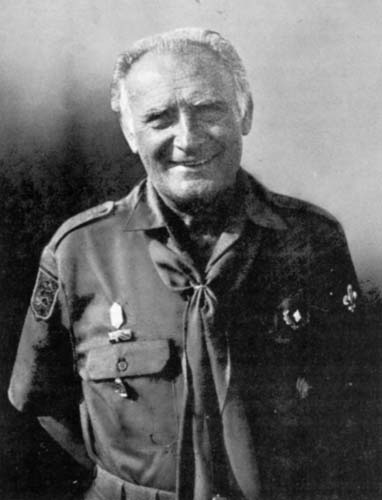
He was born in occupied Ukraine and died in the free United States. Yurii Volodymyrovych Starosolskyi was a Ukrainian legal scholar, Chief Scout of Plast, a member of the Ukrainian Military Organization, and a full member of the Shevchenko Scientific Society and the Ukrainian Academy of Arts and Sciences.
He was very fond of physical education and sport, including football, skiing, track and field — high jump, running, long jump, pole vault — tennis, and others.
Yurii Starosolskyi was Roman Shukhevych’s cousin. It is therefore not surprising that they shared many activities and interests. Although Jim Thorpe did not become the same kind of ideal for Yurii as he did for Roman, the American athlete also influenced him.
Yurii Starosolskyi recalled this as follows: “And so Jim came back to mind, followed by Romko, and then myself, still a young man, the three of us together. Romko and I were cousins and the same age. In the years I am recalling, we attended the Academic Gymnasium in Lviv together and spent much of our free time on the Sokil-Batko field, running, jumping, throwing, racing one another, and training for competitions. In those years, when physical development dominates a young man’s life and physical fitness becomes a source of pride and an ideal, and when all of this acquires — or at least did in our ‘old’ days — a romantic, knightly aura, active sport goes far beyond physical exertion. In any case, for us there was something of a philosophy of life in sport.”
These words convey well just how important a place sport occupied in the lives of the young Roman Shukhevych and Yurii Starosolskyi. For them, physical development was not merely training the body, but also part of shaping character and a philosophy of life.
A fitting summary of Yurii Starosolskyi’s Olympic recollections about Jim Thorpe and Roman Shukhevych is this explanation: “Jim did not know and did not care whether Romko existed somewhere in the world, where he was, what he was doing, or what he thought. But Romko knew very well who Jim was, what he was, and even, it seemed, what he thought and why.”
These memories were inspired by the 1984 Olympic Games in Los Angeles, United States. The Ukrainian diaspora in the United States actively used the Olympic events as an opportunity to present Ukrainian traditions, history, culture, language, indomitable character, strength of will, and desire for freedom.
Author: Oleksii Lyakh-Porodko