Dwight Eisenhower is a legendary figure of global stature. A renowned general and an outstanding U.S. president. For the Ukrainian community in the United States, he is a significant figure, as he strongly supported captive nations. During the confrontation with the USSR, the U.S. Congress adopted a resolution establishing Captive Nations Week, which categorically condemned Soviet imperialism and at the same time demanded freedom for Ukraine and other countries of Eastern Europe. Thus, for the Ukrainian diaspora in the United States, Dwight Eisenhower embodied the genuine struggle for Ukraine’s freedom and independence. He was an unshakable rock in addressing the Ukrainian question. Therefore, when the U.S. Army general had the opportunity to visit the “evil empire,” that is, the USSR, Ukrainians of the free world placed considerable hopes on the possibility that he could influence the dictatorial and terrorist communist regime of the Soviet Union.
Dwight Eisenhower Watched Ukrainian Athletes at a Physical Culture Parade
It is worth noting that the opportunity to visit the USSR came at a time when millions of people had not yet recovered from the war, the stench of which still lingered in the air of Europe and beyond. Exhausted bodies and lost souls, hearts torn in two, wasted lives, broken destinies, pain and tears — all of this was the Second World War, in which Ukrainians suffered horrific losses, abuse, genocide, and death.
Of course, as victory over the aggressors approached, this horror was supposed to be replaced by an understanding of future life, life after the war. For this purpose, sport became a “rescuer” for hundreds, thousands, and millions of people. Therefore, it is not surprising that the first postwar Olympic Games were held in 1948 in London, Great Britain. It is also worth noting here that thousands of people who were in displaced persons camps in Germany organized the DP Olympics that same year. It was a symbol of unity with the international Olympic Games in London. It is gratifying that Ukrainians were the initiators of these competitions.
The first postwar reflections of General Dwight Eisenhower on peace and the new world order read as follows: “Eisenhower on peace and tolerance. Having returned to the United States after the brilliant victory over Nazi Germany, General Dwight D. Eisenhower immediately began a campaign for the need to create a lasting peace, won at a heavy price. He, the supreme commander of the Allied forces in Europe, came directly from the European battlefields, having seen the ruins, the rubble, and the victims himself. He knows well what a future war could bring to humanity. That is why he constantly emphasizes the need for America’s active participation in building a future lasting peace.”
That is, immediately after the war, Dwight Eisenhower saw the future in global peaceful coexistence, without the continuation of war or the beginning of a new one. It was probably with these ideas that he traveled to the USSR. Although he knew perfectly well what the true condition of captive nations was. Therefore, when he became President of the United States, he fought relentlessly against the pro-communist element and supported the idea of liberating nations enslaved by the Soviet Union.
A Sports Parade on “Bloody” Red Square

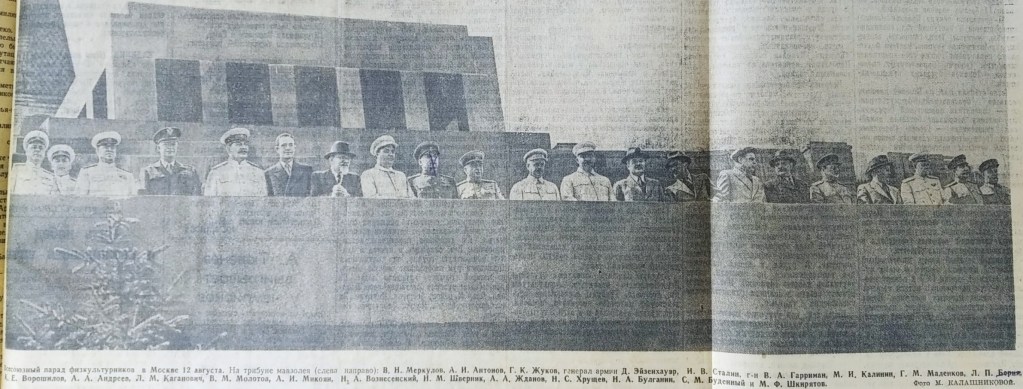
A parody of postwar sports diplomacy was the All-Union Physical Culture Parade, which took place on August 12, 1945, in Moscow. It was held at a time when the war was still ongoing. According to the operational report for August 12, Soviet troops in the Far East were advancing in combat, moving deeper into the territory of Manchuria. In other words, the war was still continuing, while sport was already serving as an instrument of propaganda for the communist regime through the use of the “soft power” of sports diplomacy.
The Ukrainian press in the United States reported the trip of General Dwight Eisenhower to the USSR as follows: “General Eisenhower in Moscow. General Eisenhower is now in Moscow, where he was invited by the Soviet government to attend a sports parade. Among other things, he was the first foreigner to stand, during the review of the Allied demonstration, on the platform atop Lenin’s tomb, alongside Premier Stalin. In a conversation with newspapermen, General Eisenhower said that he is now convinced that Soviet Russia wants to live in friendship with the United States. At the same time, he emphasized that he prefers the American system, because it gives a person greater independence of action.”
It is not surprising that the American general drew attention to the citizen’s freedom of choice. In the United States, this is natural for society. In the USSR, however, it did not exist at all.
What did the Ukrainian community in the United States expect from the authorities and, in particular, from General Dwight Eisenhower? Probably that he would see with his own eyes the oppressive condition of Ukrainians under Soviet occupation and somehow help. Such and other goals were pursued, in particular, by the United Ukrainian American Relief Committee. Dr. Volodymyr Galan, the head of the Committee, wrote about this: “If until now the Committee’s task has been to establish independence within the organizational framework, to intervene in government circles on the issue of the right of asylum for Ukrainian victims of the war, and to carry out a unified relief organization in various countries of Europe and in Ukraine, then the following work now lies before us: a) collecting money and clothing in communities to help victims of the war; b) legal defense of Ukrainian victims of the war; c) searching for missing people in Ukraine; d) resettling people who cannot return to their native land.”
Could Dwight Eisenhower have seen anything unlawful in the USSR during his stay in that country? Of course not! After all, he had been invited in order to demonstrate the people’s massive “love” for the communist authorities. Remember that he refused to come to that so-called propaganda victory parade? Because he knew it would be something like brainwashing and pulling the wool over the spectators’ eyes. But when he agreed to attend the physical culture and sports parade, he probably did not suspect that this event would be used in the same way. In the United States, sport is a matter of state and society and, to a lesser extent, carries a negatively propagandistic character. Whereas in the USSR, sport was a machine of state propaganda.
That is why this parade was impressive in its scale. Could it have been otherwise? No! And all this in front of foreign guests. Moreover, the key invited foreign figure was precisely the renowned U.S. Army general. So what was the parade like? Twenty-three thousand athletes took part in the march from 16 republics! Each republic’s delegation demonstrated its own performance. Ukrainians had the opportunity to present national color in the middle of Red Square. Several hundred Ukrainian athletes, dressed in national costumes, demonstrated free exercises, exercises with wreaths and ribbons, acrobatic numbers, exercises on the horizontal bar and trampoline, and finally performed the hopak. Only a few sentences were written in the article about the Ukrainian delegation’s performance. Exactly so. A small note — and that was all. At the same time, the author wrote in detail about the performances of other delegations. This confirms that Soviet propaganda could not reconcile itself to the brilliant performance of the Ukrainians. Although did the Ukrainians themselves want to take part in those events? Perhaps, knowing that an American general would be on the honorary platform, Ukrainians tried to attract his attention with their spectacular performance.
Delegations of physical culture athletes from Bulgaria, Poland, Yugoslavia, Albania, and Finland arrived for the parade. Among the honored guests were representatives of the United States: General Dwight Eisenhower with his son, U.S. Ambassador Harriman, and an interpreter. The Soviet press described the event as follows: “General of the Army Dwight D. Eisenhower is also invited to the platform. General of the Army Eisenhower appears on the platform accompanied by U.S. Ambassador Mr. Harriman. The cries of ‘hurrah’ and applause from all those gathered on Red Square do not subside for a long time. They enthusiastically greet the great creator of victory, Comrade Stalin, and his associates.” Is it possible that the spectators could have been greeting the representative of the United States? I believe so. But the Soviet press would not have written about that. For propaganda, it was more necessary to praise “their own” heroes.
It should be noted once again, and this is very important, that Stalin himself had previously invited him to Moscow for the Victory Parade. But General Eisenhower refused, citing urgent matters. I emphasize once again — he refused! And then, when invited to attend the physical culture parade, he agreed. Perhaps because he himself was a good sportsman? Or are there other answers? I am certain that there are several answers here that we do not even suspect.
General Eisenhower’s recollections of the parade are interesting: unfortunately, this is not a translation from English, but from russian, because I have no desire to write in the language of terrorists: “For five hours we stood on the platform of the Mausoleum while the sports spectacle continued. None of us had ever seen anything even remotely similar to this sight. The athlete-performers were dressed in bright costumes, and thousands of these people carried out movements in a single rhythm. Folk dances, acrobatic numbers, and gymnastic exercises were performed with flawless precision and, evidently, with tremendous enthusiasm. The orchestra, it was said, consisted of a thousand musicians and played continuously throughout the entire five-hour celebration. The Generalissimo showed no signs of fatigue. On the contrary, he seemed to enjoy every minute of the celebration. He invited me to stand beside him, and with the help of an interpreter we spoke intermittently throughout the entire sports celebration.” Dwight Eisenhower watched the performances of the physical culture athletes for five hours. He 100% saw the Ukrainians!
Of course, the propaganda could not fail to publish favorable reviews of the parade from foreign delegations. Here is what Fanni Solomyan, head of the delegation of physical culture organizations of Poland, wrote: “We have attended sports events in many European capitals, but we have never seen such a spectacular show as the parade of Soviet physical culture athletes organized on Red Square. The performance of the athletes from the Trudovi Rezervy society made the greatest impression on us. We watched with admiration as 3,000 young gymnasts performed gymnastic exercises in a coordinated and precise manner. We very much liked the performance of the Leningrad and Moscow Institutes of Physical Culture, the columns of gymnasts from the voluntary sports societies of the trade unions, and the physical culture athletes of the Armenian and Georgian republics.” Interestingly, did he write this text himself, or had everything already been prepared for him in advance? It is no surprise that the representative of Poland did not notice the bright performance of the Ukrainian delegation. Perhaps the envy was overwhelming.
The head of the Albanian youth delegation, Nako Spiru, said the following: “We will never forget this. What we saw impressed us. What a grand manifestation of sport! What a number of nationalities, what a multitude of athletes! Yes, Soviet youth loves and values sport. We knew, we had heard something about the Soviet Union, about Soviet sport, but what we saw at the parade in person exceeded all our expectations. We saw that Generalissimo Stalin himself was present at the parade and watched with great interest what was happening on Red Square. We believe that, with such an attitude and care toward them, young people can do anything for their country. We understand why Soviet youth is so self-sacrificing both in labor and in battle. The sports parade is a lesson for us that we will never forget.”
A positive review from the representative of the Albanian delegation, which was not under the full occupation of the Soviet Union. There was, of course, a pro-Soviet government there. But that was not what Ukraine and other captive nations felt.
Whatever hymns of praise the Soviet press wrote about the parade, we all understand perfectly well that it was merely a propaganda affair. The press of the free world barely noticed this grand mass performance of captive athletes, who had been allowed to demonstrate their national identity. Beyond the barbed wire of the USSR, it was understood that this parade was intended only for the domestic consumer, confined behind the “Iron Curtain.” At the same time, why did Dwight Eisenhower accept the invitation?
Author: Oleksii Lyakh-Porodko