


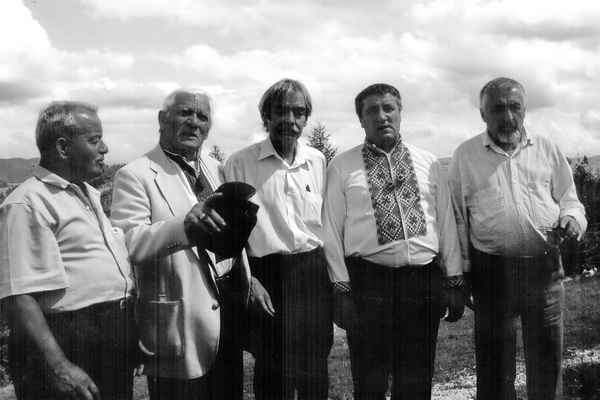
The history of the Ukrainian community in Chicago is connected with many people who, after difficult life trials, ended up in the United States and continued their public, cultural, and spiritual activities here. Among them are the poet Walter-Volodymyr Kovalyk and the UGCC priest Father Antin Lukomsky.
Walter Kovalyk: From Chicago to the Soviet Camps and Back
Walter-Volodymyr Kovalyk was born on April 10, 1921 in Chicago to the family of a Transcarpathian emigrant, Mykhailo Kovalyk. In 1936, when he was 15 years old, he and his mother first visited Ukraine. They went to their grandparents in the village of Drozdovychi, now the Starosambir district of the Lviv region. During this trip, the young man saw the nature of Galicia.
This was reported by Milena Volyanska..
Later, Kovalyk continued his studies in Przemyśl. He was fluent in English, Ukrainian and Polish. During this period, he began writing his first poems and met Emilia, who later became his wife.
In 1943–1947, Walter Kovalyk was in the Ukrainian Insurgent Army. After that, he was captured by the NKVD, where he was tortured. He was a prisoner of the Soviet prison Brigidki in Lviv and concentration camps in Mordovia in 1947–1957.
For five years, Kovalyk shared camp life with the Metropolitan of the UGCC, later Patriarch Josyf Slipy, the composer Josyf Barvinsky and Bishop Chernetsky. In the camps, he continued to write poetry, which he later restored from memory and published.
In 1957, Emilia was released after ten years of imprisonment in Inta. She voluntarily came to share ten years of exile in the Altai Territory with Walter Kovalyk. There she married him and gave birth to two children - Olga Hrytsiv, born in 1957, and Yaroslav, born in 1961.
In 1967, the Kovalyk family was allowed to leave for Lviv. Due to the inability to find work, they soon moved to the village of Pidhirne, Pustomyty district, Lviv region. Later, the family built their own house. Life gradually improved, although the family continued to be monitored by the KGB.
In 1991, Walter Kovalyk received permission from the American Embassy in Ukraine to restore his US citizenship. The following year, at the age of 70, he returned to Chicago with his adult children after 55 years of travel and trials.
In Chicago, Kovalyk visited the cemetery where his parents were buried. His wife also planned to move to him, but she fell ill and died in Ukraine in 1994.
After returning to Chicago, Volodymyr Kovalyk was engaged in public and literary activities. Since 1992, he has been a member of the International PEN Club, since 1999 - of the National Writers' Union of Ukraine, since 2000 - of the Association of Ukrainian Writers, as well as the International Association of Poets of the USA, the literary associations "Boheme" and "Candle of Taras" in Chicago, and the International Public Organization "Small Academy of Literature and Journalism".
Since 2004, Walter-Volodymyr Kovalyk has been the Honorary President of the International Children's Creativity Festival "Rekity Constellation", which is held annually in the village of Rekity, Mizhhirsky District, Transcarpathian Region.
On November 22, 2009, Kovalyk, together with Julian Kulyas, head of the "Heritage" Foundation, took part in the unveiling of a monument to the Patriarch of the UGCC, Joseph the Blind, in front of the Cathedral of Volodymyr and Olga in Chicago. The monument was created by the Kyiv sculptor Yevhen Prokopov. It was near this cathedral that the Patriarch founded the Chicago parish of the same name on July 28, 1968, and consecrated it in 1973.
Walter Kovalyk is the author of numerous poems and poetry collections. Among his works are “You Stand in Beauty with Seduction” (1947), “My People!”, “Ukraine Blooms – Free, Independent”, “Flags of Ukraine”, “I Desire” (1990), “Chicago” (1993), “When” (2000), “Dedication to the Women of the UPA” (2001).
His poetry collections include “Still Traveled Roads” (Lviv, 1995), Beneath Chicago Skies (Chicago, 1997), Various apparition memories, “I Will Never Give Up” (Lviv, 1999), “Golgotha of Metropolitan Joseph the Blind” (2000), “What Pained the Heart” (2001), “Where the Sycamore Grave is Nearby”, “Rebellious Buden” (2002), “It Wasn’t Supposed to Hide from Fate” (2003), “Kalynovy Monologue” (2004), “Above the Eternity of Being” (2005), “The Ring with the Trident”, My Emily (2006), “Sonnets” (Lviv – Chicago, 2007), “Two Eights of Being” (Lviv – Chicago, 2009), “Love and the Cross – Thorn Flowers” (Lviv, 2012), “Eternal Freedom Flows – with Love for Life” (2015).
For his work, Kovalyk was awarded an honorary award for achievements in English poetry from the city of Orlando in the USA in 2003, the “Literary Lviv” award, the medal “For Devotion to Ukraine” in 2007, and a diploma of the 2nd degree of the 18th Boykiv Literary and Local History Competition named after Myron Utrysk in 2013.
Father Antin Lukomsky

Antin Lukomsky was born on June 9, 1895 in the village of Chernytsia, Zhydachiv County, Stanislaviv Oblast, in the Kingdom of Galicia and Volodymyr, which was part of Austria-Hungary. Now it is the territory of Ivano-Frankivsk Oblast.
His father was the principal of a primary school in Chernytsia and died on October 1, 1921, when his son's future was still undecided.
Antin Lukomsky studied at the theological faculty of Lviv University, and later graduated from the theological seminary. On May 17, 1923, he was ordained a priest. In August of the same year, he became a parish priest in the village of Lolyn, now Dolynskyi district of Ivano-Frankivsk region. It was in this village that Ivan Franko often visited in 1874–1879, visiting his fiancée Olga Roshkevych.
After his appointment, Lukomsky gradually sought permission to open a reading room "Prosvita" in the village. This was opposed by the new occupation authorities, who tried to prevent the establishment of the center, understanding the importance of "Prosvita" for the formation of national consciousness and the preservation of the spirit of Ukrainians.
With the assistance of Father Antin Lukomsky, the "Prosvita" choir was organized in the village. Dmytro Bryk was invited to conduct the choir and perform the duties of a deacon from Stryi. During the first performance of the choir, Ivan Franko’s anthem “It’s not time, it’s not time for a Muscovite, he serves a Pole.”
A new school principal, Mykhailo Humenyuk, also appeared in Lolyn. He became a teacher not only for the children, but also for the entire community. With his participation, regular readings were held about important events in the country’s national life, an amateur theater group worked, which performed in nearby villages. People actively joined “Prosvita.”
Father Lukomsky founded a reading room, an amateur theater, and the “Prosvita” choir, and introduced an anti-alcohol moratorium among parishioners. In 1931, he built a new residence, and the old one began to be used for public events.
During the same period, Lukomsky was appointed to pastoral work in the village of Hnizdychiv. There he also founded Prosvita, the Village Farmer club, and a dairy.
His godmother Maria Prymyvna lived with Father Antin Lukomsky. She was the first director of the Girls' Institute in Przemysl, an institution that played a significant role in the life of the Ukrainian community. The institute was founded in 1895, and Maria Pryma headed it for 16 years. Due to illness, she was forced to retire in 1916.
Maria Pryma was the sister of Teofilia, Antin Lukomsky's mother. Teofilia was a widow and lived with her son.
The new residence, built in 1931 with Lukomsky's assistance, has been preserved in a photograph. The old residence was used for public purposes until July 11, 1944, when it was burned down by Hungarian fascists during a punitive action.
In 1931, Father Antin Lukomsky became the parish priest of the village of Hnizdychiv in the Zhydachiv region. There, organizational work was again intensified: “Prosvita” was created, a dairy and a “Village Farmer” club were opened.
In 1944, Father Antin Lukomsky, together with his wife Antonia, son Lev, who was born in Stryi in 1925, and daughter Vira, who was born in Lolyn on June 14, 1929, emigrated to Germany.
Initially, the family settled in a camp for displaced persons in Mittenwald. There, Father Lukomsky became a camp chaplain for scouts and Sumy members and founded a parish of the UGCC.
In Germany, he also baptized three of Stepan Bandera’s children – Natalia, who was eight years old, Andriy, who was five years old, and Lesya, who was two years old.
In 1950, the Lukomsky family moved to the United States and settled in Chicago. Father Lukomsky could no longer perform his priestly duties, although he received a parish in Pittsburgh.
Father Antin Lukomsky died on September 20, 1952 in Chicago. He was buried in St. Nicholas Cemetery.
Photo: Milena Volyanska..
Author: Danylo Pievchev