Ukrainian sports in the United States have thousands of unique figures. They deserve to be written about, read about, remembered, and not forgotten. Our heroes do not always have to be successful professional athletes or Olympic champions. There are also those who, through their work and devotion to physical education, sport, and Olympic traditions, deserve attention. Their passion for sport is truly impressive.
Among this constellation of remarkable individuals, Oleh Lysiak stands out brightly. Born in Lviv, he passed into eternity in Philadelphia, United States. His life was a dizzying journey and a struggle for national identity and Ukraine’s freedom. He fought for his ideas with weapons in his hands during the Second World War, with a pencil while writing editorials, and with sports equipment.
Understanding the international significance of the Olympic Games, Oleh advocated for the participation of Ukrainian athletes who would represent an independent Ukraine. That is why one of his dreams was to attend the Olympic Games. This desire never left him, even in his sleep. Oleh himself wrote about it with considerable humor: “When it comes to the Olympics, I have always had bad luck with them.” In other words — misfortune!
Once, according to Oleh’s recollections, a true Olympic adventure took place, during which he spoke about which Olympic Games he might have attended and why it was not meant to happen.
III Olympic Winter Games of 1932
The 1932 Olympic Winter Games were held in Lake Placid, United States. Writing about whether he could have attended them, Oleh Lysiak noted the following: “Lake Placid, where in 1932 the first Winter Olympics on American soil took place. I also made it there — but only 22 years after the Olympics, in 1954. Still, I had the pleasure there of taking part in the last skiing competition of my life, and the lesser pleasure of taking a proper beating from my younger colleagues, just ‘as the book says.’”

In reality, Oleh could not physically attend those Olympic competitions, because at the time he was in Ukraine, then occupied by Poland, and crossing the ocean would have required resources, time, money, and much more. Instead, he found himself on “Olympic ground” in Lake Placid in 1954, after he had been forced to move to the United States. It is noteworthy that the Ukrainian community in the United States and Canada planned that year, or in 1955, to organize Olympic-style games among Ukrainians in the diaspora. Unfortunately, large-scale, comprehensive events could not be brought to life. However, Olympic skiing competitions did take place, and Oleh Lysiak participated in them. Of course, this was not the same as the international Olympic Games. Therefore, Mr. Oleh’s dream had not yet been fully realized.
Had Oleh Lysiak attended the III Olympic Winter Games in 1932, would he have encountered Ukrainian athletes? Yes — but not from Ukraine. In those years, Ukraine was torn apart and occupied by Poland, the USSR, Romania, and Czechoslovakia. It is possible that Ukrainians competed on those national teams, but at present this is not known. At the same time, Vasyl (Valentyn) Bilas competed as a member of the United States speed skating team.
Games of the XI Olympiad, 1936
The 1936 Summer Olympic Games were held in Berlin, Germany. This is how Oleh Lysiak described his chance to attend those competitions: “…when the Olympics were geographically closest to our native Lviv, that is, when they took place in Berlin in 1936… I held the civilian rank of an unemployed master’s degree holder. Obviously, there could be no question of going to the Olympics. A few years later, when I already held the rank of private in the Division and was marching off to Berlin, there was a war underway and, instead of the Olympics, there were such attractions as raids by American bombers at noon and British bombers at midnight. So I only had the opportunity to cast a glance at the empty Olympic stadium, and that was the end of my Olympic experiences as far as Berlin was concerned.”
Thus, in 1936, the Olympic Games were held perhaps as close as they ever came geographically to the place where Mr. Oleh lived. But his social and economic situation at the time prevented him from traveling to Berlin. Later, when he himself was in Berlin, the Olympic competitions had already been overshadowed by war.
Had Oleh Lysiak attended the Games of the XI Olympiad in 1936, would he have encountered Ukrainian athletes there? Yes and no. Ukraine was still torn apart and occupied. Nevertheless, various national teams included athletes of Ukrainian origin: Aladár Gerevich, on Hungary’s fencing team; Andriy Hayda and Yurko Nemchik, on the United States soccer team; John Lysak, on the United States rowing team; Peter Fick, on the United States swimming team; Volodymyr Syrovatka, on Czechoslovakia’s rowing team; and Adalberts Bubenko, on Latvia’s track and field team.
IV Olympic Winter Games, 1936
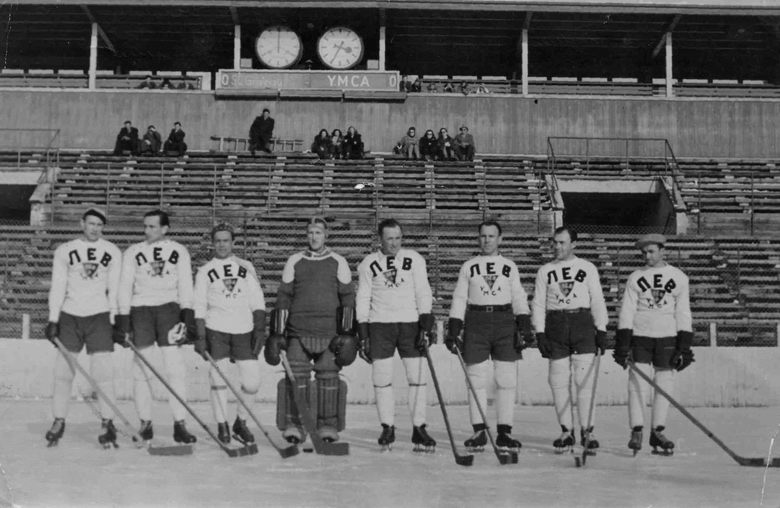
The 1936 Olympic Winter Games were held in Garmisch-Partenkirchen, Germany. Oleh Lysiak recalled the possibility of attending those Olympic competitions in the following way: “A few years later, when I was already a full-fledged, five-times-screened ‘DP’ and lived in unforgettable Mittenwald, in one of the Ukrainian republics on German soil, in the green Bavarian Alps, it was only a stone’s throw to the place where the 1936 Winter Olympics had taken place — Garmisch-Partenkirchen. But not a trace remained of the Olympic stadium in ‘Garmisch,’ as the place was popularly called among the DP people. Even the five Olympic rings on the large ski jump had been painted over… Still, the Lev team did play hockey there a few times, and in its best Lviv lineup… I even had the honor there of having my head smashed open on the ice by a player from SC Grainau. No small thing — an Olympic stadium.”
It turns out that Oleh Lysiak played several hockey matches at the Olympic stadium. However, as he himself essentially said, this too was not quite what he had dreamed of.
Had Oleh Lysiak attended the IV Olympic Winter Games in 1936, would he have encountered Ukrainian athletes there? From Ukraine — hardly, because neighboring countries had occupied Ukraine. However, Roman Turushanko, having overcome all obstacles, competed in figure skating for Romania’s national team.
Games of the XII Olympiad, 1940
During the years of the Second World War, neither the Games of the Olympiad nor the Olympic Winter Games were held. In 1940, the Summer Olympics were initially supposed to take place in Tokyo, Japan, and later in Helsinki, Finland. But neither of those Games ever took place. Incidentally, the same happened in 1944.
Oleh Lysiak recalled this period as follows: “…there was also supposed to be an Olympics in Helsinki in 1940, but I did not manage to go there either, because in 1940 Finland was at war with the Soviets and, instead of competing on Olympic tracks, the Finns were fighting the Bolsheviks near Viipuri. I was left with a commemorative badge issued on the occasion of that Olympics back in 1939. Well, the badge exists — but there was no Olympics.”
It was a tragic time for millions of people around the world. Of course, Olympic competitions were not appropriate at that moment.
Games of the XIV Olympiad, 1948
The 1948 Olympic Games were held in London, Great Britain. Perhaps this time Oleh Lysiak managed to attend the Olympic competitions? He wrote the following about it: “Then there was also the Olympics in London, in 1948, the first after the war. At that time, from the Council of Physical Culture in Augsburg, we sent a letter to the president of the Olympic Committee, Lord Burghley, trying to explain to him why Ukrainian youth were absent from this celebration of youth from around the world. Surprisingly, Lord Burghley, a former Olympic champion in the 400-meter hurdles, politely replied to the letter. I myself came to London only two years later, but by then there was no trace of the Olympic spirit left there either.”

Again, as Mr. Oleh might have said, it was bad luck with these Olympic Games. This time, too, luck was not on his side. Although it should be noted that in 1948, Ukrainians in Germany initiated the DP Olympics. Other nationalities who supported Olympic values also joined the competitions. It will surprise no one that the Russians, as always, tried to harm these competitions. These were the same “good” Russians who could not return to the USSR — now Russia — but nevertheless spread propaganda and disinformation in every possible way. Incidentally, they never dared to take part in the competitions in Germany, nor in London either. The above-mentioned head of the Organizing Committee of the Olympic Games in London personally traveled to the USSR and invited them to participate. In response, however, he received a refusal. Later, their propaganda machine spread the lie that Soviet athletes had not been allowed to participate in the Olympic Games. Does this remind you of anything? Yes, this is exactly what Russia is doing now — falsifying, lying, abducting, killing, and doing so in sport as well.
Had Mr. Oleh attended the Games of the XIV Olympiad in London, would he have met Ukrainian athletes there? As we have already established, Soviet athletes were not there. Accordingly, Ukrainian athletes were not there either, because the USSR occupied Ukraine. However, Olympians of Ukrainian descent from other countries were present in London. For example, Aladár Gerevich, on Hungary’s fencing team; Steve Lysak, on the United States rowing team; Walter Bahr, on the United States soccer team; Jack Zwirewich, on Canada’s rowing team; and Joseph Kotys, on the United States gymnastics team.
VI Olympic Winter Games of 1952 and the Games of the XVI Olympiad, 1956
The 1952 Olympic Winter Games were held in Oslo, Norway, while the 1956 Olympic Games took place in Melbourne, Australia. With his characteristic humor and literary talent, Oleh Lysiak described those years as follows: “As for the Olympics in Oslo in 1952, there was, of course, no question of it. At that time, a man was working up a sweat to earn his first degree of Americanism — so could the Olympics really have been on his mind? As for Melbourne in 1956, it was enough that Zenek Snylyk went there as a competitor on the U.S. Olympic team. He, too, was born in Lviv — so there was representation, and not the worst kind. Besides Zenek, one more Ukrainian from America went to the Olympics in Australia — Achilles Chreptowski.”

Thus, in those years Oleh Lysiak could not travel to Oslo or Melbourne, because he was already thoroughly preparing for his move to the United States. His full attention was therefore focused on everyday matters and on building a new life in a new country.
Had Mr. Oleh visited Oslo, he would not have encountered Ukrainian athletes from the USSR, because Olympians from that country were not yet among the participants. Joseph Cernota, who had Ukrainian roots, played on the U.S. hockey team. Had he traveled to Melbourne, he would have encountered many Ukrainians on the USSR team, as well as athletes of Ukrainian descent competing for other countries. For example: Vasyl Manchenko, on Bulgaria’s basketball team; Aladár Gerevich, on Hungary’s fencing team; Roman Zub, on Poland’s fencing team; Kostiantyn Lysenko, on France’s track and field team; Bernard Newman, on Canada’s gymnastics team; Zenon Snylyk, on the United States soccer team; Dorothy Kozak, on Canada’s track and field team; Volodymyr Kozak, on Canada’s boxing team; George Bossy, on Canada’s rowing team; Dick Boushka and Ron Tomsic, on the United States basketball team; Joseph Kotys, on the United States gymnastics team; and William Yorzyk, on the United States swimming team.
VIII Olympic Winter Games, 1960
The 1960 Olympic Winter Games were held in Squaw Valley, United States. This time, it was perhaps the best opportunity to attend the Olympic competitions, since they were taking place in the United States, where Oleh Lysiak was already living. Oleh himself wrote about this possibility as follows: “When the Olympics were held here on American soil, in Squaw Valley, a few weeks before they began I started feeling queasy. What do you mean — the Olympics in America? True, a few thousand miles from Franklin Street, but still, in our country!”
For a long time, Mr. Oleh was preoccupied with the idea of traveling to Squaw Valley. Unfortunately, this time too, nothing came of it. Once again, he had bad luck with the Olympic Games.
Had he gone to Squaw Valley, he would have seen Ukrainian athletes with his own eyes, but not on the USSR team, because there were none there. Ukrainians were oppressed and subjected to genocide in that country. Mr. Oleh could have encountered athletes of Ukrainian descent, for example, on Canada’s hockey team — Yuri Samoylenko — or on the U.S. speed skating team — Juan-Mary Omelenchuk.
Thus, although Oleh Lysiak’s Olympic dream did not come true, he remained connected to Olympic traditions and values. His devotion to physical education, sport, and the Olympic movement had deep Ukrainian roots, whether he was in Germany or in the United States.
Author: Oleksii Lyakh-Porodko