How many American athletes do you know who visited the USSR? Of course, there were quite a few. But there is one important nuance: these were either official competitions, friendly matches as a form of sports diplomacy, private initiatives, or secret operations. At the same time, there were also those who, as teenagers, went on sports tours of European countries and, according to the itinerary, were also supposed to visit the “evil empire.” It should immediately be noted that American athletes had little desire to travel to the USSR, apart from a few rare exceptions, such as Muhammad Ali or Sidney Jackson, who, under the influence of various circumstances, remained in the country.
History has left us several interesting facts concerning the Ukrainian diaspora in the United States. In particular, there were isolated cases when Ukrainians were part of American delegations. This did not happen often, but such stories do exist, and they are exceptionally interesting — sometimes mysterious or even detective-like. Ukrainians from the free world were not particularly welcome in the communist USSR. Therefore, every such visit was a challenge to the Soviet occupation system, which had committed genocide against the Ukrainian people.
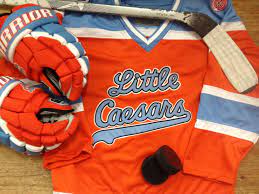
An 18-year-old American of Ukrainian descent, Roman Kinal, shared his memories of a trip to Finland and the USSR. By nature and character, he loved sports and played soccer for the Ukrainian sports club Chernyk in Detroit, hockey for the Little Caesars Hockey Club, golf, and other sports. He was also very active in the Ukrainian community and school, which helped him preserve his native traditions.
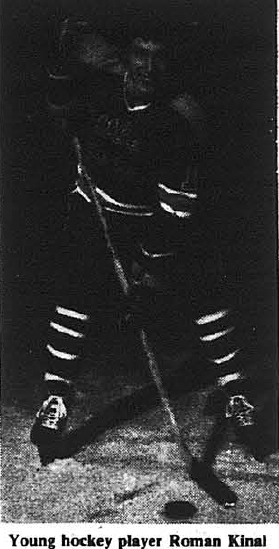
Hockey Tour to Finland and the “Evil Empire”
The story goes like this: the Little Caesars team won the 1981 national championship in its division and went on a tour of Finland and the USSR. Roman recalled: “On April 21, 1981, I left my hometown of Warren, Michigan. My destination was the Scandinavian city of Helsinki, Finland, and from there — the country behind the Iron Curtain, the Soviet Union. The purpose of my trip was to play hockey against some of the best teams in the world.”
Such an event could not go unnoticed by the local media. Before the flight to Finland, reporters from Channel 7 Action News were waiting for the team, filming a segment and speaking with some of our coaches and managers.
Roman continued: “Finally, it was time to board the plane. We were very excited about flying across the vast Atlantic Ocean, as well as traveling to a foreign country to play hockey. We arrived in Helsinki eight hours later, and after the restless flight, everyone badly needed some rest. However, because of the time difference, instead of it being nighttime outside, it was daytime. We spent the rest of the day trying to catch up on sleep.”
Over the next three days, the American hockey players took to the ice. They played two games and won them 7–2 and 10–2. An excellent result!
Roman went on to recall: “Finland was an amazingly hospitable country. A bus took us from the hotel directly into the city and then back again after several hours of shopping. Food was always ready whenever it was convenient for us. Of course, the food was not as tasty as in the United States, but we were soon to discover that our Russian friends had an even bigger surprise in store for us.”
Here and throughout the interview, Roman frequently refers to Russians and Russia. There is an explanation for this. Soviet propaganda in the West created the impression that Russian nationality was the dominant and ruling identity in the USSR. At the same time, it suppressed all other nationalities and prevented them from identifying themselves independently on the international sports stage.
Roman continued his recollections and shared his somber impressions of the USSR: “On April 24, we boarded a train from Helsinki to Leningrad. The train was nothing like an American one, but we were not going to complain. As we approached the Russian border, surrounded by barbed wire, 10 to 15 Soviet soldiers boarded the train. They thoroughly searched everyone’s luggage and even unscrewed the ceiling panels to check whether we had hidden anything there. When the soldiers spoke among themselves, I understood some of what they were saying. That, combined with the nasty looks on their faces, gave me the impression that they did not like Americans very much.”
The young American saw and felt firsthand the contemptuous attitude toward foreigners in the Soviet Union — and especially toward U.S. citizens.
“We arrived at the Leningrad railway station. Looking out the window, I saw many old buildings, most of which were government or parliamentary buildings. Our guide was Liuba, a very nice lady who had the difficult task of trying to make the Soviet Union look like a beautiful country through American eyes. From the station, she led us to a bus. It was a cold day, with occasional snow flurries. Everyone was dressed warmly, wearing boots and long coats. There were many young people on the streets, teenagers and school-age children. There were also older people, around 40 and above. Most of the men smoked cigarettes and wore ragged clothing. The women wore long coats, usually black, and boots reaching their knees. The overall mood in Leningrad was depressing. As we drove to our hotel, people looked at us with blank expressions. It seemed there was nothing to smile about. May 1 was approaching. It looked like a day of mourning, with banners featuring images of Lenin filling the streets. They carried short slogans, usually declaring that the Communist Party and the Russian people were united as ‘one whole.’”
He continued: “During our stay in Leningrad, we visited many historical museums and landmarks, including the Peter the Great Fortress. We also attended the famous Russian ballet, whose performance lived up to our expectations of seeing the best ballet in the world.”
Had Roman visited Ukraine, of course, his impressions of Leningrad would have been very different. Ukrainian landscapes and landmarks would certainly have impressed him.
“The food in Russia left us feeling that it should have been better. For breakfast, we had eggs, but milk was never served. We drank either Pepsi or water. For lunch, we had fish or meatballs, and dinner was usually lighter than lunch. We were not very happy with the food, but when you are so many miles from home and your mother is not there to spoil you with her cooking, there is not much you can do.”
The lengthy sightseeing tours began to make the young American players restless because they wanted to play hockey. Roman described his emotions this way: “Exploring Leningrad was interesting, but we were becoming restless, hoping we could finally play against the Russians. At last, game time arrived. The match took place at the arena where the Russian national team trained. First, we exchanged gifts, as is traditional when two teams from different countries play one another. Soon the game began, and during the first 10 minutes they were leading 2–1. Around that time, our manager arranged another game after speaking with Russian officials. In the final period, the score was 5–4 in our favor. We pushed hard to finish the game with a victory and scored five more goals.”
The final score was therefore 10–4! Can you imagine that? What happened next came as a surprise to the American hockey players.
Roman recalled: “The next morning, we got up early, ready to play again. Just then, our coach told us the game had been canceled. We did not know the reason, and we never found out why. We could only assume that Soviet officials were afraid of losing to us again.”
That is what happens when sport is used for political and anti-democratic purposes. The game was canceled because they were truly afraid of another high-profile defeat. That is why I was unable to find any information about this visit by the American hockey players in the Soviet press.
“Later that same day, we went shopping and bought Russian souvenirs and wooden crafts. On April 28, we boarded a train that took us back to Finland. As we left Russia, customs officers once again checked our luggage. We, the players, as well as the parents traveling with us, talked about what a relief it was to leave that communist-oppressed country. The train slowly passed the barbed wire, fences, and Soviet guards. Finally, we arrived in Finland, which now looked like paradise to us. We spent an entire day shopping at the eastern market, where fish from the Baltic Sea was sold. On April 29, we arrived at John F. Kennedy Airport in New York. We were happy to be back on American soil. At the airport, we were met by our parents and reporters from Channel 7 Action News. This trip was an experience I will never forget. I realized that America, with all its problems, is the best country in the world.”
Such vivid memories and genuine emotions are truly valuable.
The Road to Victory in Golf Tournaments
In addition to hockey, Roman was very fond of golf. He joined the Ukrainian Golf Association of America and regularly took part in competitions, eventually becoming a winner. For example, in 1991, the U.S. press reported the following about a golf tournament among Ukrainians: “The Ukrainian Golf Association of America concluded its first year of activity with a 36-hole championship held on September 13–14. Thirty-five of the association’s 60 members gathered at the Grossinger’s and Nevele golf courses to ‘drive, slice and hook, tackle the hills and valleys of the challenging Grossinger’s courses, and simply try to survive the gnats and aerated greens at Nevele.’ Participants came from as far away as Detroit and Fort Lauderdale, Florida, and one associate member joined from Sydney, Australia. In the low gross standings, Walter Wynarchuk finished first, Bohdan Anniuk second, Vitalii Zinkevych third, and Roman Kinal fourth.”
Thus, we learn that Roman Kinal was a member of the Association and took part in some of the earliest golf competitions among Ukrainians. Unfortunately, he did not win that time, but he earned an honorable fourth place.
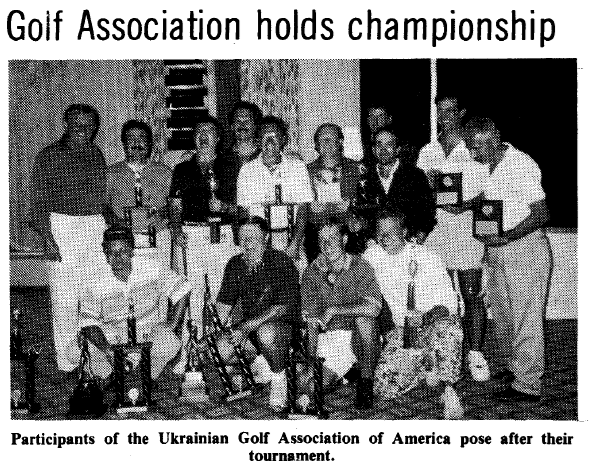
Roman Kinal participated in various golf tournaments organized by the Ukrainian diaspora in the United States. In 1992, he took part in the Hartford Ukrainian Open. The press wrote the following about the tournament and Roman’s result: “A field of 85 golfers from throughout the East Coast enjoyed a warm, sunny day at Tallwood Country Club in Hebron, Connecticut, where the par-72 course measures 6,126 yards. The winner in the Ukrainian division of this year’s tournament was Mike Demetro of Vernon, Connecticut, who posted an excellent score of 74, two over par. Mr. Demetro, who had previously won the tournament in 1983, edged George Tarasiuk of Newtown, Pennsylvania, by just one stroke. Roman Kinal of Detroit and Bohdan Anniuk of Philadelphia both shot 78 and tied for third place.”
So this time, Roman finished third in the tournament.
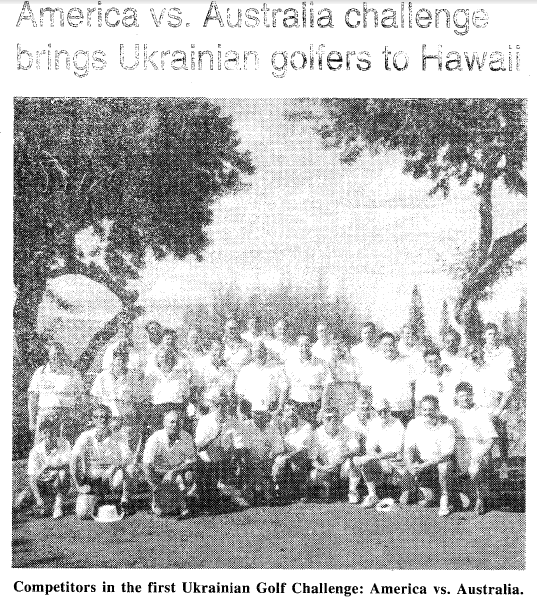
In 1993, a unique golf tournament was held among Ukrainians. The Ukrainian Weekly wrote the following: “The first Ukrainian Golf Challenge — a competition between teams from America and Australia that brought together 33 golfers in Hawaii in October 1993 — was a success; preparations are now underway for a rematch scheduled for 1996.”
It turns out that Ukrainian golfers from the United States, Canada, and Australia joined forces and began organizing a golf tournament. Naturally, Roman Kinal could not miss such an event. He became the winner of that year’s tournament — and it was his second consecutive victory!
So we certainly have people and achievements to be proud of! After all, sport unites Ukrainians around the world!
Main photo generated by AI
Author: Oleksii Lyakh-Porodko