


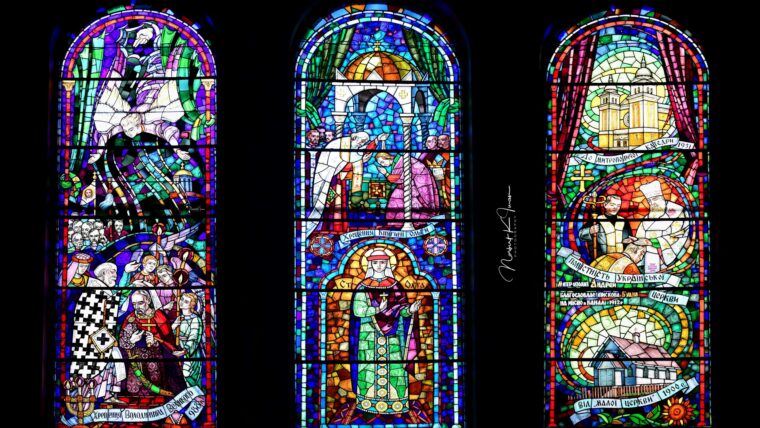
The Cathedral of Sts. Volodymyr and Olga in Winnipeg, Manitoba, features dozens of stained glass windows, which have become one of the church's primary artistic highlights. Their creation spanned several decades. The majority of the work was executed by the Ukrainian artist and sculptor Leo Mol (Leonid Molodozhanyn).
This was reported by Norbert K. Iwan.
The Ukrainian Catholic parish in Winnipeg was founded in 1907 with the assistance of a Ukrainian-American priest, Father Mykola Strutynsky. The first, small church was located on McGregor Street and served over 400 parishioners.
A notable feature of the modern Cathedral of Sts. Volodymyr and Olga is its large number of stained glass windows. Five are located in the sanctuary, 14 large ones are in the upper section of the church, and another 14 smaller ones are in the lower section. A large, circular rose window is installed above the choir loft.
During the design phase of the cathedral, it was envisioned that the stained glass windows would serve as the building's main adornment. Through their subject matter and vibrant array of colors, they were intended to create a decorative effect within the church's interior.
However, by the time the cathedral opened in 1951, a New York-based firm had installed only two stained glass windows. The first, located behind the altar, depicted the cathedral’s patron saints, Volodymyr and Olga. The second window—a large, circular one located above the choir loft—featured an image of Christ surrounded by roses and numerous symbolic Christian motifs.
At that time, the remaining 34 windows were fitted with colored glass. Funds had been allocated for the construction of the cathedral, but it proved impossible to find an experienced artist capable of designing stained glass that aligned with the church’s purpose and specific requirements.
Leo Mol’s Work on the Cathedral’s Stained Glass
In 1963, the Ukrainian artist Sviatoslav Hordynsky completed the interior murals of the cathedral. It soon became apparent, however, that the light filtering through the colored glass obscured the beauty of the paintings and ornamental designs. To preserve and enhance the visibility of the artwork, it was decided that stained glass windows should be installed as soon as possible.
Leo Molodozhanyn—a Winnipeg-based artist and sculptor known as Leo Mol—agreed to undertake the project. In the winter of 1963, he installed two stained glass windows in the cathedral. One depicted the princes of Ukraine, Saints Boris and Gleb, while the other portrayed the founders of monasticism in Ukraine, Saints Anthony and Theodosius.
Work on the stained glass was subsequently paused until 1972, as the artist had received commissions for other projects.
In 1972, Leo Mol completed and installed 14 stained glass windows, which are currently located in the upper section of the nave. He designed the remaining 14 windows—situated on the lower level—in 1977.
Before beginning the work, the artist had to determine the theme for each window. In total, the project encompassed thirty stained glass windows. Twelve of them depicted events from the Christian history of Ukraine, while two others were dedicated to the Nativity and the Resurrection of Christ. Two stained-glass windows in the sanctuary portrayed Saint Andrew the First-Called on the hills of Kyiv, as well as Saints Cyril and Methodius.
The lower windows featured decorative designs incorporating emblems representing various regions of Ukraine and international cathedrals.
The costs for the design, materials, and installation of the stained-glass windows were covered by donations from parishioners. Five of the windows had individual benefactors who paid the full cost of their creation.
Leo Mol: A Sculptor and Artist from Winnipeg
Ukrainian sculptor Leo Mol (Leonid Molodozhanyn) passed away on July 7, 2009, at the age of 94. He was a simple, unpretentious man who often remarked that his sculptures would speak for themselves.
During his lifetime, the artist created sculptures of Popes Paul VI and John Paul II, as well as a posthumous sculpture of John XXIII. His body of work also includes sculptures of Cardinals Josyf Slipyj and Tisserant, U.S. President Dwight Eisenhower, Queen Elizabeth II of Great Britain, Prime Minister Winston Churchill, Saint Volodymyr, and Canadian Prime Minister John Diefenbaker.
In his work, Leo Mol sought not to idealize his subjects, but rather to convey their inner lives, including the very human, earthly weaknesses inherent to them.
Despite achieving global recognition, the sculptor remained in Winnipeg, which became his home city.
In 1990, Leo Mol donated his collection—comprising over 300 bronze sculptures, paintings, and other works—to the city of Winnipeg. The collection was valued at more than four million dollars.
In 1992, Canada gifted the sculptor a plot of land, which later became the site of the Leo Mol Sculpture Garden. In 2003, he completed work on this garden in Winnipeg’s Assiniboine Park—a project that had been a lifelong dream.
Leo Mol was a member of the Royal Canadian Academy of Arts, a member and vice-president of the Sculptors Society of Canada, and a member of the National Sculpture Society (USA).
His works can be found in public squares across Canada, as well as in Washington, London, Buenos Aires, and Saint Petersburg. His sculptures are on display in parks, public spaces, and churches.
Photo: Norbert K. Iwan
Author: Danylo Pievchev