


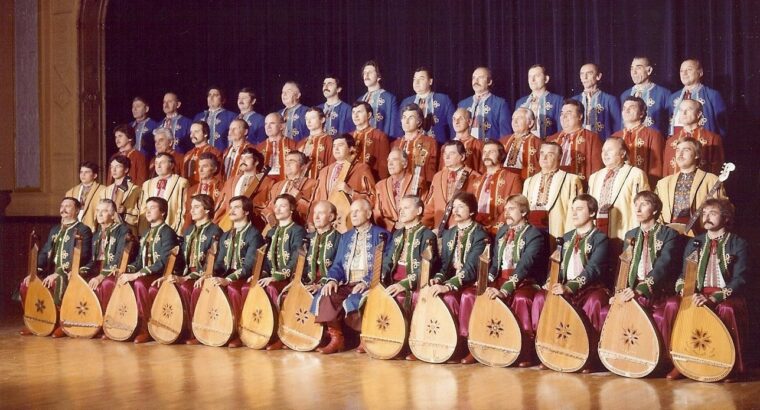
The Taras Shevchenko Ukrainian Bandurist Chorus journeyed from performing in wartime Europe and displaced persons camps to establishing a concert career in North America. In 1949, the ensemble—along with their families—emigrated to Detroit, which became their headquarters. Over the following decades, the Chorus toured various countries, saw changes in conductors and repertoire, and in 2021, began a major project to organize and digitize its archive.
From Vienna to Displaced Persons Camps
In July 1944, the Taras Shevchenko Ukrainian Bandurist Chorus left the town of Turka in the Lviv region and set off for Hungary. The five months spent there, together with their families, marked the ensemble’s final period on Ukrainian soil. By July 21, Soviet forces were approaching Lviv; consequently, the Galician intelligentsia, various institutions, and patriotic and artistic organizations hastened to depart for the West.
This was reported by Olha Ruda.
Before long, the members of the Chorus found themselves in Vienna. On August 13, under the auspices of the Ukrainian National Association, they gave their first concert for Ukrainian refugees. Later, they performed for the wounded in hospitals, factory workers, city residents, and military personnel in barracks.
However, on August 25, general mobilization was declared throughout Germany, bringing their concert activities to a halt. The entire kapela (ensemble), along with their families, had to relocate to Berlin. There, Mykola Prykhodko signed an agreement to hold 25 monthly concerts for Slavic Ostarbeiter (forced laborers).
During the winter holidays, the bandurysty (bandura players) organized a Christmas concert for Ukrainians who had arrived in Berlin while fleeing Soviet rule. In the packed Beethoven Hall (Beethovensaal) of the Philharmonic, they performed pieces such as "Dumy moyi, dumy moyi" ("My Thoughts, My Thoughts"), "Pisnya pro Morozenka" ("Song about Morozenko"), "Chuyesh, brate miy, tovaryshu miy" ("Do You Hear, My Brother, My Comrade"), "Duma pro kozaka Holotu" ("Duma about Cossack Holota"), and others.
On Christmas Eve, the ensemble members performed at a celebration organized by the Ukrainian Central Committee for the Ukrainian community, where they sang kolyadky (Christmas carols). On January 24, a small, private concert was held for Stepan Bandera, who was deeply moved by the Ukrainian songs and dumy (epic ballads).
The musicians and their families managed to survive the bombing of Berlin by American and Soviet air forces, enduring long periods in bomb shelters, financial hardship, and the constant struggle to find food and shelter. During one of the air raids, a bomb struck their hotel. A section of a wall remained standing, as did a bandura that had been left behind in the room by chance.
On March 10, the anniversary of Taras Shevchenko’s birth, the ensemble gave a concert at Beethoven Hall. Although few Ukrainians remained in the city, those present sang "Yak umru, to pokhovayte..." together, and concluded the performance with the anthem "Shche ne vmerla Ukrayina".
The ensemble gave its final concert in Germany for Ukrainian soldiers at a camp located 80 kilometers from Berlin.
On April 5, the kapella (ensemble) hastily left the city. The musicians managed to catch the last train to Munich. Together with their families, they waited to see how events would unfold in the village of Notzing, Bavaria.
On April 31, American forces occupied the town of Erding. A rumor spread among the refugees that they, along with prisoners of war, were to be sent back to their homeland. The bandurists and their families feared returning to the Soviet zone.
Repatriation began in June. Some Ukrainians were forcibly loaded onto trucks and taken away. The kapella also narrowly avoided being among those sent back; however, the members and their families refused to go to the Soviet zone. Consequently, they ended up in a camp for displaced persons (DPs).
These camps were typically located in military barracks. They had their own administrations, schools, newspapers, printing presses for books, and theater groups.
In 1946, the kapella toured the DP camps—of which there were several hundred at the time across the occupation zones of Western Germany and Austria. Each camp usually featured a large room or hall used for concerts, theatrical performances, and celebrations. Many camps even had their own choirs. Nevertheless, the venues were always packed whenever the kapella performed. The bandurists provided support to the people, offered them hope, and served as a reminder of Ukraine.
While in the Displaced Persons (DP) camps, the ensemble also marked its 25th anniversary. The official founding document for the kapella was issued only in 1923.
Volodymyr Bozhyk and other professional singers—mostly from Galicia—were invited to join the performances. Consequently, the ensemble evolved into a male choir, with only a portion of the members providing accompaniment on the bandura.
Concert Activities in the USA
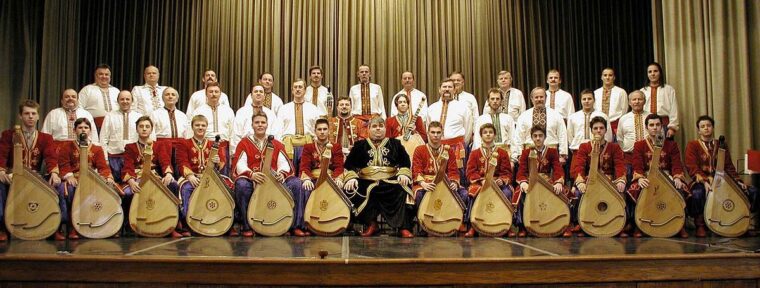
In 1949, the kapela and the families of its members emigrated to Detroit. Soon after, the group resumed concert performances, striving to maintain its professional status.
However, promoting ethnic vocal and instrumental music in this new environment proved unprofitable. Many of the artists took jobs in local industries to support their families, leaving them only a few weeks each year to dedicate to musical performances. Consequently, the ensemble transitioned to the status of an amateur group.
In 1958, the kapela embarked on a tour of Europe. Although the performances received favorable reviews, the tour was a financial failure, leaving the ensemble with significant debts. Due to the lack of a necessary financial foundation, conductors Volodymyr Bozhyk and Hryhoriy Kytasty left the group.
In the early 1960s, the ensemble faced an artistic crisis. There was frequent turnover in leadership; at various times, the kapela was directed by Ivan Kytasty, Yevhen Tsiura, Petro Potapenko, and Ivan Zadorozhny. The membership was also unstable.
Meanwhile, Petro Honcharenko—who had served as the kapela’s administrator for many years—succeeded in settling the accumulated debts and preserving the ensemble. He recruited new conductors, continued the release of phonograph records, established the production of banduras in America, and organized professional concert tours. One of the most successful endeavors was the artistic project titled "Slovo Tarasa" (The Word of Taras).
In 1968, Hryhoriy Kytasty returned to lead the kapela. With his involvement, the repertoire was expanded with new works. He also made a significant contribution to the training of young bandura players, who subsequently joined the ensemble.
Every two years, the Capella toured North America, and in 1981, it performed in Australia.
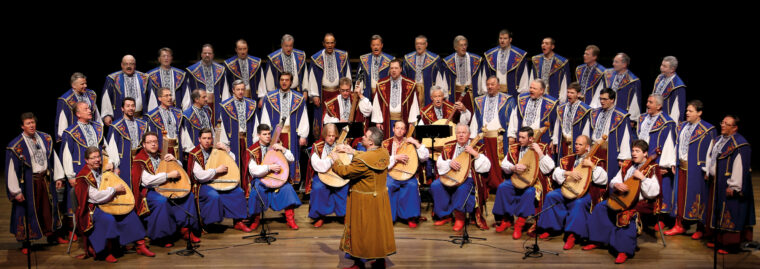
In 1984, Hryhoriy Kytasty passed away, and leadership passed to Volodymyr Kolesnyk. Under his direction, a group of young singers joined the Capella. The repertoire was expanded to include works by Hnat Khotkevych—pieces that had previously been banned following his arrest. These included "Poem about Baida," "Storm on the Black Sea," "Slave Market in Kaffa," and "The Testament" (Zapovit). For a time, these works were also part of the repertoire of the Poltava Bandurist Capella.
Under Kolesnyk’s leadership, the performers switched entirely to Kharkiv-style banduras and began studying the Kharkiv school of playing the instrument.
Between 1991 and 1994, the Capella toured Ukraine under his direction and received the Shevchenko Prize.
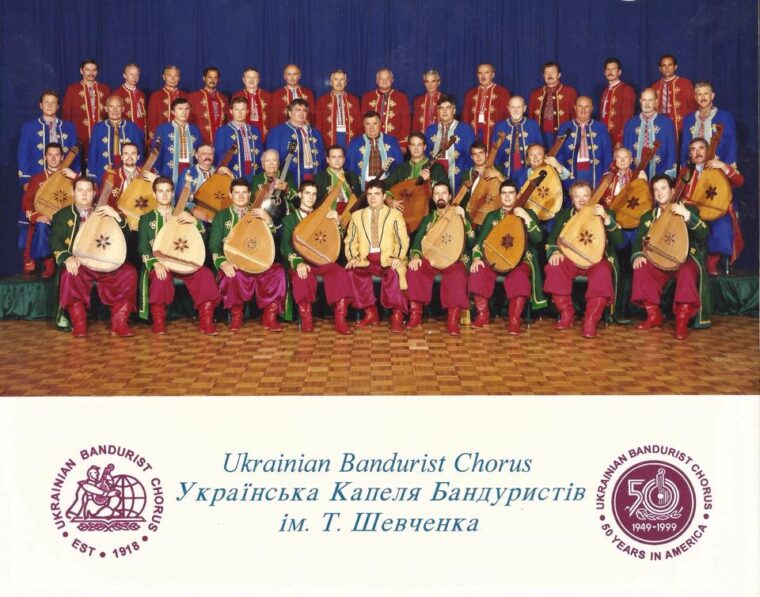
In 1996, Oleh Makhlai took charge of the ensemble. Under his leadership, the Capella visited Ukraine, performed in Europe, and released numerous recordings.
The repertoire of the bandurist choir differed from the programs of similar Soviet ensembles. It included religious works, church carols, as well as songs from the Ukrainian People's Republic, the Sich Riflemen, and the insurgent movement.
The Kapela’s Archive: Preserving History and Digitizing Materials
In early 2020, Mykola Mursky, the archivist for the Ukrainian Bandurist Chorus of North America, assessed the state of the ensemble’s archive and began the process of organizing its materials.
The Chorus possessed over 40 large boxes containing photographs, handwritten memoirs, and newspaper clippings. Mursky developed a five-year plan that included reviewing, identifying, cataloging, and digitizing these materials, as well as analyzing sources held in various repositories around the world that contain records related to the ensemble’s history.
In June 2021, the Chorus began a collaboration with the Ukrainian American Archives and Museum of Detroit (UAAM). Two researchers were brought on to work on the archive: Iryna Voloshyna, a doctoral student in the Department of Folklore and Ethnomusicology at Indiana University Bloomington; and Kvitka Sozanska—a bandura player, soprano, laureate of national and international competitions, vocal instructor, and doctoral student at the Mykola Lysenko Lviv National Music Academy. She also taught the bandura at the Solomiya Krushelnytska Lviv State Music Lyceum.
The researchers processed the contents of over 40 large plastic containers filled with archival materials, identifying, cataloging, and digitizing the records. The materials were sorted by decade. Initially, the focus was on preserving records dating from the 1920s through the end of the 1960s.
After several weeks of work, slightly less than half of the materials were successfully digitized and properly archived.
On July 30, 2021, the kapela and the Ukrainian American Archives and Museum of Detroit hosted a presentation at the museum for over 75 invited guests. Among the attendees were current and former members of the ensemble, as well as descendants of former members.
The ensemble expressed its gratitude to the museum’s Board President, Dzvinka Hayda, and the entire Board of Directors for allowing them to use the institution’s facilities as a base for their archival work over the preceding six weeks. They also thanked the museum’s Executive Director, Olya Liskivska, for her professionalism, expertise in archival practices, and support for the project.
During the presentation, Kvitka Sozanska and Iryna Voloshyna presented the results of the work and showed the found materials. Among them was a tattered but legible concert program for 1942 from Rivne, which related to one of the first tours of the restored ensemble in Ukraine. The researchers also found a train ticket from this tour and handwritten memories of eyewitnesses about the war years.
At that time, the first steps in processing the archive were taken. The chapel estimates the project could take three or more years to complete.
During the address to the community, the artistic director and conductor of the Ukrainian Music Academy Oleg Makhlai emphasized the importance of the archive for determining the modern mission of the collective:
"We cannot simply forget the sacrifice and dedication of the musicians who came before us, and Kapelya strives to honor their legacy by preserving their memory and contributions. For more than 100 years, UKB has carried the candle of the Ukrainian language and history through music and education. Today, our mission is as important, if not more important, than ever. Our goal is to build on the incredible legacy that was founded and nurtured by the people who walked this path before by us, who sang and played for the glory and beauty of Ukraine and its people."
Photo: Olha Ruda
Author: Danylo Pievchev