


Our planet is enormous. Have you ever stopped to think about that? Amid oceans, rivers, and bodies of water, there are green groves and forests inhabited by dozens and hundreds of furry — and not so furry — creatures. Every day they go about their business: hunting one another, building nests, settling into tree hollows, storing food for winter, gazing at the sky, and falling asleep in the bushes. A world of its own, one where there seems to be no place for us humans. What a wonder nature is. A source of inspiration for countless beliefs, artists, and ordinary inhabitants of the planet whose routine thoughts, at least from time to time, allow them to stop and look around.
For us Ukrainians, the Carpathian Mountains, sea bays, and vast steppes are so familiar. But who would have thought that the swampy landscape of South Florida could capture the heart of someone accustomed to seeing the roaring Dnipro and enormous bridges that had not yet been bombed by our eastern neighbors? In this distant, unfamiliar, permanently flooded world of lizards, stingrays, and sharks, it is difficult to find much in common with the familiar beavers, hedgehogs, and squirrels that used to greet you as soon as you left Kyiv behind. But life is unpredictable, and one day the coexistence of alligators and crocodiles no longer raises questions, while the prospect of coming face to face with a tropical storm seems more like an everyday occurrence than a frightening story.
So when you hear that back in your homeland, reptiles so beloved in Florida are kept by wealthy people as decorative pets, you start scratching your head, tangled in questions. And the first is this: how, where, and why did a real crocodile end up in the terrarium of a man linked to a case involving the possible embezzlement of public funds allocated for the construction of protective structures at energy facilities in the Kyiv region?
It all began with Serhii Sternenko. On social media, the volunteer and activist claimed, that while serving as head of the Kyiv Regional Military Administration, Mykola Kalashnyk signed contracts worth more than half a billion hryvnias, without tenders, for the protection of substations with companies that had neither employees nor equipment. According to Sternenko, the work was never completed.
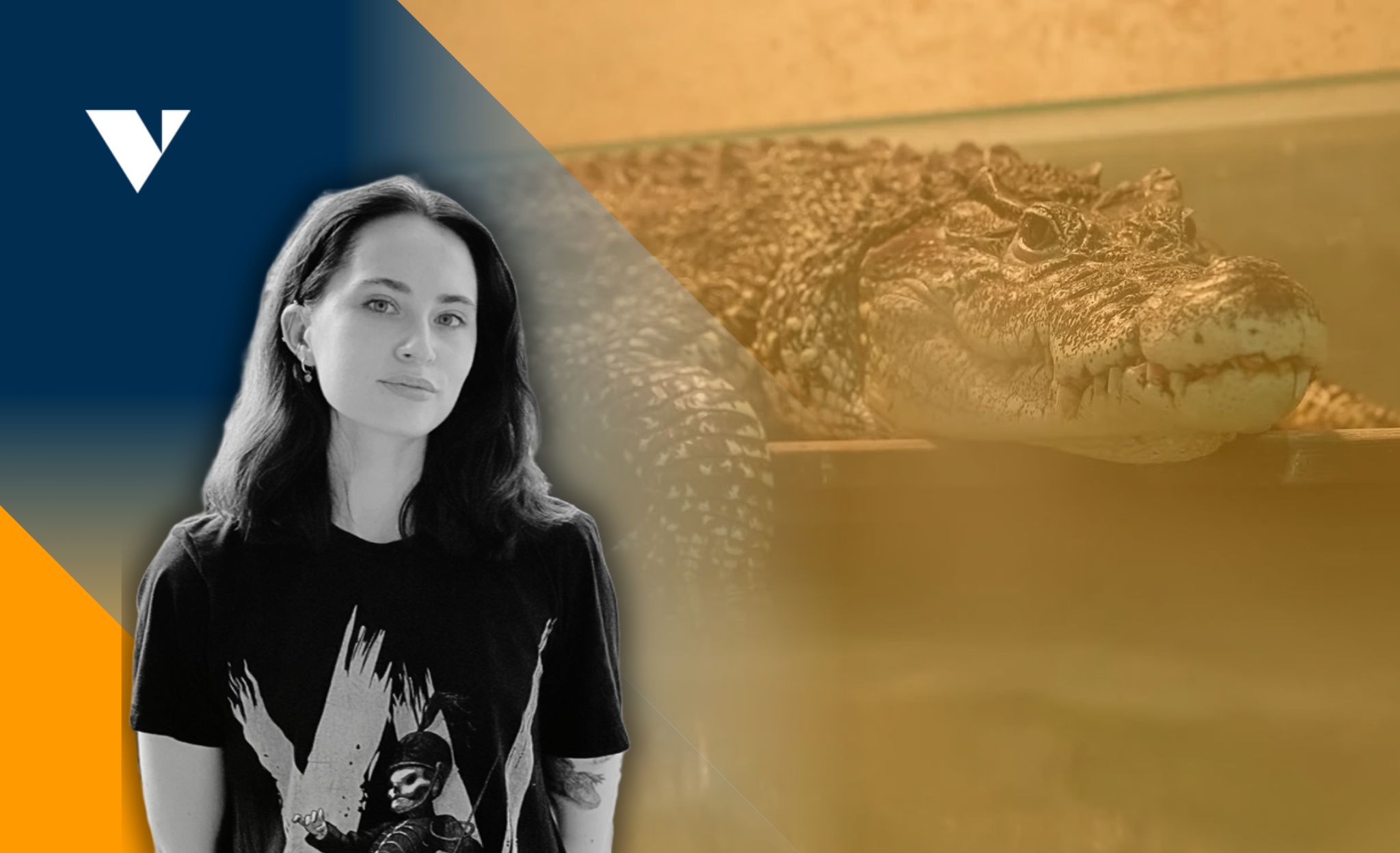
Later, Sternenko published photographs that, according to him, were taken during searches of individuals involved in the case concerning the possible embezzlement of public funds during construction of protective structures for energy facilities in the Kyiv region. According to data from Slidstvo.Info the images presented to the public by the blogger were taken at two properties belonging to Vladyslav Sokolov in Dnipro. In addition to a terrarium containing a live crocodile, there were portraits of the man in the style of Yanukovych, a swimming pool, and a jacuzzi. And, of course, no collection would be complete without a good old Rolls-Royce. In short — the classic package.
On November 12, Vladyslav Sokolov denied all the allegations. And rightly so, because such elements of luxury can, of course, be afforded by every Ukrainian family. And since the 47-year-old businessman received 25 government contracts worth approximately 1.89 billion hryvnias, expensive cars presumably should not raise any questions.
At the same time, according to a ruling by the Sviatoshynskyi District Court of Kyiv, the searches concerned the construction of protective structures for the Kyiv region’s energy infrastructure. Sokolov’s companies — Stal Plus and TD Tryzub — supplied metal products to contractors carrying out government orders. Investigators are examining whether the businessman inflated the prices of these materials. Separately, police are investigating the possible misappropriation of 129 million hryvnias during the aforementioned construction of protective structures for energy facilities.
And while law enforcement officers sort through the money, documents, and all the other tedious routine that accompanies investigations like this, the crocodile — whose life can hardly be called happy — remains sitting in its terrarium.
And where did Sokolov get this Floridian “puppy” in the first place? It is unlikely he caught it outside the door of his house in Ukraine. But the businessman did not keep everyone waiting long and quickly explained that the crocodile, “which caused such a stir across the Internet,” had been “officially purchased from the Odesa Zoo for just $2,500. It has never been sick since then — God bless its health.”
The zoo, however, denied having made any such sale, explaining that it had not kept crocodiles for the past 15 or 16 years. So for now, it remains unclear exactly how, why, and — most importantly — for what reason the reptile ended up in a glass prison.
Do you think this crocodile committed some crime in its own world of hungry predators? Perhaps it robbed the alligator state? Kept humans in terrariums for the sake of some incomprehensible aesthetic? Or misappropriated a couple million… tadpoles, or whatever else passes for currency in the swamps and bodies of water inhabited by reptiles?
It is a pity that their world has no journalists of its own, because it may turn out that we are trying to defend a serial killer rather than an ordinary little crocodile.
But if we set the sarcasm and skepticism aside, we are faced with a harsh reality in which greed and abuse have very concrete consequences. Stealing public money is wrong — surely that should be obvious? Money does not simply materialize in the state budget, and it should serve not as a means of displaying someone’s unique, extravagant, and inhumane taste, but as a resource for the country’s development.
Corruption steals from people the possibility of having heat during wartime winters, a strong army, reliable bomb shelters, proper education, and a future. Without investment in defense, social protection, and other vital areas of public life, it is not only Ukraine that loses its chances — each and every one of us does.
And all of this so that someone can keep a reptile in their office? Well, that seems like a rather unjustifiable price for the suffering of so many people and animals.
Inhumanity is something that can manifest itself not only in the way we treat our fellow creatures. Those for whom flora and fauna are nothing more than resources are unlikely to understand the importance of kindness even toward members of their own species. If a live crocodile behind glass is considered normal, why should the suffering of some unknown people matter when decisions are being made?
For corrupt officials, thieves, criminals, and murderers, the entire world may be nothing more than scenery in which the rest of us play supporting characters whose storylines are never fully written. Let children freeze in schools, let teachers be unable to work properly, let doctors be unable to do their jobs, let animals die in zoos — none of it matters to them. Some crocodile will live in horrible conditions because someone wants it as part of the interior — so be it.
But moments like these make you wonder: did we make a mistake when we assumed that human beings are the most intelligent creatures on planet Earth? Because if intelligence has come hand in hand with such unjustifiable cruelty, then perhaps the world should finally clean out our terrarium, leaving free only those whose right to freedom does not need to be proven in court.
Author: Viktoriia Hridina
