


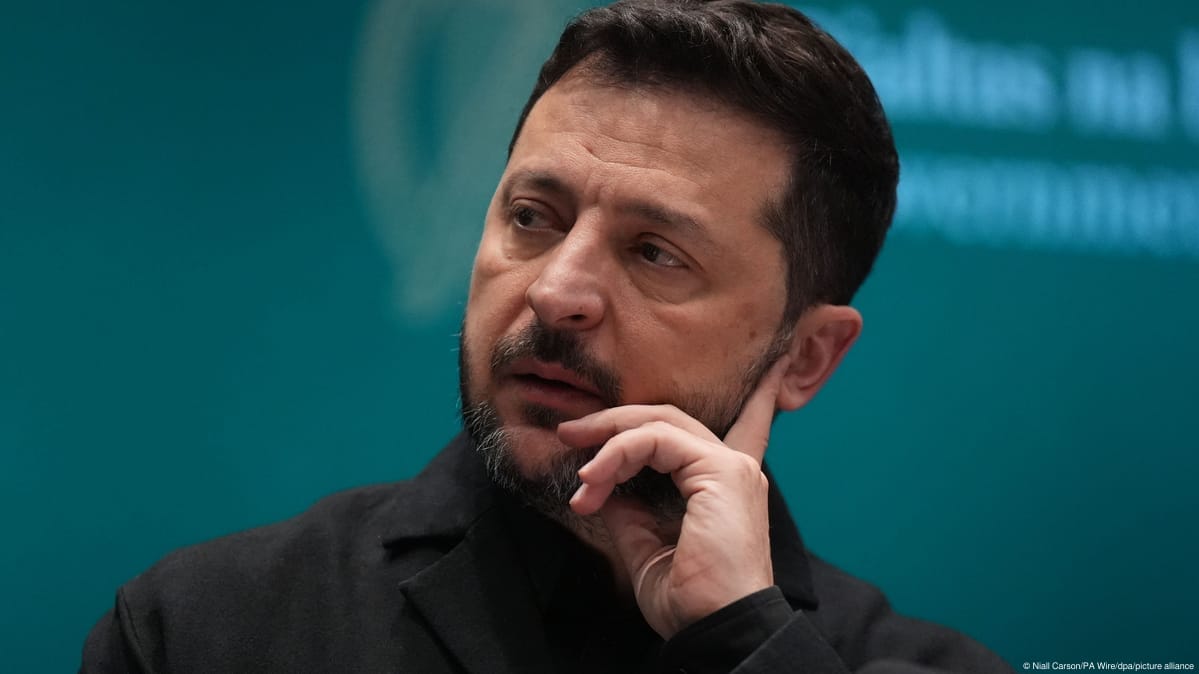
Ukraine, the US, and European partners continue to discuss the terms for ending the war and future security guarantees. Meanwhile, the UN Security Council has called for an end to strikes on energy infrastructure and food logistics. Against this backdrop, Ukraine has confirmed operations targeting Russian vessels in Libya and the Gulf of Finland.
Zelenskyy Believes the US Aims to Reach an Agreement with Russia to End the War by December or January
Ukrainian President Volodymyr Zelenskyy believes that the American negotiating team aims to reach an agreement with Russia to end the war against Ukraine as early as December 2026 or January 2027. He stated this in an interview with Bloomberg. According to the head of state, the American side wishes to end the war as quickly as possible—a goal shared by Ukraine. At the same time, Zelenskyy emphasized that any peace agreement must not come at Ukraine’s expense alone.
The President also stated that if negotiations fail to yield results, Kyiv will continue working to strengthen international support. Specifically, Ukraine intends to engage with both parties in the newly constituted US Congress, advocating for the imposition of sanctions against Russia and continued support for the Ukrainian state. Zelenskyy also addressed the Pentagon’s delay in supplying air defense systems capable of intercepting Russian ballistic missiles.
"The American side is not authorizing the delivery of anti-ballistic missile systems." "Because America itself is putting itself in a very awkward position. Politically, it looks as though it is moving in the same direction as what Putin wants: forcing Ukraine into unfavorable compromises," Zelenskyy said.
The US has urged Ukraine and Russia to cease attacks on energy and food logistics
The United States has called on Ukraine and Russia to stop attacks on energy infrastructure and food supply chains, and to ensure safe navigation in the Black Sea. This was stated by Dan Negrea, Deputy Permanent Representative of the US to the UN, during a UN Security Council meeting dedicated to Russia's war against Ukraine. He emphasized that commercial shipping must be able to proceed safely and without obstruction. According to the diplomat, strikes on civilian port infrastructure and merchant vessels endanger human lives, violate freedom of navigation, reduce agricultural exports, and pose risks to global food security.
Negrea noted that, as a result of attacks in the Black Sea, grain, fertilizers, and food shipments end up on the seabed, while sailors from various nations are killed or wounded. Ukrainian farmers also face difficulties in exporting their produce. The diplomat pointed out that millions of people around the world can no longer rely on food supplies from Ukraine and Russia. Separately, he stated that Washington, together with Kyiv and European partners, is working on four aspects of a future settlement: security guarantees for Ukraine, the prospect of its EU accession, a post-war economic recovery plan, and arrangements regarding security mechanisms to be implemented after a peace agreement is concluded. The U.S. intends to continue this work based on the negotiations held in Abu Dhabi, which involved Ukraine, Russia, European partners, NATO, and the EU.
Kushner Outlines Condition Under Which Trump Might Approve NATO Article 5-Style Security Guarantees for Ukraine
U.S. President Donald Trump could approve security guarantees for Ukraine—similar to those provided under NATO’s Article 5—if he becomes convinced that doing so aligns with the national interests of the United States. This was stated by the American president’s son-in-law, Jared Kushner, in a post on the social network X. He identified Trump’s willingness to consider such guarantees as a key condition for achieving a lasting peace. Kushner also noted that Russia’s readiness to discuss such mechanisms represents an important step forward and potentially indicates the seriousness of its intentions regarding a peaceful settlement. According to him, the guarantees must be concrete, reliable, and clearly documented.
At the same time, Kushner emphasized that such commitments rank among the most significant obligations the United States could undertake, and therefore require careful consideration.
"He would take such a step only if he were convinced that it unequivocally served America’s national interests, and that the broader security arrangements made it highly unlikely that this guarantee would ever need to be invoked," Kushner believes.
He added that security guarantees for Ukraine must be considered in the context of shaping a post-war European security architecture. Among the potential mechanisms, Kushner cited permanent channels for consultation, crisis communication, the prevention of military clashes, and measures to avert escalation. He also emphasized the need for a long-term plan for Ukraine’s prosperity, which would entail reforms to strengthen state institutions and the economy. In the coming weeks, the U.S. plans to discuss these issues with Ukraine, European partners, and Russia.
"Nothing is considered agreed upon until it is officially agreed," Kouchner emphasized.
At the UN, France stated that a real, yet fragile, possibility for de-escalating the war against Ukraine exists
France, together with its partners, is prepared to engage in serious negotiations with Russia, with the participation of Ukraine and the United States. At the same time, Paris is urging Moscow to choose between further escalation and confidence-building measures that could create the conditions for a peaceful dialogue. This was stated by Jérôme Bonnafont, France’s Permanent Representative to the UN, during a UN Security Council meeting dedicated to the Russian war against Ukraine. According to the diplomat, France has carefully listened to the U.S. position and confirms its readiness to join the negotiation process. Bonnafont noted that Russia could either continue escalation and put forward maximalist demands, or take steps that would facilitate dialogue.
The French diplomat also drew attention to Ukraine’s proposal to extend the approach used in the Oleshky operation to 15 other areas of its territory. He described this initiative as evidence that the possibility of de-escalation remains real, albeit fragile. Furthermore, France called for a dual moratorium: one on strikes against energy infrastructure and another on attacks against shipping in the Black Sea. According to Bonnafont, 40 sailors of various nationalities have died there since the beginning of the year, and at least 300 civilian vessels have come under attack. He also stated that problems with grain exports are exacerbating food security risks outside of Europe. According to the UN Food and Agriculture Organization, wheat trade has declined by 9% this year; furthermore, the volume of grain that failed to be exported via the Black Sea between July and October could have provided food for 123 million people suffering from acute food shortages.
Ukraine confirmed strikes on Russian vessels in Libya and the Gulf of Finland, describing them as acts of self-defense
Ukraine used naval drones to strike the Russian naval corvette "Merkuriy" in the port of Benghazi, Libya, causing the vessel to sink. President Volodymyr Zelenskyy reported this on November 23, releasing footage of the attack captured by the Security Service of Ukraine (SBU). According to him, Ukrainian forces also struck the Russian dry-cargo ship MV Angara—which Moscow had been using to transport weapons—and destroyed a Ka-27 combat helicopter. The SBU stated that the naval drones were launched from a carrier vessel located in the region. According to the Institute for the Study of War, the corvette "Merkuriy" had been docked in the port of Benghazi for several days to refuel and resupply as part of a cooperation agreement, while escorting cargo ships that may have been transporting military supplies to Russia. The eastern part of Libya, where the port is located, is under the control of military commander Khalifa Haftar, whose Libyan National Army has ties to Russia.
The operation was condemned by Libya’s internationally recognized Government of National Unity, which controls the west of the country and is headquartered in Tripoli. It stated that Libya would not allow itself to be drawn into the war, and that foreign forces may not use its ports and infrastructure for military purposes. The eastern-based Libyan government requested that the UN investigate allegations regarding the launch of drones from the western part of the country and the possible presence of Ukrainian military specialists there. In response, on November 24, Ukrainian Foreign Minister Andrii Sybiha stated that the attack was a legitimate act of self-defense under Article 51 of the UN Charter. "Ukraine is not 'dragging' anyone into the war, nor is it 'exporting' the war anywhere," he wrote on Telegram. Sybiha emphasized that Ukraine respects Libya’s sovereignty and territorial integrity, and that its actions are aimed at countering Russian aggression. He further stated that the right to self-defense under international law is not limited to the territory where the aggression is taking place; it may also be exercised within the territory of the aggressor state or in international waters.
Zelensky also confirmed Ukraine’s involvement in the attack on the Russian cargo ship Sparta II, which caught fire in international waters in the Gulf of Finland on November 22. According to the President, the vessel was transporting weapons and was, therefore, a legitimate target. The Sparta II is operated by the Russian company Oboronlogistika, which is involved in military transport. The Finnish military previously stated that Ukraine was likely behind the attack. All 16 crew members were evacuated to another Russian vessel; one person sustained minor injuries. Following the fire, Russian, Estonian, and Finnish vessels participated in firefighting efforts, and the damaged ship was subsequently towed to the port of St. Petersburg. Kremlin spokesperson Dmitry Peskov described the incident as a dangerous trend of rising terrorist activity in the Baltic Sea.
Photo: Niall Carson/PA Wire/dpa/picture alliance
Author: Danylo Pievchev