


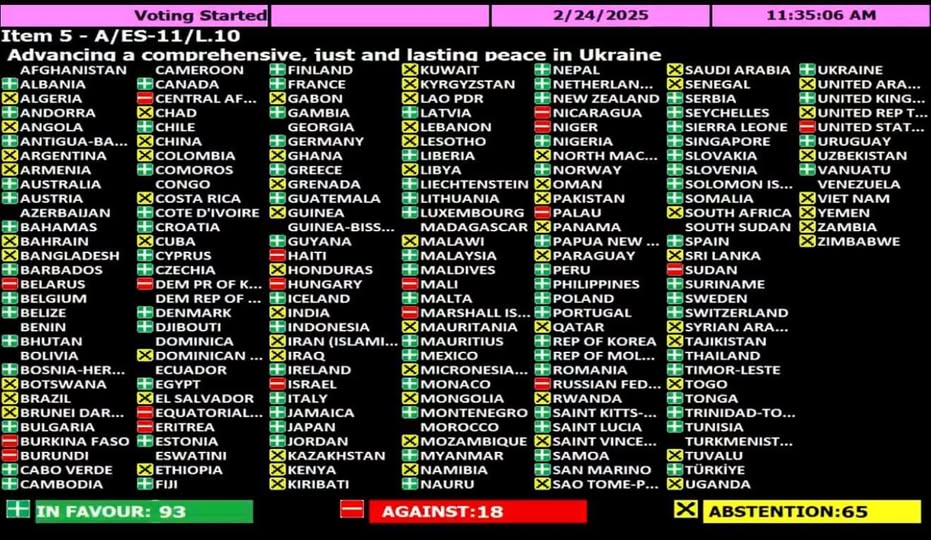
On February 24, the UN General Assembly adopted a resolution condemning Russia's invasion and reaffirming Ukraine's territorial integrity. The document received 93 votes in favor, 18 against and 65 abstentions. The United States, which has supported similar resolutions in the past, abstained this time.
Russia, Belarus, North Korea, Mali, Sudan, Nicaragua, and several other countries voted against the Ukrainian resolution. The United States abstained, which came as a surprise to many diplomats.
Washington presented its own resolution, which did not mention Russia as the aggressor. The text of the resolution itself consisted of a few sentences.
"The General Assembly, deploring the tragic loss of life during the Russian-Ukrainian conflict, reaffirming that the primary purpose of the United Nations is the maintenance of international peace and security, calls for a prompt end to the conflict and the further achievement of a lasting peace between Ukraine and Russia," the proposed US resolution reads.
Ukraine and its allies tried to introduce amendments directly referring to Russian aggression, but the United States refused to support them.
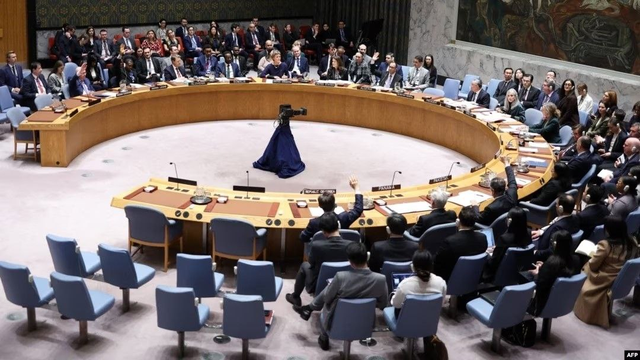
The United States also tried to push the document through the UN Security Council, and succeeded there, with ten countries supporting the document, including Russia itself. The European permanent members of the Security Council, the United Kingdom and France, as well as Denmark, Greece and Slovenia, abstained. "Ten states voted in favor: permanent Security Council members Russia, China and the United States, as well as Algeria, Guyana, Pakistan, Panama, South Korea, Sierra Leone and Somalia.
However, former Ukrainian Ambassador to the United States Valeriy Chaly called the vote "historic" and that "Ukrainian diplomats are working with dignity."
"Ukraine, with the support of its partners, has defended the basic narratives about Russian aggression and at the same time saved the face of American partners," he wrote on Facebook.
Chaly called the protest against the adoption by the UN Security Council of the American version of the resolution, which does not mention Russia as the aggressor, "a fly in the ointment.
The U.S. decision not to support the Ukrainian resolution and instead to promote its own document without condemning Russia raised many questions. In particular, BBC diplomatic correspondent James Landale noted that "it is rare for the US to be so out of step with its nominal allies in Europe."
"The Donald's White House has broken transatlantic alliances by cozying up to Moscow and calling into question Trump's long-standing commitment to maintaining security in Europe," he stressed.
Although UN General Assembly resolutions are only advisory, they are an indicator of international support. But the vote signals a shift in U.S. foreign policy that could affect further military and financial aid to Ukraine.
Ukrainian diplomacy is now focused on minimizing the consequences of this vote, as Chaly emphasized: "The result will not put Ukraine at odds with the United States, but it shows a level of support that Washington cannot ignore.
The Embassy of Ukraine in the United States, for its part, stressed, that peace should be based on the full restoration of the country's territorial integrity.
"The resolution calls for de-escalation, an early cessation of hostilities, and condemns the participation of DPRK troops fighting alongside Russia. Ukraine's territorial integrity must be restored. Three years after Russia's full-scale invasion, global support for Ukraine remains strong," the embassy said.
Author: Danylo Pievchev