The traditions of the Olympic movement in Ukraine reach back to ancient times. Moreover, their roots go back to the era before our time. First and foremost, this refers to the times of Ancient Ukraine, when the ancient Ukrainians were generators in cultivating the ancient Greek cultural and Olympic heritage. It is worth noting that the modern Olympic movement would not be what it is today had Ukrainians not joined it in the second half of the 19th century. It was at that time that Pierre de Coubertin became inspired by the idea of reviving and globalizing the Olympic ideals of the modern world. In this difficult but important endeavor, he was strongly assisted by Ukrainians — Oleksii Butovskyi, Mykola Ritter, Ivan Boberskyi, and many other worthy figures.
Their work was not in vain. After all, the field of Olympism greatly appealed to Ukrainians. Even despite hundreds of years of genocide against the Ukrainian people and the occupation of Ukraine, we did not abandon the struggle for a free Ukrainian Olympic movement. A vivid example of this is the series of large-scale Olympic competitions held in the United States, Germany, Canada, and Argentina in 1936, 1948, 1980, 1984, 1988, 2000, and 2008.
In the United States, Ukrainians repeatedly organized sporting competitions that were directly connected to the international Olympic Games. This has truly become a fine tradition of the Ukrainian community in the United States. As early as 1936, the First Ukrainian-American Olympiad was held in Philadelphia. Later, Olympic competitions in Philadelphia were held in 1988, 2000, and 2008. In other words, the city of Philadelphia may unofficially be considered the capital of Ukrainian Olympiads in the diaspora. There was an intention to organize another diaspora Olympiad in 1992. However, due to certain challenges, unfortunately, this could not be accomplished. And, of course, Ukrainians in the United States once again chose the city of Philadelphia as the venue for the Olympiad!

Although the most recent diaspora Olympiad to date took place in 2008, this does not mean that they will not be revived in the future. In particular, I believe in this and eagerly await the next Olympiad of the Ukrainian diaspora in the United States, which will unite Ukrainians from around the world.
Thus, in July 2008, the Ukrainian Diaspora Olympiad and Youth Rally took place. It is pleasant to note that the Ukrainian press in the United States informed readers in detail about the course of the preparation, organization, and holding of the Olympiad. In particular, the newspaper Narodna Volia wrote the following: “On July 4–6, 2008, the games of the Fourth Ukrainian Diaspora Olympiad took place, with teams from Ukrainian sports centers from many cities in America and Canada participating. In total, there were more than 500 athletes, including almost half of youth age. The games were held in five age groups in soccer, two age groups in volleyball, in chess, and in several age groups in swimming, tennis, and track and field.”
As we learn, this Olympiad was large-scale, numerous, and representative. Therefore, the preparation for it was accordingly thorough and responsible. On this occasion, the newspaper Svoboda wrote the following: “The Olympiad is an unforgettable celebration of strength, agility, endurance... The impressions from the last Ukrainian Diaspora Olympiad are still alive in the memory of many. It seems as if it took place only yesterday. But eight years have already passed, and the Ukrainian Diaspora Olympiad 2008 is coming to replace Olympiad 2000. On February 1, the Main Office of the Ukrainian National Association and the editorial offices of the newspapers Svoboda and The Ukrainian Weekly were visited by the organizers of Olympiad 2008 — the chairman of the Olympiad preparation committee Ihor Chyzovych, his deputy Orest Lysiuk, and activity coordinator Irynei Isaiv.”
In an interview with the newspaper Svoboda, Ihor Chyzovych shared details of the preparations and the competition program. Here is what he reported, quoting an excerpt: “Olympiad 2008 will last three days — July 4–6, 2008. These are the days of the U.S. Independence Day celebration. The venue is the Trident sports estate in Horsham, Pennsylvania. Swimming, volleyball, and track and field competitions will take place at a nearby school. In addition to these sports, the competition program includes soccer, tennis, golf, and chess. Besides the sporting events, we are preparing a large program of recreation and entertainment. On the first day, Friday, a reception for participants and guests will be held at Tridentivka; the next day there will be a concert and a dance with music by two orchestras; and on Sunday, the ceremonial closing of the celebration.” Yes, indeed, such a rich program is not easy to organize well. But we are Ukrainians, so everything turned out extremely well and at a high level.

According to Ihor Chyzovych, numerous sports associations were invited to participate in the Olympiad: “Kryla” of the Ukrainian Youth Association, “Levy,” “Ukraina” — all from Chicago; “Ukraina” from Buffalo, New York; “Ukraina” from Syracuse, New York; “Krylati” of the Ukrainian Youth Association from Yonkers, New York; Ukrainian sports clubs from Rochester and New York; “Karpaty” of the Ukrainian Youth Association from Clifton, New Jersey; “Karpaty” and “Ukraina” — both from Toronto, Canada; “Chornomorska Sich” from Whippany, New Jersey; “Vatra” from Long Island; “Lviv” from Cleveland; “Chernyk” from Detroit; and “Tryzub” from Philadelphia. Sports teams from the youth organizations Plast and the Ukrainian Youth Association were also invited to the competitions.
The leading sponsors of the Olympiad were the following Ukrainian organizations: the Ukrainian National Association, the Ukrainian Federal Credit Union in Philadelphia, Western Union, Meest, the committee organizing “Ukrainian Day” at Giants Stadium, and others. In addition, it was noted that every supporter of Ukrainian sport could also join in and make a donation toward holding the Olympiad.
Ihor Chyzovych revealed a few more secrets and interesting details on the eve of the Olympiad: “Sports shirts with its emblem will be made, and there will also be a souvenir bazaar where one will be able to purchase folk art items. Stars of Ukrainian sport have also been invited to the celebration, including Olympic champion Oksana Baiul, with whom it will be possible to speak. There is no need to worry about food — very tasty dishes are prepared at the Tridentivka estate. We will also publish in the newspaper the email addresses of hotels with which we will arrange accommodation for our guests at lower prices. The organizing committee advises everyone to follow the reports and announcements in Svoboda about the progress of preparations for the Olympiad and invites everyone to take part in it. It will be not only a celebration of Ukrainian sport, but also a demonstration of the unity of our community, interesting communication, and unforgettable impressions.” Exactly so: these are not only sports competitions or records. Ukrainian Olympiads are a unification of Ukrainians and the preservation of Ukrainian traditions, culture, history, and language as national heritage.
It is notable that the organizers invited well-known Ukrainian athletes, public figures, and politicians to take part in the ceremonies. Among them was Oksana Baiul, the first Olympic champion of restored independent Ukraine. This was truly a unique event for Ukrainian sport in the diaspora. The celebrated star of Ukrainian sport was expected to “shine” and inspire the participants, spectators, and guests. But an unpleasant moment occurred. Oksana delivered her speech in russian. According to the recollections of eyewitnesses, everyone present was shocked. After all, she had promised the Ukrainian community in the United States that she would learn the Ukrainian language and communicate in it.
The Ukrainian authorities did not overlook the Olympiad, and that is gratifying. In particular, Ukraine’s Ambassador to the United States, Oleh Shamshur, issued a special greeting to the Ukrainian Diaspora Olympiad. I quote the greeting in full because it carries state significance: “Most honorable community! Dear compatriots! I sincerely congratulate you on the opening of the Fourth Ukrainian Diaspora Olympiad. I express my sincere gratitude to the organizers for their devotion to Olympic principles, enthusiasm, and persistence in holding this wonderful sporting celebration, and for providing its participants — athletes from America and Canada — with the opportunity to demonstrate their talents and achievements and to enrich the legacy of previous sporting generations. I am convinced that forums of such scale, in addition to promoting a healthy lifestyle, encourage broad participation in physical culture and the upbringing of young people in a patriotic spirit. Ukraine has always been famous for its sporting talents, whose names have been forever engraved in golden letters in the history of world sport and the Olympic movement. Consider the names of our compatriots such as Ivan Piddubnyi — a Greco-Roman wrestler who became famous throughout Europe for spending 40 years on the wrestling mat without losing a single international match and leaving it undefeated! Gymnast Larysa Latynina, who won 18 Olympic medals during her sporting career, which became the greatest achievement in the history of the Olympiads! Serhii Bubka, multiple world and Olympic champion in pole vaulting, who set 35 world records! Figure skater Oksana Baiul, who won the first Olympic gold medal for independent Ukraine! And this is only part of the long list of outstanding Ukrainian athletes who at different times glorified their state on the international stage. Young people have always been and remain the adornment, hope, and driving force of society. For those who are young in body and spirit, who live brightly, fully, and interestingly, nothing is unattainable. I am convinced that you will successfully realize your talents, and that your energy, willpower and strength of spirit, courage, and endurance will lead to a worthy victory in fierce sporting battles.”

These are very powerful words of support from Ukraine’s ambassador to the United States. This testifies to the importance and relevance of such sporting competitions organized by the Ukrainian diaspora. This greeting was delivered during the opening ceremony of the Olympiad by Oleksandr Mykhalchuk, counselor of the Embassy of Ukraine in the United States. In addition to this high-level state greeting, other messages also arrived from Ukraine, including from the National Olympic Committee of Ukraine — Lviv Regional Branch. It was signed by Petro Oliinyk, adviser to the President of Ukraine; Yurii Maiboroda, head of the Department of Physical Culture; Myroslav Hertsyk, honorary rector of the Lviv State University of Physical Culture; and Stepan Rodak, director of the Lviv State College of Physical Culture. A greeting from the Committee on Physical Education and Sports of the Ministry of Education and Science of Ukraine — Lviv Regional Office — was signed by Bohdan Yukhnytskyi and Yaroslav Havryk, while a greeting from the Society for Relations with Ukrainians Abroad “Ukraine and the World” — Lviv Regional Branch — was signed by Bohdan Yakymovych and Oksana Vatseba, professor at the Lviv State University of Physical Culture.
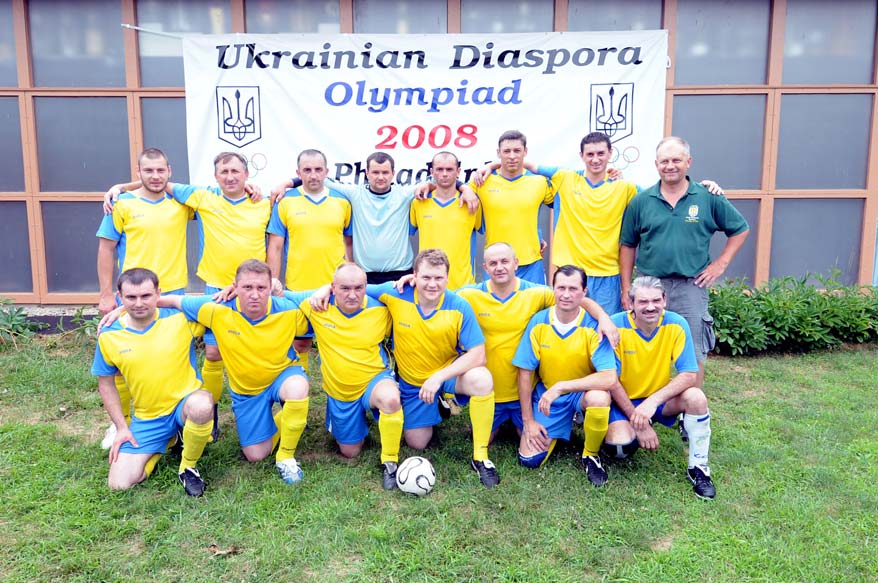
I will not now describe the results of the competitions in detail. They are available in the press, and anyone who wishes may look them up. However, I will focus on one moment that was told to me by Serhii Raiko, a participant in the Olympiad’s soccer competitions. I had the pleasure of interviewing him. Here is what he recalled about that moment and the creative photo: “We went there. We went there. Philadelphia has a more developed soccer school. They had a good team, and we had a smart team. We went out onto the field. At that time, I was still playing and coaching at the same time. I said: ‘Guys, they can beat us, but we cannot lose…’ After the game, we were joking around. I suggested taking a group photo. And then we all came out naked, sat in three rows in the stands, and took the photo. All the spectators ran over to watch what was happening. I said: ‘Guys, we only live once, we have to do something so that they remember us.’” Truly, it was Serhii’s creative idea, one that the participants, organizers, spectators, and guests of the Olympiad remembered for life. Another participant in the match, Vitalii Demchenko, confirmed this and added that one more fact prompted the players to take such a unique photo — that they had taken only second place, “because they did not become champions.”
The holding of the World Olympiad of Ukrainians in 2010 became a symbolic idea of uniting Ukrainians around the world. This came precisely after the Olympiad in Philadelphia in 2008. Here is how the press of that time wrote about it: “According to a report by Vasyl Boiechko, head of the Department for Ukrainians Abroad at the Ministry of Foreign Affairs of Ukraine, the first sports Olympiad of Ukrainians of the world will take place in Ukraine in 2010. Therefore, the task of the leadership of USCAC is to keep an eye on sporting talents already during the Olympiad in Philadelphia, so that the best of them may take part in the World Ukrainian Olympiad.” It was a good idea, but truly not a new one. After all, as early as 1992, a proposal had already been made to organize a World Ukrainian Olympiad. It was mentioned again in 1996. Later still, it was brought up again in 2018–2020.
Thus, the Ukrainian Diaspora Olympiad of 2008 had enormous significance for Ukrainians around the world and, in particular, for the Ukrainian community in the United States. It was an example of the unity of sport, Olympic traditions, physical education, Ukrainian culture, language, and history. Even now, we value, honor, and remember the glorious legacy of the Ukrainian diaspora. We have much and many to be proud of! Know your history — and you win victory!
Author: Oleksiy Lyakh-Porodko