


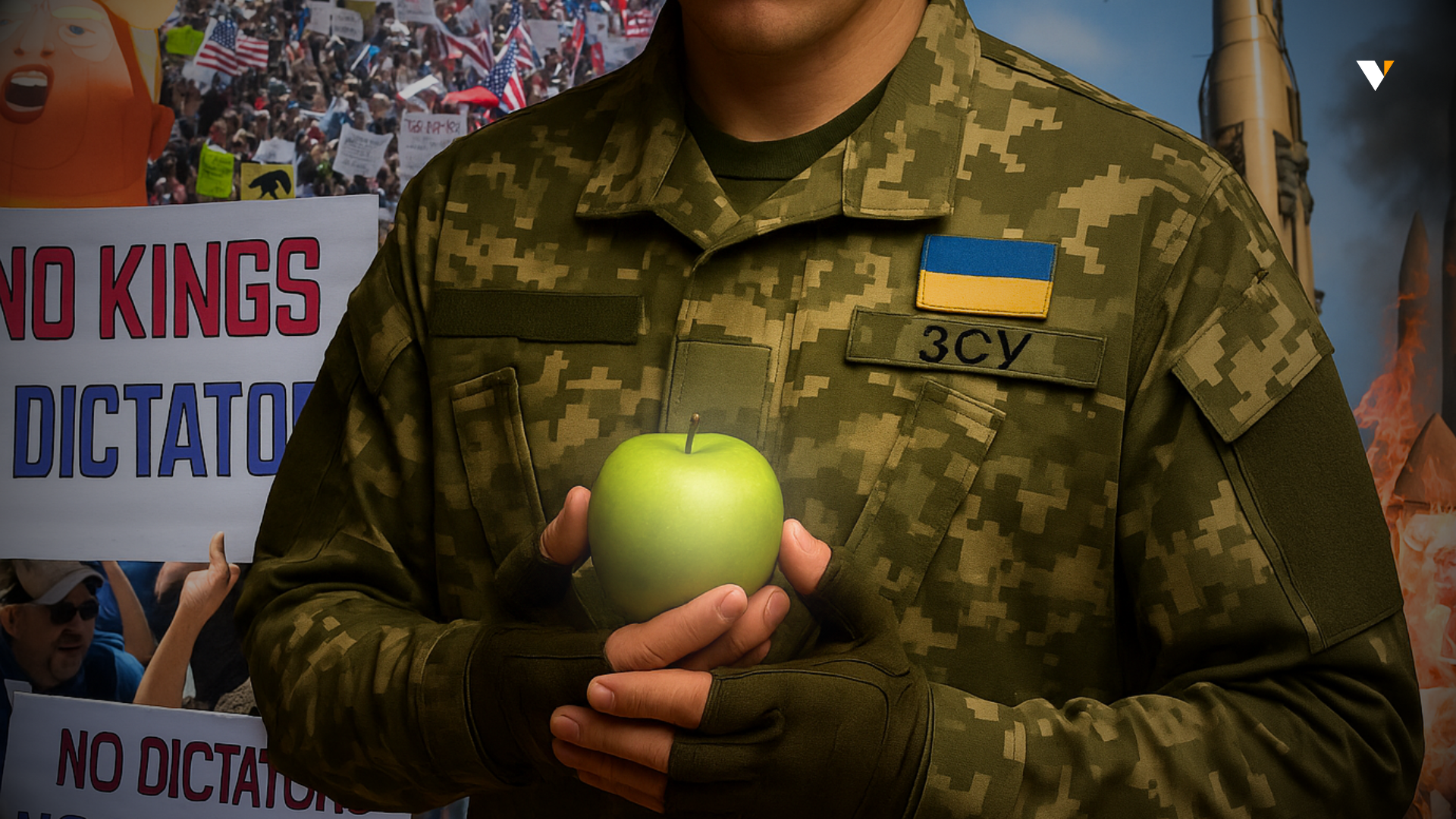
The American political season, coinciding with the onset of summer, reveals a dangerous concentration of domestic upheavals: massive “No Kings” rallies alongside a military parade in Washington created a sharp—and television-spectacular—dichotomy between popular protests and imperial rituals. While ICE immigration raids in Los Angeles and San Francisco triggered a wave of arrests, tanks and robotic dogs rolled through the capital in honor of the 250th anniversary of the U.S. Army, and hundreds of demonstrations swept streets across seven time zones. Organizers speak of millions of protesters in nearly two thousand cities; separately, 80 000 people were counted in Philadelphia, more than 60 000 in Houston, and even tiny Livingston, Montana, gathered several hundred participants with placards reading “No Kings”—the new slogan of Americans weary of an authoritarian course.
The unprecedented deployment of 700 Marines under Title 10, together with 4 100 National Guardsmen, forced California to recall images from 1992, even though the Posse Comitatus Act was not formally breached. Protests that might have become a point of dialogue turned into a stress test of the chain of command: federal guardianship over rebellious megacities was practiced live on air. University legal scholars have already called this exercise a rehearsal for the rapid federalization of the National Guard should interstate conflicts intensify. Paradoxically, the more dramatic the picture of chaos in liberal cities, the louder the slogan “Order at any cost” sounds in conservative media—exactly the division White House political consultants aimed to sharpen ahead of the 2026 elections.
The demonstrative parade, capped by a short speech from Donald Trump and fireworks drowned out by “No Kings” chants, only underscored the contrast: against a backdrop of tanks and military bands, the president’s face looked gaunt, as if he suddenly realized that the festive scenery had lost to the living energy of the streets. The first Ipsos poll after Saturday showed that 54 percent of Americans consider the parade “ill-timed,” while 61 percent support the right to peaceful protest. A 20-point gap among independent voters signals a dangerous loss of centrist support. Yet, despite critical headlines, the information space filled with scenes of domestic conflict rather than war news from Avdiivka or Bakhmut.
The more television channels and social-media feeds revolve around whether the federal government can deploy troops to “disobedient” states, the fewer minutes of airtime remain for Ukraine. A 28 percent drop in prime-time mentions of the war over the past month is already visible in Pew Research reports. This is an alarming signal: without constant presence in voters’ minds, even the strongest alliance weakens, and when allocating the budget, Congress responds first to the loud demands of the electorate. Ukraine again finds itself in a shadow cast by Americans absorbed in their own domestic drama.
Meanwhile, the Middle East is erupting once more. The Israeli Air Force’s morning raid, “Operation Rising Lion,” destroyed the upper echelon of Iran’s military leadership and damaged nuclear facilities near Qom. Tehran responded with hundreds of rockets and drones targeting Israeli cities, and both sides openly speak of further escalation. The European Union and Japan call for restraint, but in Washington—preoccupied with internal turbulence—only cautious statements about “the inadmissibility of a nuclear scenario” can be heard. RAND analysts already describe this as a diplomatic failure: the administration has allowed simultaneous escalation in Israel and a loss of focus on Ukraine, creating a double collision for its own foreign policy.
East of the fallout from the parade and the rocket barrages, Ukraine keeps knocking bricks out of Russia’s military-economic façade. A drone strike on the air base in Chelyabinsk disabled up to 10 percent of Russia’s strategic bombers, and Moscow responded by sharply tightening controls on Chinese cargos moving through Kazakhstan. Kilometre-long lines of sealed trucks now clog Siberian highways: the Kremlin is hunting for “Trojan drones,” but in practice it is strangling its own imports of critical components. One German general, commenting on the strike, remarked that “a single drone sortie slowed Russia’s bomber force more than a month of sanctions.”
The external blow is reinforced by internal fissures. In eleven of Russia’s largest cities, unsold apartments have flooded the market: in Nizhny Novgorod only 36 percent of new builds have found owners, in Krasnoyarsk just 32 percent. Meanwhile, over three years, veterinary services have risen 70 percent in price because of a shortage of Western medicines, and global brands such as McDonald’s and Coca-Cola have officially refused to return even after 2026 despite rumors about trademark registrations. Construction sites without buyers, pricier dog vaccines and the absence of Coke at the kiosk may seem like trifles, yet together they form a broad picture of an economy being slowly suffocated.
On the external front the Kremlin is desperately trading away the last things it still values. The offer to grant India the source code of the Su-57E fighter—an unprecedented gesture in any arms deal—signals a deep technological crisis. At the same time, Russian envoys have already struck a deal with Pyongyang to start producing Shahed drones on North Korean soil. This is not only an attempt to close gaps in Russia’s own defense industry but also a direct escalation of risks for South Korea and Japan, which now find a factory of kamikaze drones on their doorstep.
Put these puzzle pieces together—the American domestic split, the Iranian-Israeli escalation, Russia’s economic agony and a North Korean drone bunker—and the picture looks like a global “reset operation,” in which every authoritarian leader exploits a neighbor’s crisis to strengthen his own power. World capitals react like jackhammers pounding in different directions yet never in sync. The greatest danger is that democratic societies, paralyzed by internal polarization, lose strategic focus precisely when autocracies are learning to act in concert.
Even so, Ukraine’s daily reality remains a counterpoint to global pessimism. In Kharkiv, summer terraces open to the sound of air-defense guns; in Lviv, a children’s art festival takes place; in Chernihiv, a pair of newlyweds exchange rings in a shelter during an air-raid alert. Statistics from the State Civil Registry Service show that in the first five months of 2025 more than 105 000 children were born in Ukraine—only eight percent fewer than before the full-scale invasion. Life blooming under shelling may be the most convincing advertisement for the value of freedom.
One emblem of such resilience is the story of Dmytro Shapovalov from Vinnytsia oblast. After returning from captivity in April 2023 he bit into a green apple on camera and quietly said, “I dreamed about it for a whole year.” Last week Dmytro’s heart stopped during a combat mission, and his comrades placed that very kind of apple on his coffin—the fruit weighed more than any general’s medal. The story of this soldier reminds the world that today our dreams of the simple and ordinary are won at the price of life.
Ukrainians—both those under fire and those building businesses in California and Chicago—offer American society a lesson in fidelity to values: when the world is burning, the defense of freedom cannot be a secondary column in the news grid. If Washington’s attention drifts exclusively to domestic dramas, Kyiv will feel it at the front tomorrow, and Moscow and Tehran will read the silence as an invitation to further experiments with the West’s weakness.
Yet the decisive choice still belongs to Americans themselves. Today, in the city named after the man who once united the nation, the legendary Oval Office is occupied by a leader who now divides Americans, sorting them into “right” and “wrong.” Whether the nation that coined the phrase “We the People” will reject a new monarchical temptation and regain its standing as the chief pillar of freedom is a question not only for the United States but for a whole world in which Ukrainian children are born in bomb shelters and democratic values are tested for strength every day. On the answer depends whether the twenty-first century becomes an era of new authoritarian kings or a time when nations, united, defend the most precious thing—the right to freedom.
