


The National Mall is usually an expanse of open lawns stretching between the U.S. Capitol, the Washington Monument and the Smithsonian museums. But through the trees, it feels as if words are hanging in the air: Putin has abducted 20,000 Ukrainian children. Bring the children home.
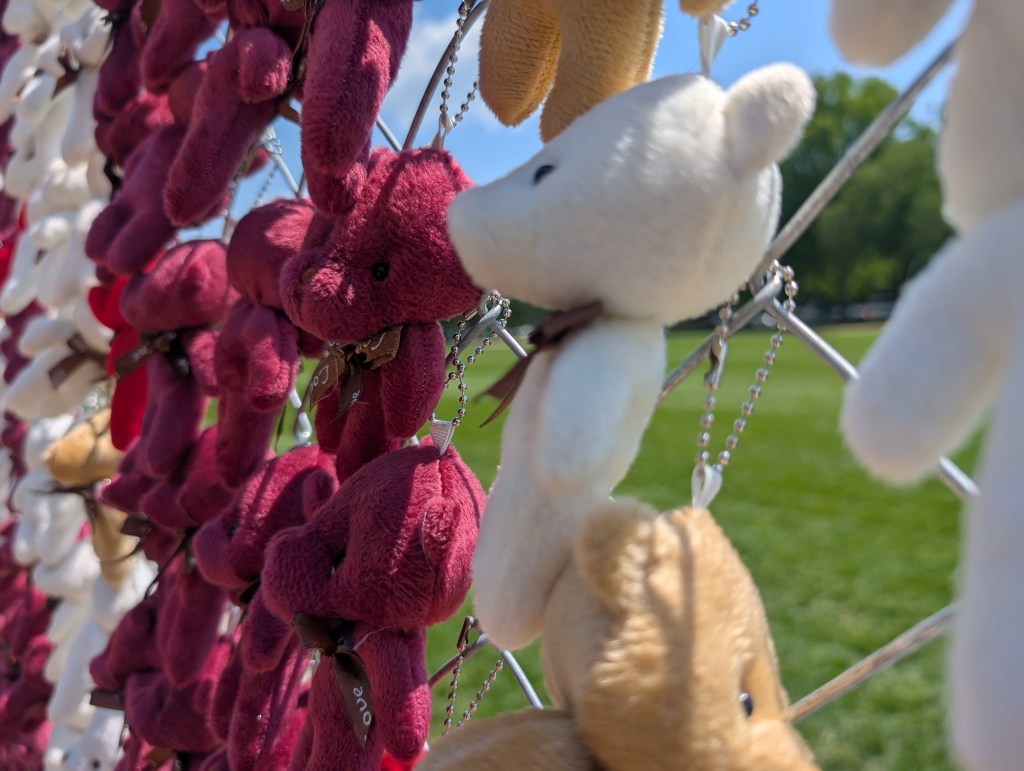
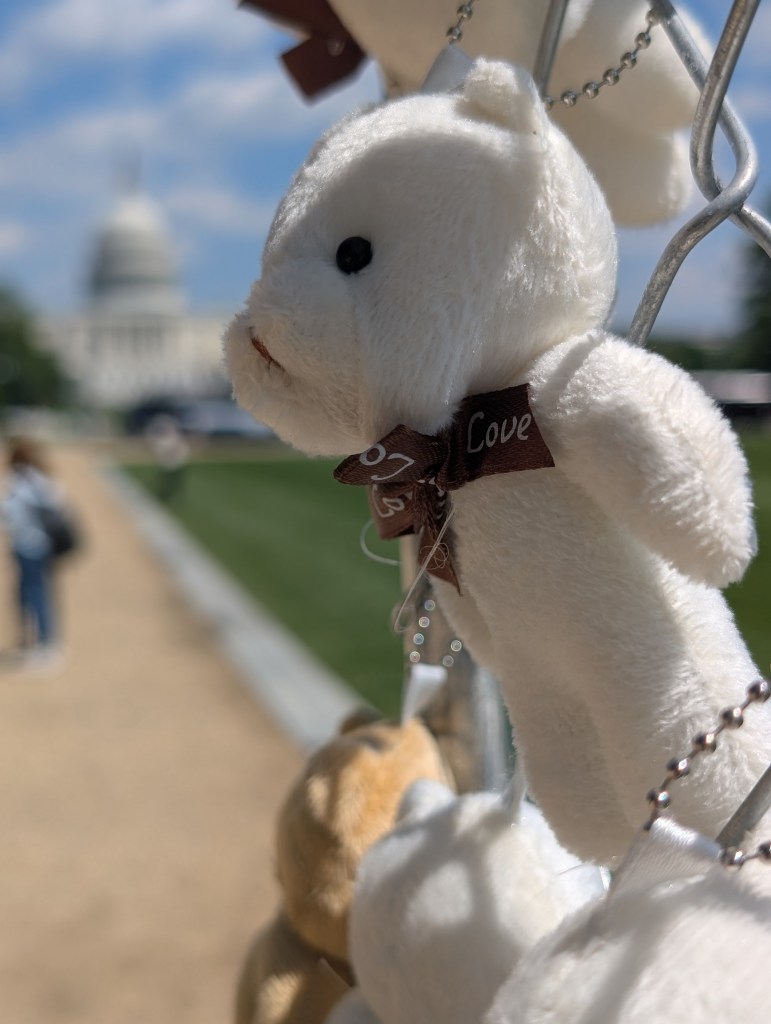
In reality, the words take shape through a striking visual: 20,000 small teddy bears, each carefully fixed to a custom-built structure, forming a message that is impossible to ignore.

What might read as a statistic elsewhere, here becomes an image. The teddy bear - a universal symbol of childhood, takes on an entirely different meaning in this context: a silent witness to war.

Razom for Ukraine organized the installation in partnership with the American Coalition for Ukraine, United Help Ukraine, the St. Gabriel Institute and the Ukrainian Catholic National Shrine of the Holy Family. Their aim is to draw attention to the fate of Ukrainian children abducted by Russia. Katya Pavlevych, a policy adviser at Razom for Ukraine, said that the return of stolen children is a sensitive matter and publicizing details about children who remain missing can endanger rescue efforts. So activists opted for a symbolic approach - one that allows them to speak about the tragedy without putting the children themselves at risk.
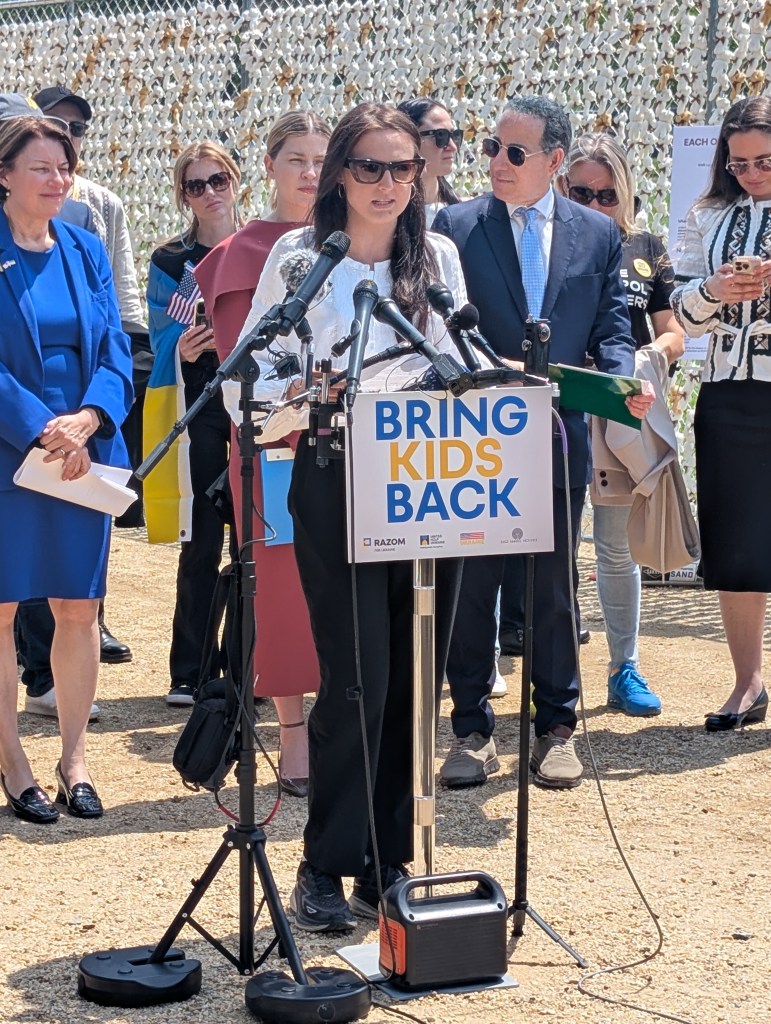
“We are here to draw attention to Ukrainian children,” she said. “Advocacy community has been struggling with the abduction of Ukrainian children trying to help people understand that this is the largest case of missing children since World War II. That's why we chose a teddy bear, a universal symbol of childhood. Each teddy bear represents one child abducted by Russia, and there are 20,000 of them behind me.”
The figure reflects documented cases cited by the Ukrainian government. The true number of children abducted by Russia could be significantly higher. According to Katya Pavlevych, the focus should also extend to the estimated 1.6 million Ukrainian children living in temporarily occupied territories, where they face violence, so-called “re-education,” ideological indoctrination and militarization.
Ukraine’s ambassador to the United States, Olga Stefanishyna, said:
“Since the beginning of the war, Ukraine has returned more than 2,000 kids already. So, 2,000 living witnesses said they were learning to forget their identity. They were learning to forget their names.”

The Yale Humanitarian Research Lab said in a report that two Russian energy companies - Gazprom and Rosneft may have helped finance a network of camps and programs tied to the deportation and so-called “re-education” of Ukrainian children. The report identifies 2,158 children from Ukraine between 2022 and 2025. Organizers said the findings highlight the need to maintain U.S. sanctions on Russian oil companies, arguing that energy revenues are helping sustain what they describe as a coordinated system of child abductions.
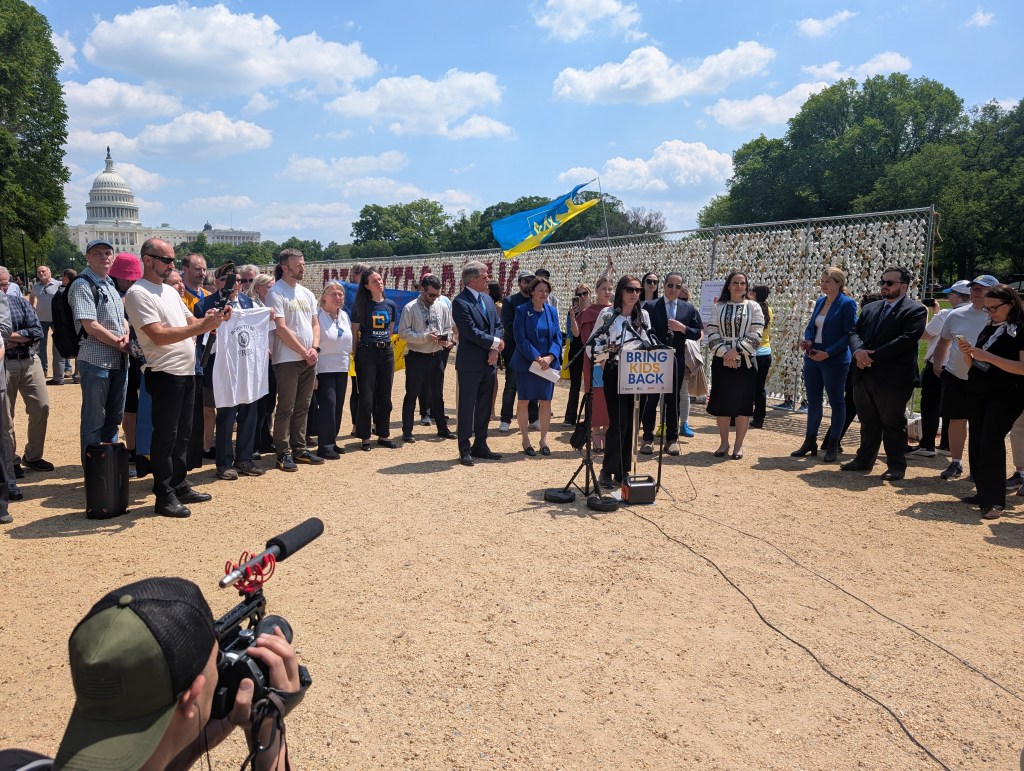
Katya Pavlevych thanked U.S. authorities for steps already taken and urged continued support to help secure the return of Ukrainian children, saying the effort will not advance without sustained political and financial pressure.
“We are grateful to the State Department, the Congress, and the first lady, Melania Trump, for their efforts that they made to help return these children,” she said. “We ask for continued financial and political support in the matter. Make no mistake about it, Putin is not going to return children willingly, and we must use all available means to bring them home.”

Ukraine’s ambassador to the United States, Olga Stefanishyna said she previously oversaw efforts to build a system for collecting data on abducted Ukrainian children while serving as Ukraine’s justice minister.
“This is so important because, thanks to these efforts and because these crimes are being witnessed and documented, no one dares to question the abduction of these children,” she said. “They remain in captivity every day, calling themselves by different names, referring to others as their families, and some who were taken more than four years ago may no longer remember their parents.”
Organizers and Ukraine’s ambassador urged Congress not to lose focus on the issue of Ukrainian children. And a strong turnout of lawmakers underscored bipartisan support.

Sen. Amy Klobuchar (D-Minn.) is a co-sponsor of bipartisan U.S. legislation aimed at expanding efforts to locate and return Ukrainian children forcibly transferred by Russia.

Following legislative initiatives in Congress and sustained advocacy by Ukrainian organizations, the U.S. State Department announced $25 million in funding for programs aimed at returning the children and supporting their rehabilitation, in coordination with Congress. Previous grants were also awarded to the Yale Humanitarian Research Lab, which identified the involvement of Russian oil companies in the abduction of Ukrainian children.
Amy Klobuchar spoke about her conversations with Ukrainians: “I met four teenagers who had been in captivity, taken from battlefields, taken from towns that have been blown out,” she said. “Kids that had lost both their parents, kids that were somehow able in Russia, in schools to get cell phones, behind closed doors, and call what seemed inevitably to their grandmothers. Relatives would cross enemy lines, get those kids, bring them back.”
Sen. Richard Blumenthal (D-Conn.) has visited Ukraine 10 times since the start of the full-scale invasion and has personally met with children abducted by Russia.
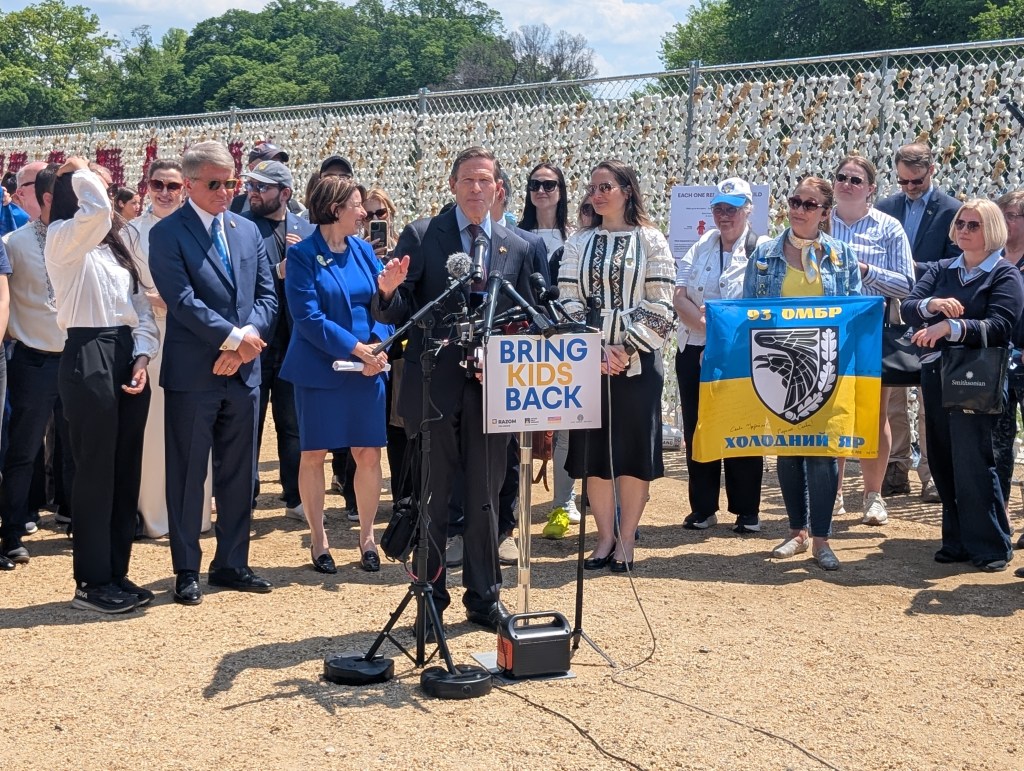
“What I saw in the eyes of those children,” he said. “Who were kidnapped by Russian forces, abducted from their homes, said to be orphans, only because the Russians killed their parents, is the relief of return, but also the grief of the torture, emotional burdens that they will have throughout their lives what Putin is doing to tens of thousands of children - more than 20,000 - is a war crime.”
Sen. Richard Blumenthal (D-Conn.) said he is working on bipartisan legislation in Congress that would designate Vladimir Putin a war criminal if he does not immediately return the children. He added that on his next visit — his 11th — he plans to bring a teddy bear from the installation.

Rep. Michael McCaul (R-Texas) drew a historical parallel during his remarks, saying that the last time child abductions occurred on such a scale was during World War II, when Nazis deported Polish children. He said the return of Ukrainian children must be an essential part of any peace agreement.

“I introduced a resolution calling for a cease-fire agreement to include the return of these abducted children,” he said. “I've also introduced a bipartisan drop back that the senators joined with us that requires targeted sanctions on anyone dealing in Russian oil. We have to have consequences for bad behavior and the sanctions will provide that. I also call upon full implementation of the REPO Act that I passed that calls for Russian sanctioned assets to pay for the very war that they started. Make Russia pay for their war crimes.”
Rep. Michael McCaul (R-Texas) said Russia appears to be deliberately trying to reshape the identity of abducted Ukrainian children as part of a long-term strategy. He said the effort goes beyond the current war in Ukraine, reflecting broader ambitions that could extend further, including preparation for a potential war with NATO.
Rep. Jamie Raskin (D-Md.) said the abduction of children during armed conflict is a grave violation of international law and should be treated as a war crime. He added that when carried out intentionally to destroy or subjugate a nation, such actions can serve as evidence of genocide, as they are aimed at undermining the future of an entire people.

Rep. Jamie Raskin (D-Md.) sought to convey the emotional dimension of the tragedy through personal experience.
“I was thinking about the one time our three kids lobbied us to go to Disney World”, he said. “We were at dinner and suddenly one of them got lost. And for about 10 or maybe 12 minutes, we could not find our child. I can remember those 10 or 12 minutes like it happened yesterday. It was so painful, terrifying, and so scary. I cannot imagine what the moms and dads and uncles, and aunts, and grandparents, and siblings must feel like in Ukraine. We must share their anguish and their pain. We must get those kids back.”
Among the organizers was the American Coalition for Ukraine. Marianna Tretiak, Chair of the Board of the ACU, said the issue of abducted Ukrainian children emerged as a central focus of the Ukraine Action Summit, which concluded a day earlier. Over two days, summit delegates held 437 meetings with members of Congress, and the issue was raised in nearly every conversation.

“Next to me here on this wall, you see teddy bears,” she said. “They are a symbol of childhood innocence, the very thing that makes a child feel safe when they're scared. But each of these teddy bears represents a child who has had not only had their innocence stolen from them, but their very identity. Russia has kidnapped tens of thousands of Ukrainian children, separated them from their families, and erased their names, their language, and their identities. This is not a side effect of war, it is a deliberate strategy of cultural annihilation. We came to Capitol Hill this week with one clear message. Their return is non-negotiable. We call upon Congress to maintain pressure, to fund accountability mechanisms and to stand firmly behind every diplomatic effort to bring these children back to Ukraine”.

Among those who stopped by the installation was Washington, DC resident George Lentz, who came across it by chance while riding his bicycle. He said he has followed developments in Ukraine since the early days of the full-scale war but has recently noticed that interest among his friends has begun to fade.

He said the length of the war and competing global events, including escalating tensions in the Middle East have shifted Americans’ attention elsewhere. At the same time, he said, symbolic displays like this one can help refocus public attention.
“This is a very powerful symbol. Americans respond to visual messages like this, they help people grasp the scale,” Lentz said. “I’ll show these photos to my friends to remind them: Ukrainians are fighting not only for themselves, but for shared values. They are standing up to America’s adversaries and, in effect, defending Europe.”
Steve Ernst of California said he had come to Washington to visit Congress and museums but stopped at the installation on the National Mall along the way. He said he has long followed the war in Ukraine and supports Ukrainian organizations financially.
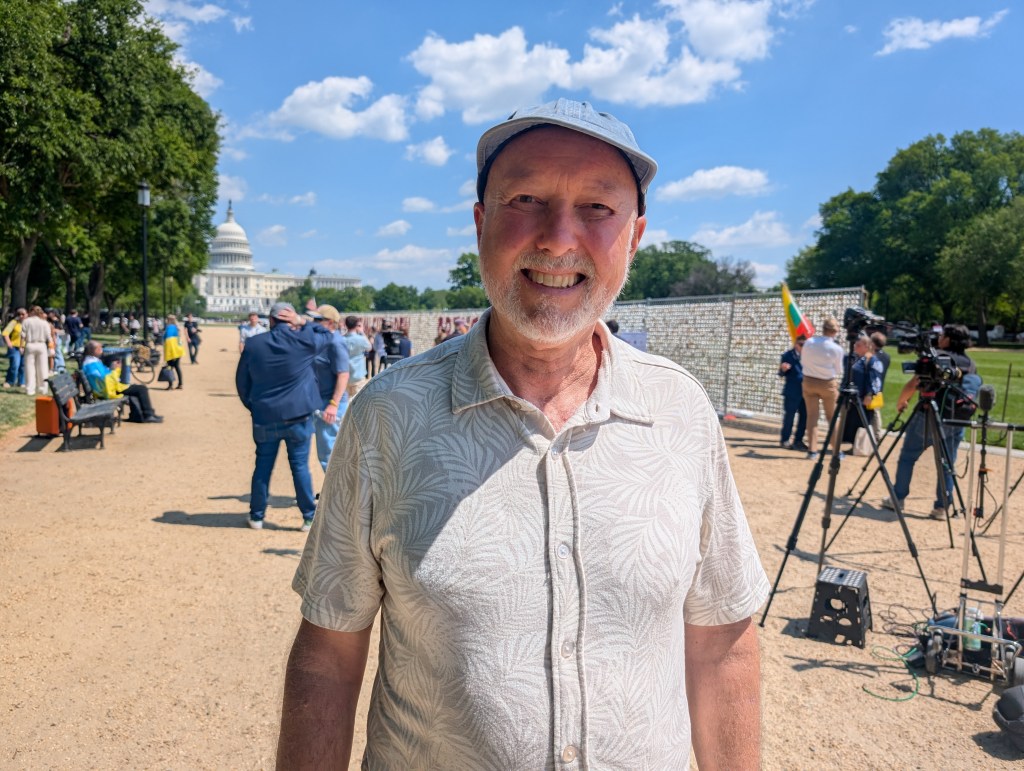
Ernst said the issue also resonates on a personal level: his parents were once forced to leave Germany due to persecution under the Nazi regime. That experience, he said, helps him understand what Ukrainians are fighting for today.
“I’ve donated to Ukrainian organizations and try to keep up with what’s happening,” Ernst said. “My family has its own history of fleeing persecution, so I feel a connection to this story. Ukrainians are fighting for freedom, and that’s something that cannot be ignored.”
Participants said public support for Ukraine remains especially important as the White House administration scales back assistance. Sometimes no words are needed: one passerby walked by the installation carrying an upside-down American flag.

The inverted flag is widely seen as a symbol of protest, a sign that the person believes the country is “in distress.”
The 20,000 teddy bears representing Ukrainian children abducted by Russia are the result of a collective effort by about 100 volunteers who prepared the installation.

They brought the toys, arranged them and secured them to a specially built structure, transforming the space into a powerful visual message.
All of it serves as a reminder: the war will not be over until every Ukrainian child is brought home.
Author: Andrew Getman
