


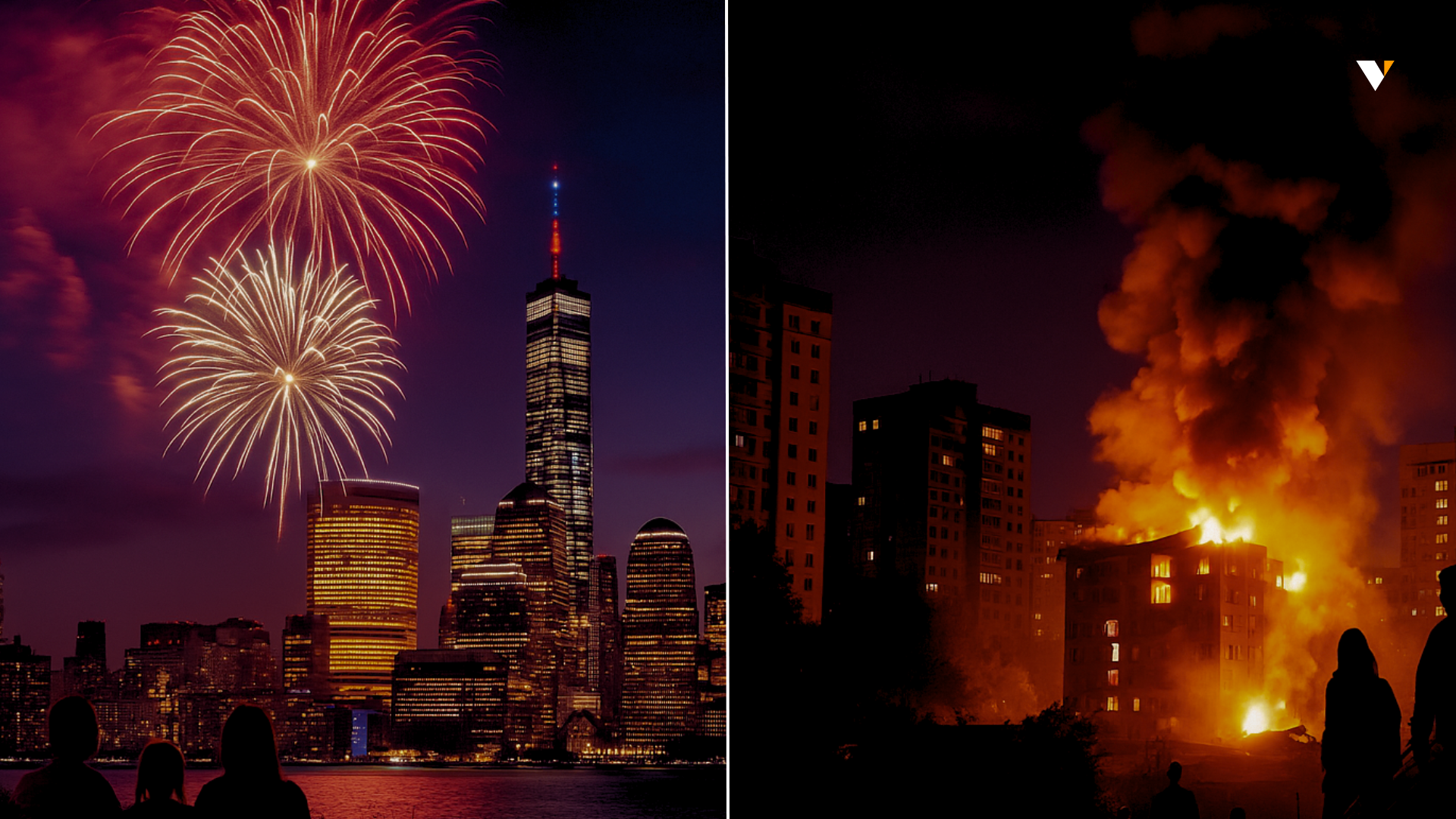
This year the United States celebrated the Fourth of July far more quietly than even last year. The scale normally associated with Independence Day in ordinary households, in some places, faded almost completely. Indeed, surveys show that most Americans admitted to more modest celebrations: inflation, fire-safety bans on fireworks across many regions, and a heightened sense of general anxiety made loud salutes seem inappropriate. At the very same time, air-defense sirens were wailing in Kyiv and other Ukrainian cities, and Russian missiles and drones kept taking lives. The contrast between cautious festivities in the United States and the daily war in Ukraine laid bare the central question: can Washington’s politics rise to a historic challenge when the freedom of one nation is under attack and the legitimacy of the international order hangs by a thread?
Americans have plenty of reasons to worry, and those reasons directly shape the prospects of Ukraine’s resistance. First, debate over the “hellish sanctions” against Russia—bill S.1241—has entered its final phase: the draft law calls for 500-percent tariffs on buyers of Russian oil and a full blockade of Russian sovereign debt. Donald Trump has voiced support for the initiative yet has reserved the right to soften the harshest provisions at the signing stage. Postponing the vote until the Senate returns after 7 July looks like foot-dragging, while every day costs Ukrainian lives.
Simultaneously the media space was shaken by Elon Musk’s announcement of the “America Party.” Formal registration of the new force requires almost 1.5 million signatures and tens of millions of dollars, but even now the idea is splitting the electorate: Trump called the plan “ridiculous,” investors punished Tesla with a five-percent slide, and political analysts warned of siphoning Republican votes. For Ukraine this means even greater uncertainty: the less internal consensus in the United States, the harder it is to marshal resources on the external front.
The stance of outside players is illustrated by a striking CNN report: during a four-hour meeting with the EU’s top diplomat, Chinese Foreign Minister Wang Yi stated bluntly that Beijing “cannot allow Russia to lose,” otherwise the United States would “turn all its attention to China.” Behind declarations of “neutrality,” China is openly interested in prolonging the war, with Ukraine serving as a buffer against U.S. pressure in Asia. The message is clear: helping Kyiv is not merely a moral duty but a strategic tool for preserving global balance.
Meanwhile an editorial in the New York Post—a paper Donald Trump reads closely—issued a direct appeal urging the president not to turn away from Ukraine, calling Russia a “dying terrorist state” and warning that a Kremlin victory would destabilize Europe, embolden China, and stain the U.S. administration. Such rhetoric shows that even the “hawks” within the Republican Party understand the strategic stakes; nevertheless, the political process is still stalling.
Economic figures sharpen the picture. According to the U.S. Census Bureau, in May imports of Russian goods into the United States jumped to $540 million—the highest since March 2023. Yet that amounts to only one-tenth of Moscow’s daily war budget. Any new sanctions package would erase even this symbolic flow, underscoring that Western economic levers remain underused and the “window of opportunity” has not shut.
From the Ukrainian side, encouragingly, the requests are precise and well reasoned. President Zelensky called his telephone conversation with Donald Trump “the most productive ever”: the main topic was the delivery of additional Patriot batteries, without which Russia’s aerial terror cannot be stopped. Yet decision-making in Washington has wavered for a third month between budget constraints, internal quarrels, and preparations for the 2026 mid-term elections.
Against this backdrop, front-line statistics are painful to recite alongside American holiday numbers. Over the past week Russia fired a record number of kamikaze drones at Ukraine, and the shelling of Kyiv on 4 July coincided with fireworks preparations in the United States, forcing residents of the capital to seek shelter for the second time that day. Inside the aggressor state there is no sign of restraint: Russia’s economy is mobilized, society is demoralized, and casualties are replenished through forced recruitment and support from Iran and North Korea. Beijing, according to Ukraine’s Foreign Ministry, also figures in supplying drone components via third countries.
For Ukrainians in the United States the situation feels ambiguous. On the one hand, America’s media landscape clearly signals that supporting Ukraine is already a matter of U.S. security and global leadership. On the other hand, the political machinery resembles a slow locomotive: every new law or aid bill passes through a gauntlet of financial and electoral filters. Ordinary people sense the danger—hence fewer fireworks and more anxious kitchen conversations in California or Texas, where a flood recently claimed dozens of lives, once again revealing the vulnerability of large systems. Yet that very anxiety can serve as a catalyst: in congressional offices it is easier to justify spending on an ally’s weapons when citizens already grasp the fragility of “normal” life.
The main task for our community, therefore, is to keep Congress’s attention. First, sustained pressure is needed so that the sanctions bill S.1241 is not diluted by amendments. Second, we must explain to American friends that every Patriot battery protects not a “far-off city” but the very rules by which the free world lives. Third, the Chinese factor demands close monitoring: Wang Yi’s remarks about the undesirability of Russia’s defeat mean that the stakes extend beyond the Donbas or Crimea to the balance of power from the Baltic to the Taiwan Strait.
Russia’s war has already become the greatest test of the international system since World War II, and that reality is felt in American homes. When the evening sky over San Francisco—like the skies over thousands of other cities—remained dark on the holiday of freedom, many people realized for the first time that a fireworks display is not merely a colorful finale but a symbol of national confidence. While that symbol flickers more weakly than usual, we must use the pause to turn moral support into concrete votes, budgets, and sanctions, because every hour lost in Washington translates into lives lost in Eastern Europe. And if the world has not experienced such anxiety since 1945, the memory of that war offers the prescription: delay only increases the price of victory.
About Author:
