


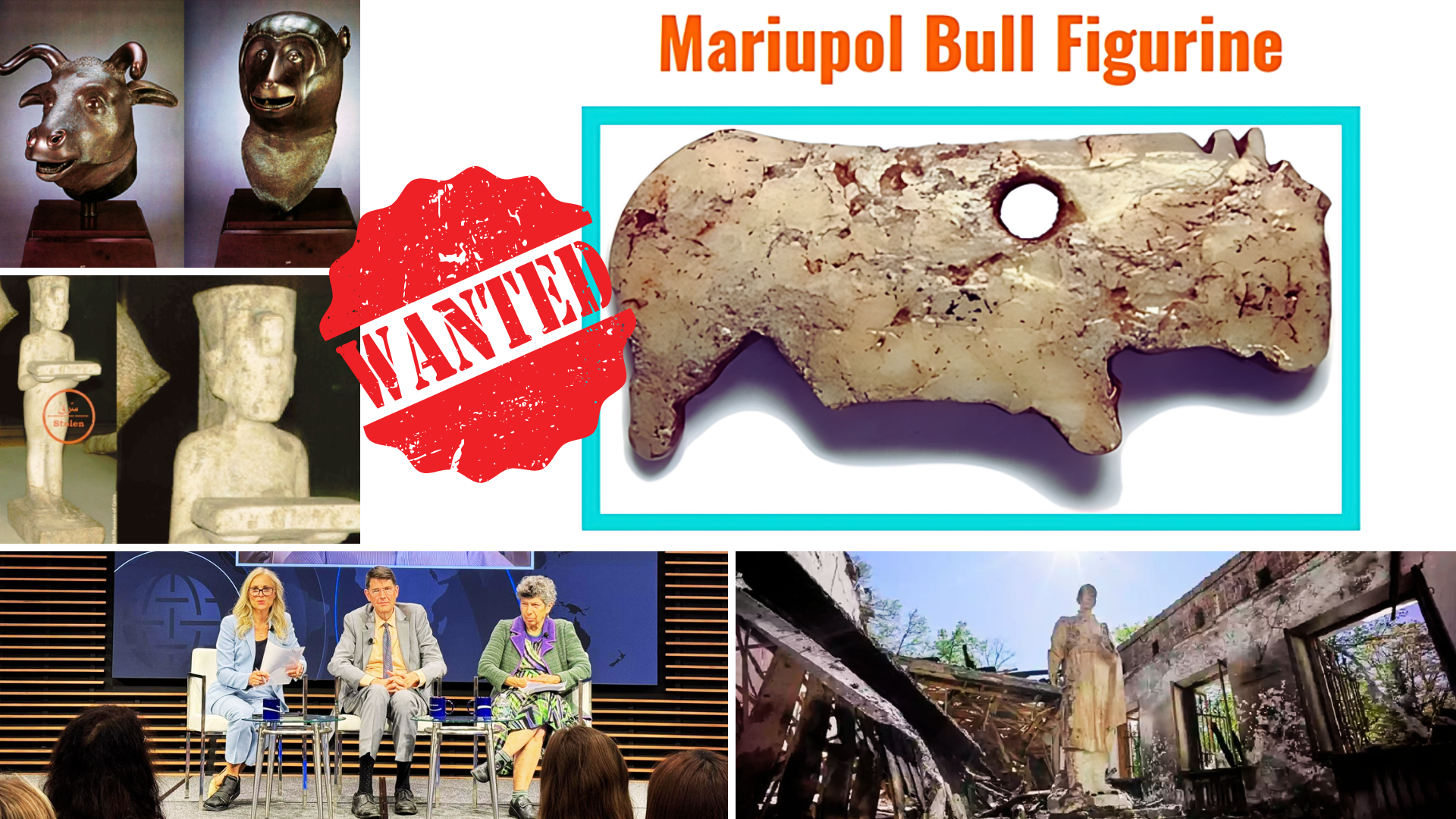
In the U.S. capital, a panel discussion titled Examining Russia’s Assault on Ukraine’s Cultural Heritage, organized by the Atlantic Council in partnership with The Antiquities Coalition, brought together diplomats, scholars, cultural heritage experts, and human rights advocates. The participants examined Russia’s systemic attacks on Ukrainian culture and explored ways for international cooperation to preserve it.
Opening the discussion, John Herbst, Senior Director of the Atlantic Council’s Eurasia Center, emphasized that the destruction of Ukrainian culture is not an accidental consequence of hostilities, but a deliberate part of the Kremlin’s strategy.
“The attack on Ukrainian artists and culture is a fundamental part of the invasion. It is part of the effort to erase Ukrainian national identity, which contradicts the Kremlin ‘führer’s’ view of history,” he said.
Ukraine’s Ambassador to the United States, Oksana Markarova, stressed that attacks on cultural heritage have been one of the main reasons behind Russian aggression since 2014.
Markarova reported that more than 2,000 exhibits were stolen from the Mariupol Local History Museum alone after the 2022 occupation. Among them is a unique bull figurine from the 6th millennium BCE, discovered by archaeologist Mykola Makarenko. This artifact became the first Ukrainian object to be included in The Antiquities Coalition’s Ten Most Wanted Antiquities list.
According to Ukrainian authorities, at least 35,000 museum items have been stolen from the temporarily occupied territories. More than 1,300 cultural infrastructure sites have been damaged or destroyed, including the Mariupol Drama Theater, libraries, and UNESCO World Heritage sites such as Saint Sophia Cathedral in Kyiv.
Chair of The Antiquities Coalition Deborah Lehr called the Mariupol figurine a symbol of Russia’s broader campaign to destroy and rewrite history:
“This is not only about destruction. It is about control — using artifacts to rewrite history and erase identity.”
She noted that including an object on the Most Wanted list is a call to action, and that international cooperation has repeatedly succeeded in returning cultural treasures.
First Deputy Minister of Culture and Information Policy of Ukraine, Halyna Hryhorenko, emphasized that protecting cultural heritage cannot be postponed until the war ends: “This is a war for the survival of Ukrainian society. Cultural heritage is the core of our identity and our motivation to live. Recovery is happening today.” She said that Ukraine is actively documenting crimes against culture, cooperating with law enforcement and international organizations, imposing sanctions on Russian museum officials involved in looting, and creating the International Cultural Heritage Fund of Ukraine to coordinate assistance.
Brian Daniels, Director of Programs at the Penn Cultural Heritage Center, spoke about the unique combination of analytics, satellite imagery, and on-the-ground documentation in Ukraine: “We are seeing unprecedented destruction — especially of libraries, which is an attempt to destroy the Ukrainian language. But we also see the extraordinary dedication of Ukrainians to their culture.”
Professor Louise Shelley, Director of the Terrorism, Transnational Crime and Corruption Center at George Mason University, highlighted the links between cultural looting, organized crime, and terrorism: “This is a dual crime: it not only generates profit, but also destroys social solidarity and undermines the future of society.”
She called for engaging a wide range of volunteers and specialists in the search for stolen objects, using artificial intelligence and online monitoring.
According to Hryhorenko, the European Union currently provides Ukraine with packing materials, equipment for storing evacuated collections, and temporary storage facilities abroad. As of today, more than 630,000 museum items have been evacuated. Digitization of collections and registers of immovable heritage is also underway, forming the basis for future legal claims and the return of stolen exhibits.
Writer and founder of the Monuments Men and Women Foundation, Robert Edsel, recalled that after World War II, the USSR massively removed cultural property from Germany, while the Western Allies returned it to its owners: “We must demand a full accounting of what was stolen or destroyed, and the restoration of justice. This is our shared cultural heritage, and without it the world will be poorer,” he said, adding that only by uniting countries and people of goodwill can we ensure that Ukraine’s cultural heritage not only survives, but is restored after the war.
This discussion in Washington was not only a record of losses, but also a signal to the world: the attack on Ukrainian culture is a challenge to all of civilization, and its protection requires an immediate, coordinated, and global response.
Author: Diana Khudko