


In 1980, Moscow hosted the Olympic Games, but the preparations for them were accompanied by a powerful wave of international opposition. The world community boycotted the holding of the games in an authoritarian state that represses its own citizens and takes aggressive actions against other countries - the escalation of Afghanistan. The most active supporters of the boycott were Ukrainians in the United States and Canada. For the diaspora, this was not only a political position, but also a moral obligation - a protest against imperial oppression and Soviet crimes.
This was reported by Oleksiy Lyakh-Porodko.
The world Ukrainian community, which had suffered for centuries in imperial and communist captivity, took a principled position regarding the Olympics in Moscow. The initiative to boycott the Games was first put forward by political representatives of the United States and Canada. Ukrainians in North America enthusiastically supported the call of the US President, although among the Americans and Canadians there were also those who considered the boycott wrong.
Immediately after the address of US President Jimmy Carter, the Ukrainian People's Union, represented by its chairman John O. Flis, expressed its full support. The letter to the president read: “Be assured that our members, 87,000, fully support your position on the Olympic Games, as well as on the position of the United States on relations with the USSR… We fully support the economic and political sanctions you have imposed against the Soviet Union.”
A survey published in the magazine “Ukrainian Weekly” recorded the reactions of individual Ukrainians in the United States to the question of the boycott. Lubomyr Zobniw, an engineer from Binghamton, responded:
“I think a boycott is a good thing. If the U.S. team participated, Americans would go to the USSR and spend money there. That would enrich the Soviet treasury. In addition, the Soviets would have a good propaganda tool. Without U.S. participation, the effectiveness of that tool is reduced.”
Magda Kolcio, a trainer from Mendem, said:
“I support the boycott, but I am disappointed that there has been so little cooperation with other European nations on this issue. They must have forgotten that they have a serious enemy on their doorstep and what the Soviet Union is capable of. The world stood by until the Soviet Union invaded Hungary in 1956 and Czechoslovakia in 1968. At least we in the United States will be able to say that Americans did not stand by when the Soviets invaded Afghanistan.”
Andy Mycak, an IT specialist from New York, said:
“I think the President made the right decision to boycott the Olympics. I think it’s an important cause and it will hurt the Soviet Union. As an athlete, I feel for the athletes who have trained and prepared for these games for so long, but I look at it this way – in war, guys give their lives for their country. Now they are being asked to give up their competitiveness for one international sporting event. I don’t think it’s too much to ask.”
Yuri Chernyk, a manager from Atlanta, expressed his opinion:
“I think it’s a good form of protest. As a person, I was outraged by the Soviet invasion of Afghanistan. As a Ukrainian, my outrage against the Soviets was even stronger. I think the Alternative Olympics should be held this year for the benefit of the athletes who will not be participating in the Moscow Olympics.”
Nina Samokish, a New York scholar, added:
“A noble and honest spirit of cooperation among the participants of different nations must permeate the Olympic Games. When this spirit is clearly lacking in the host country, as the blatant Soviet invasion of Afghanistan shows, then it is absolutely right to boycott the games. As further evidence of the lack of the Olympic spirit, the Soviet authorities’ deportation of the families of political prisoners so that tourists would not encounter the dark side of the “worker of paradise.”

The state treasury is growing, as a result of the Olympics, but Soviet citizens are suffering. They now have to stand in long lines for basic food products, as food distribution has been changed to accommodate the influx of tourists to the games. Not to mention the Olympic souvenirs made by political prisoners in Soviet concentration camps. No, that is definitely not the Olympic spirit.”
In Canada, state support for the protest was expressed by prominent politicians of Ukrainian origin, including Senators Paul Yuzyk and Andrew Witer. Senator Yuzyk, speaking before the Senate of Canada on May 6, 1980, positively assessed the government’s decision to boycott the Games and drew attention to the statement of the “Association of Olympic Guarantees in the USSR,” emphasizing the underground nature of this organization’s activities and the persecution of dissidents. Yuzyk stated that the Soviet government had decided “to purge Moscow of dissidents and unreliable people before the Olympics, primarily by arrests, expulsions, exiles, and various provocations.”

Senator Yuzyk also focused on the Soviet authorities’ violations of the Olympic Charter and cited the example of the oppression of Ukrainian athletes: the Papirov brothers, who were excluded from the USSR team at the Winter Olympics in Lake Placid.
During a press conference in Lake Placid, Soviet dissident Nina Strokata-Karavanskaya called on the world not to turn a blind eye to the killings in Afghanistan and to resolutely say “no” to the Olympic Games in Moscow. Concluding his speech, Senator Yuzyk called on the Canadian government to fulfill its obligations to NATO as “the bulwark of freedom and democracy in the world” and stressed the importance of a strong Western alliance.
Address by Andriy Viter, delivered on September 20 before the Speaker of the House of Commons of Canada:
“About 100 Ukrainian athletes are participating in the Olympic Games, which are taking place in Seoul, Korea. They are the pride of their homeland, but none of them will carry the flag of Ukraine. Estonia, Latvia and Lithuania were once participants in the Olympic movement. However, Moscow also denied them independent participation. The Soviet government claims that these countries cannot participate independently, as this would violate the Olympic Charter. However, the IOC President denied this claim, and the Charter itself states that any nation or country that forms its own National Olympic Committee can join the Olympic family. We share the pride in our own Canadian Olympians, and this only highlights the injustice against the wonderful young athletes who were denied the opportunity by Moscow to represent their homeland. I I call on the Canadian government to express an official protest to Soviet officials against this blatant violation of the Olympic Charter and fundamental human rights, and to demand that Lithuania, Latvia, Estonia, and Ukraine take their rightful place in the Olympic family.”
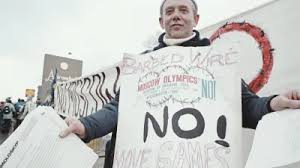
In addition to the US and Canadian diaspora, Soviet dissidents and political prisoners opposed the Games, including Vladimir Bukovsky, Leonid Plyushch, Natalia Gorbanevskaya, Valentin Moroz, Petro Grigorenko, Nadiya Svitlychna, Nina Strokata-Karavanskaya, and others. They appealed to Western countries to dismantle the Soviet repressive machine and boycott the Olympics; in particular, Vladimir Bukovsky called the decision to choose Moscow as the venue for the Games irresponsible because it “sanctioned the irreversibility of repression.”

Some Americans also supported the boycott. Dr. Martin Abend said:
“What should we say when we say to go to the Olympics or not because of Afghanistan. It must also be said that there are no Olympics in the Soviet Union because of inhumanity, especially to Ukrainians.”
In the USSR itself, a resistance movement appeared a few years before the Games. The Ukrainian Information Service “Smoloskyp” reported receiving a samizdat – the Appeal of the “Association of Olympic Guarantors in the USSR”, which was translated into English and on February 15, 1980, handed over to Zbigniew Brzezinski in the White House and to officials of the US State Department.
Also in early 1980, the Ukrainian Main Liberation Council in the USA published an appeal from political prisoners of Mordovia to the participants of the Olympic Games entitled “The Essence of the Regime Remains Unchanged,” authored by Kuznetsov, Ginzburg, Gayauskas, Yevgrafov, Karavansky, Lukyanenko, Murzhenko, Osadchy, Rebryk, Romanyuk, Stepanov, and Shumuk.
Author: Danylo Pievchev