


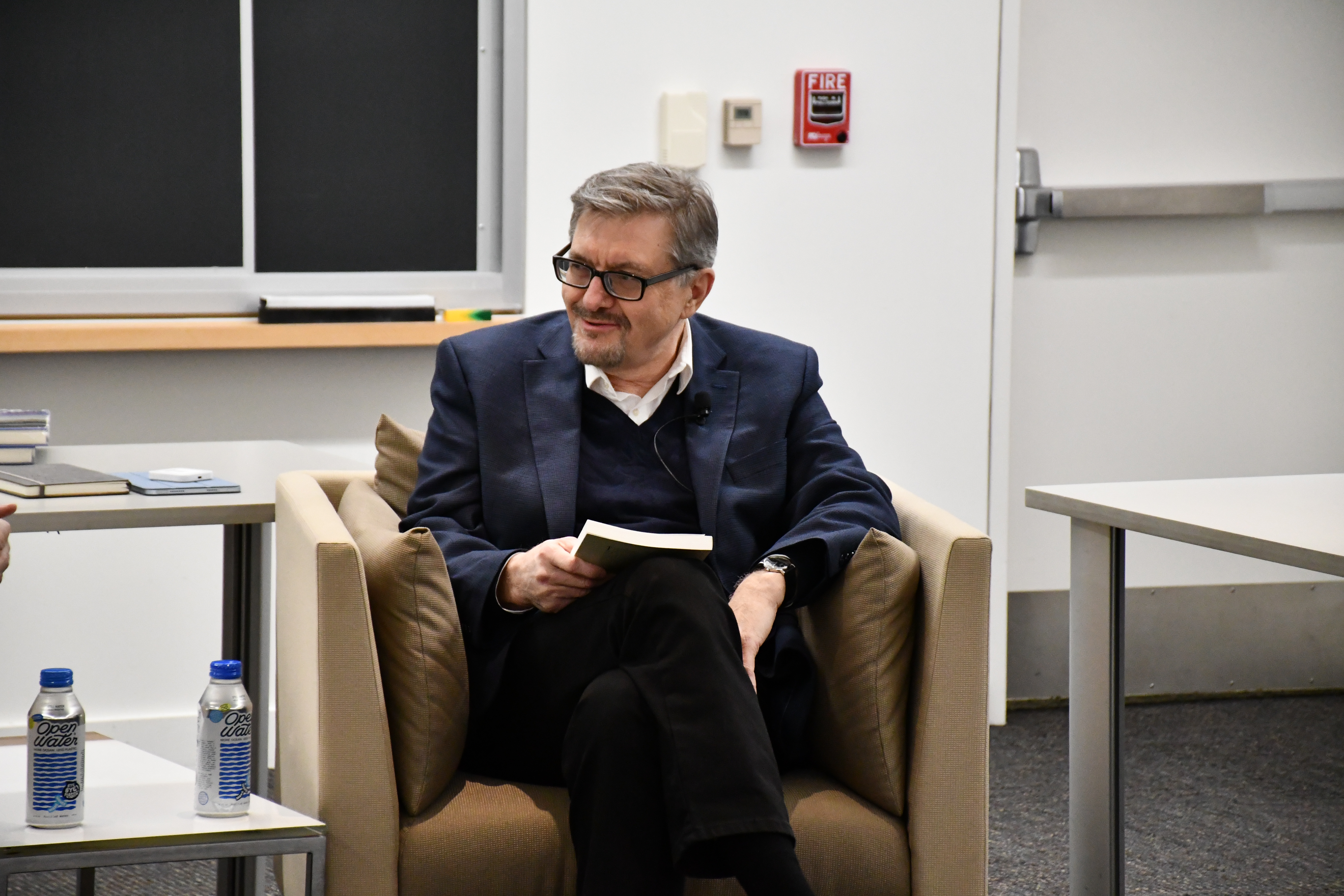
Ukrainian historian and Harvard University professor Serhii Plokhy, in his new book David and Goliath, reflects on the Russian-Ukrainian war through a historical lens — from the imperial myths of the Kremlin to Ukraine’s contemporary resistance. In an interview for Vilni Media, the author speaks about faith as a driving force of victory, explains Russia’s main historical mistake, and reflects on how imperial myths became a weapon — and why Ukraine’s experience of struggle is already changing the global language about empires and colonialism.
— The biblical story of David and Goliath is known to everyone. But in your book it is not just a metaphor, but a way of thinking about the war. When did this analogy stop being an image for you and become an impetus for writing this book?
— The book consists of various interviews, opinion pieces, and commentaries. The idea for the title appeared when all these genre-diverse texts began to come together into a single whole.
In one of the interviews, I compared this war to the clash between David and Goliath. It was in the process of shaping the book that I realized this metaphor probably reflects not just a separate thought, but the central idea of the entire work.
For me, first and foremost, it is about David winning through the power of faith — faith in God, but also, in a broader sense, faith in oneself, faith in victory. Likewise, through strength of will and, speaking in modern terms, technology: he uses a sling. David defeats Goliath not because he is bigger or physically stronger, but because he is smarter.
— You show that history does not merely explain the war, but becomes part of it. In your view, what is Russia’s main historical mistake?
— First and foremost, this is a war that Russia justifies precisely through history. A few months before the invasion, an essay — or rather a pseudo-essay — by Vladimir Putin on the “historical unity of Russians and Ukrainians” was published. It essentially reproduced the Russian imperial ideology of the nineteenth century — the idea of the existence of a “great Russian nation.”
This is an attempt in the twenty-first century to turn the clock back to the nineteenth. Such attempts — whether to restore “Great Russia” or “Greater Germany,” as in Hitler’s time — usually have very low chances of success.
Крім того, Путін пропустив надзвичайно важливий етап The three-day формування сучасної української держави та Moreover, Putin missed an extremely important stage in the formation of the modern Ukrainian state and nation — the period after the annexation of Crimea in 2014. It was then that Ukrainian society realized itself as never before — in conditions of existential crisis and threat to its existence. кризи і загрози своєму існуванню.
— If we continue the biblical analogy, which moment of this story are we living through now: the throwing of the stone, the fall of Goliath, or something more complex?
— The biblical story is quite short. Our war, unfortunately, is already entering its fifth year. I think the moment of the throw has already taken place. But Goliath is still standing. Either we have already hit him, or our stone — which I am convinced will be victorious — is still flying. I think we are somewhere in that moment, if we speak in the language of the biblical metaphor.
— Are there historical examples in the twentieth century or earlier that most resonate with what Ukraine has been experiencing since 2022?
— Yes, there are quite a few such examples. In fact, almost every war of independence in the twentieth century has certain parallels. After the First World War, the Ottoman, Austro-Hungarian, and partially the Russian empires collapsed. After the Second World War, the British and French colonial empires fell apart.
Almost every nation that gained independence in the twentieth century went through war. Perhaps not as prolonged and exhausting, but through war. One can mention Ireland, one can mention Vietnam — there are many examples.
We are not unique in the mere fact of fighting for independence. But our war is one of the most significant in this historical series. And undoubtedly — it is the largest war of the twenty-first century.
— Can it be said that the full-scale invasion is an attempt by Russia to replay the collapse of the USSR?
— To some extent, yes. This is a continuation of the story of imperial collapse. The USSR was a continuation of the Russian Empire, and empires do not disappear in a day or even in a few years — it is a long historical process. Today Russia is trying to restore control over the post-Soviet space. Ukraine is the main obstacle on that path. And what Russia seeks is to restore that control at the expense of Ukrainians. It sees its future only on the condition that Ukrainians do not exist as a separate people.
The USSR at least allowed a semblance of autonomy: “Ukrainian” could be written in one’s passport, the Ukrainian language could be taught in schools. Yes, there was the Holodomor, repression, persecution of dissidents — but there was recognition that Ukrainians existed.
Putin’s “Great Russia,” which he wants to build, envisions something different: in his imagination, its future must arise on the bones of Ukrainians — without Ukrainians themselves.

— Was the short format — essays, interviews, commentaries — a conscious choice? For whom was this book primarily written: the academic reader or the broader public?
— The book was essentially written over four years. It was not created at once as a coherent text. Since most of the interviews were given to Western media or published in the West, the main goal was to influence Western audiences — to shape the framework through which the war is perceived, to inform about what is happening.
Especially in the first days, weeks, and months, it was critically important to outline this framework in a way that would help our allies and the Western public in general treat Ukraine with sympathy and support. Because at the beginning of the war and even today, Ukraine largely depends on Western democracies, where decisions are made through voting.
Now that these materials have been collected into one book, it is an attempt to speak to the Western reader in the long term. But without compromising the academic component — academic integrity and the quality of argumentation for a broader audience — that was an important goal I tried to achieve.
— You said that journalists and interlocutors effectively became co-authors of the book. Can you name a few without whom it would have been different? And did you feel that their questions shaped the direction of the conversation — and ultimately the book itself?
— Yes, I felt it then and feel it now. They helped formulate the questions that were important specifically for Western audiences and to pose them in a way that allowed me to respond clearly for people who perhaps did not know much about Ukraine before — and at the beginning of the war might not even have been able to find it on the map.
I probably would not have managed such a task on my own. My interviewers played an extraordinarily important role. I can mention Isaac Chotiner, who interviewed me for The New Yorker a few days before the full-scale war began. Also the German journalist and historian Katja Hoyer, who grew up in East Germany and has personal and family experience connected to the Soviet Union. As a historian, she has a very fine sense of historical time. Others could be named, but these are the first that come to mind.
— Is there a difference between texts written in the first months of the invasion and those that appeared later? How did your tone change?
— Since the book was created in dialogue, my tone always responded to or was part of the overall atmosphere, which changed along with the war. It shifted from the shock of the first days and weeks to the optimism that came with the first victories around Kyiv and later the Kharkiv operation, the pushing of Russian forces from the right bank of the Dnipro, from Kherson. Then came the gradual realization that this war would last.
The feeling of imminent victory was replaced by the understanding that this is a long-distance run. These stages are reflected in the questions I was asked. The book contains not only my answers, but the questions themselves — and I responded to them within the context of a specific historical moment.
— A review of David and Goliath notes that the book shows how history helps explain Ukraine’s determination and success — both on the battlefield and in the public sphere. To what extent do you agree with that assessment? And what does success mean to you in a war that is still ongoing?
— My analysis is the analysis and viewpoint of a historian. The history of Ukraine’s struggle for independence, in my view, inevitably converges with the present war. One of my tasks was to explain not only to Western audiences, but to some extent to myself, how it happened that a country predicted to fall within days or weeks endured and continues to resist. And I personally am convinced that it is impossible to answer this question without turning to history.
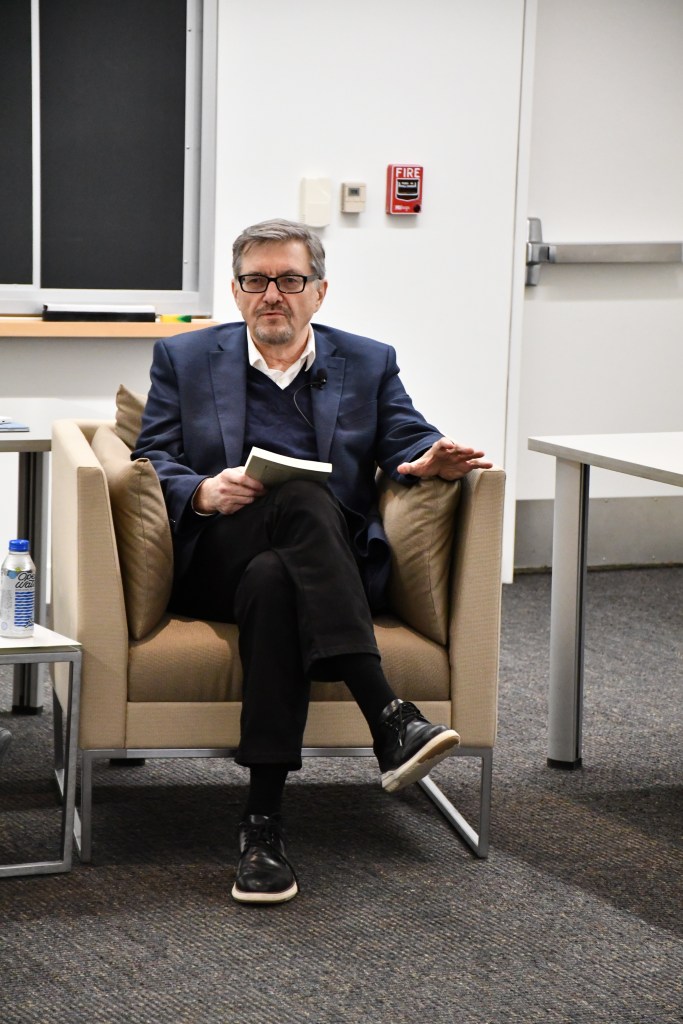
As for success — for me it is first and foremost the preservation of Ukraine’s independence, sovereignty, and subjectivity. If that is preserved, it will already be a victory. Loss of territory is an extremely painful matter. I hope it will not come to that, but history shows that territorial issues are sometimes resolved in the longer term. Almost all our neighbors in Central Europe began the twentieth century as stateless nations: they fought for statehood, fought for territory, lost territories — but if they managed to preserve statehood, history later unfolded in their favor.
— You mention the deep pessimism of February–March 2022 and the optimism of late 2022. As a historian, do you trust cold analysis more, or the intuition of the moment?
— I rely on historical analysis. How “cold” it is is difficult to say. But it helps me avoid emotional extremes, which are very easy to fall into while being in Ukraine and living through this exhausting situation.
There were actually two occasions when respected Ukrainian publications interviewed me and published the interviews with a delay of several months. At the time of recording, my answers seemed too pessimistic. When they were printed later, they were perceived as realistic. Perhaps both the audience and its readiness to accept more complex assessments had changed.
— You speak about your historical optimism regarding Ukraine. What is it based on?
— First and foremost, on historical experience — not only Ukrainian, but global. Empires fall. Independent states arise from their ruins. This applies to Europe, Asia, Africa, Latin America. The fact that Ukraine is fighting and standing means it has extremely good chances of continuing this historical trend, which has been ongoing at least since the American Revolution of the seventeenth century. It was a revolution about uprising, colonies against empire, the victory of the colony and its formation into a successful, in fact global state, as in the case of the United States of America.
— The book is published in the series of the Harvard Ukrainian Research Institute. In your view, what is still most misunderstood in the West about this war?
— It seems to me that it is not fully understood that concessions to an aggressor lead only to greater aggression. Various justifications are constantly found — why not to support Ukraine, why not to take a clear position. But there is no full awareness that aggression also reaches those who allow it to develop. The appetite of the aggressor only grows.
In my view, this is one of the main problems of contemporary Western perceptions of the war in Ukraine and its global consequences.
— Do you feel that over these years Ukraine has changed not only its own history, but also the language in which the world speaks about empires and colonialism?
— I can say that it has definitely changed the mood and the academic discourse. The questions of rethinking Russian studies, decolonizing narratives, revising paradigms — all this has become part of the agenda in American and European academic environments.
I am convinced that without this war — or more precisely, without Ukrainian resistance — these changes either would not have happened or would have happened much later.
— Even if someone has not yet read this book, you say it is worth seeing — from cover to format. What was more important for you in this work: explaining the war to the world or helping us better understand ourselves within it?
— When it comes to my own understanding, these interviews and texts written in response to specific questions stimulated my own thinking. They helped me better understand the situation myself. To explain something to others, one must first explain it to oneself. This is an extremely important process. And these interviews and short essays helped me greatly in this.
Now that they have come together in a book, it is already a projection of my understanding — understanding formed in dialogue with others — onto the broader world.
— You have noted that the younger generation does not avoid complex texts — it avoids boring ones. Can it be said that this book is an attempt to speak with them on equal terms?
— It is an attempt to speak briefly, to the point, without embellishment and without historical pessimism — but with a view toward the future. It seems to me that this often distinguishes generations with greater life experience from younger ones. The younger generations have a much broader horizon of the future. Their perspective is less limited by the bitter experience of the present.
Speaking for the future is also important. But one cannot speak about the future without the present, and about the present without the past. The past sets the framework and perspective. If one manages to expand that framework into the future as well — then dialogue takes place. I very much hope this book will contribute to that.
— If in 20–30 years someone reads David and Goliath as a historical source, what would you want them to feel above all — fear, hope, or responsibility?
— I hope they will gain an understanding of the war in its specific moment — see it historically from within, not only through the prism of the final outcome.
Any outcome — positive or negative — simplifies the perception of experience. I would like this lived experience to be passed on — in 20, 30 years — and to help future generations navigate the challenges the world may once again face.
New trials will undoubtedly come. And I would like the Ukrainian experience of today to inspire — to give faith in victory. That is why we turn to the story of David and Goliath — a very ancient story — and continue to draw strength from it.
— You have studied Ukrainian history for many years. Has this war changed you as a historian — or as a person?
— I think so. I have come to understand much more deeply the history I study — through emotional experience that I simply did not have before, because I lacked similar experience of major wars.

When today I look at the history of the Second World War, at the Soviet system, or at how the Red Army fought, I see certain parallels literally before my eyes — through the experience of the current war.
Previously, one could analyze the movements of fighters for Ukrainian independence and describe them. But to feel them emotionally — that was more difficult. Today, when you see Ukraine’s and Ukrainians’ heroism every day, those events become more voluminous, deeper, more significant.
— Which of the books of the Harvard Ukrainian Research Institute, aside from your The Future of the Past, Poltava 1709, and The Frontline, would you recommend within the framework of the international initiative The Ukrainian Book Challenge? And why that one in particular?
— Here I will abandon objectivity and put on the historian’s hat. I would like to recommend the most recent book published by the Harvard Ukrainian Research Institute, by Ukrainian historian Yurii Shapoval and Australian scholar Philip Slaveski, Stalin’s Liquidation Game.
It is the story of a life — of disillusionment and rise, and of the death of Oleksandr Shumskyi, one of the key figures of the Ukrainian revolution and later People’s Commissar of Education of Soviet Ukraine in the 1920s, who was an active participant in the policy of Ukrainization. Ultimately, he was killed by Stalin and his executioners — poisoned.
This book allows one to see from within, through the fate of one person, the extraordinarily complex path of Ukraine in the twentieth century — the path to independence. The independence that exists today — and I am convinced will continue to exist.
Interviewed by: Inna Mikhno