


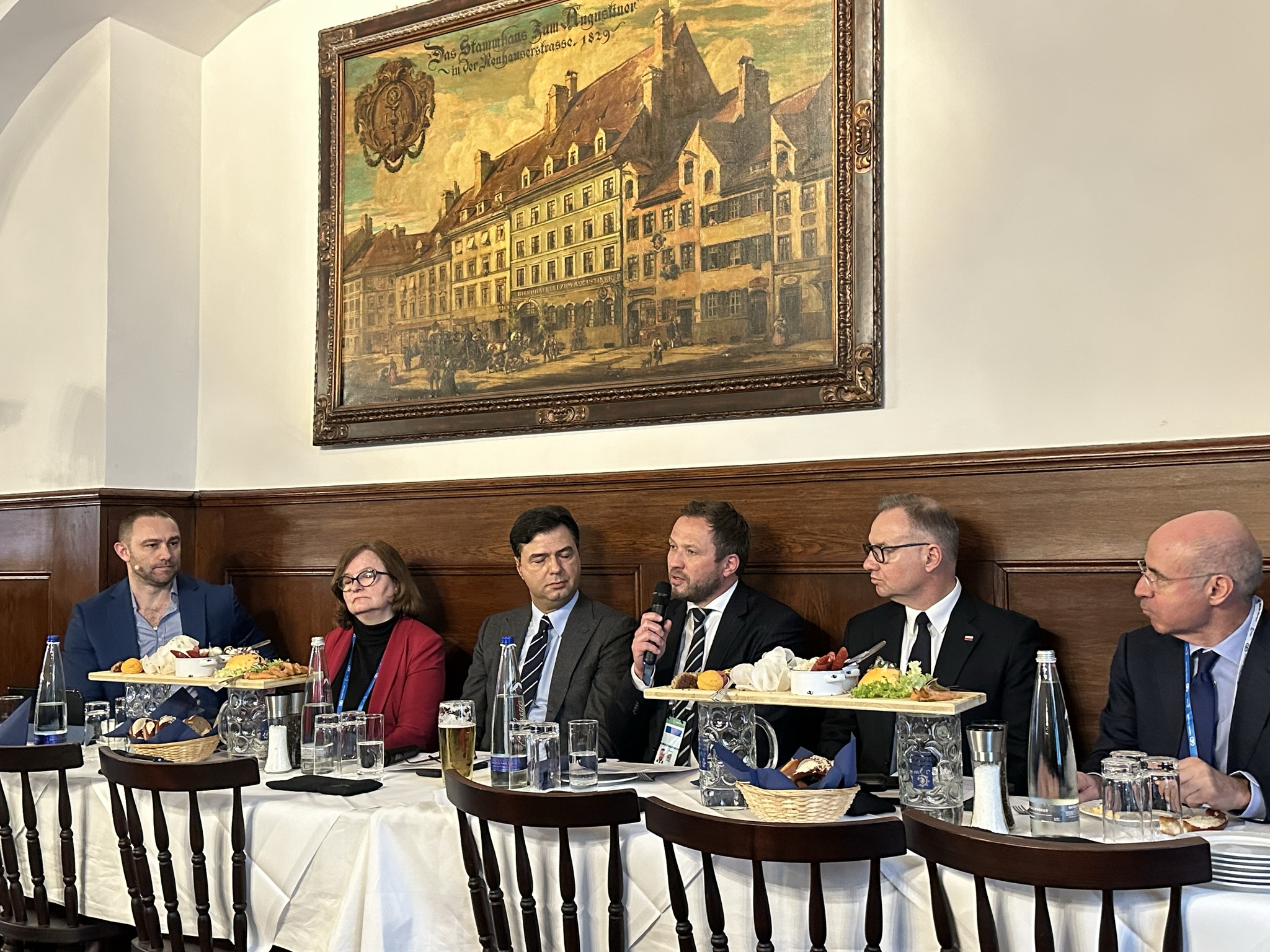
At this year’s Munich Security Conference, the issue of Ukraine was raised not only as a matter of security, but as a question of accountability. Razom for Ukraine initiated a discussion on a specific mechanism: how frozen Russian state assets can be lawfully directed toward Ukraine’s reconstruction.
This was reported by Razom For Ukraine.
According to Razom for Ukraine, every February global security leaders gather in Munich for one of the most influential international forums shaping transatlantic policy, defense priorities, and approaches to international accountability. What is discussed in Munich often becomes the basis for decisions in Brussels, Washington, and other capitals.
This year, Razom for Ukraine ensured that an issue directly tied to Ukraine’s future was firmly placed on the agenda: how frozen Russian assets can legally be used to support reconstruction efforts.
 Senior Legal Fellow Juliya Ziskina co-organized and spoke at a panel titled “Making Russia Pay: Next Steps on Frozen Russian Assets and Ukraine’s Reconstruction.” The event drew a full house and lasted three hours.
During the discussion, senior European Union officials and leading legal experts addressed a question that is no longer theoretical: since Russia owes reparations and its sovereign assets are immobilized, what lawful and practical steps can be taken to utilize them.
 Policymakers, diplomats, journalists, civil society representatives, and experts participated in the conversation. Organizers emphasized that the discussion was not about abstract financial mechanisms, but about specific destroyed homes, schools, hospitals, and energy infrastructure in Ukraine that could be rebuilt through existing and lawful accountability tools.
Following the main panel, Juliya Ziskina joined a closed technical briefing with experts to discuss concrete legal and economic pathways for implementing the initiative.
Organizers underscored that Munich is where security narratives take shape, and that discussions about accountability must translate into real recovery instruments for the people of Ukraine.

