


We all want to be loved, don’t we? Even those who passionately prove the beauty of a solitary life still, one way or another, have at least some close people who could share with them both joy and sorrow, victories and failures. It has simply turned out this way: a person needs society, respect, recognition, and warmth in the soul. And what brings us the greatest flame inside, if not a beloved and close person? And what is love, anyway? That pun-filled nonsense from romantic films, where the characters have known each other for less than a day but are already ready to risk their lives for their so-called “other half”? Or perhaps the dramatized physical attraction from paperback books, where a barely dressed woman is shown clinging to a man with a mane of hair, muscles, and a square jaw? Surely not.
There are different kinds and subtypes of love. The kind a mother feels for her child, a pet owner for a furry or scaly friend, a friend for a group of friends, a sister for a brother, a teacher for their students, and so on. In human relationships, love should take first place; then, I think, we would all forget about the exploitation of animals, murders, and wars. But life is a little more complicated than my utopian dreams of a daily happy ending from a Disney cartoon. Sometimes it seems that everything we were taught from an early age was a mistake, because the real world looks more like Final Destination than a cartoon about Lilo and Stitch… But that, as they say, is an entirely different story. Without getting carried away by pessimistic notes, I will remind you that we were always taught: “Love knows no bounds.” Only after reaching adulthood did we become convinced of the opposite, and June in Kyiv demonstrated this to us once again.
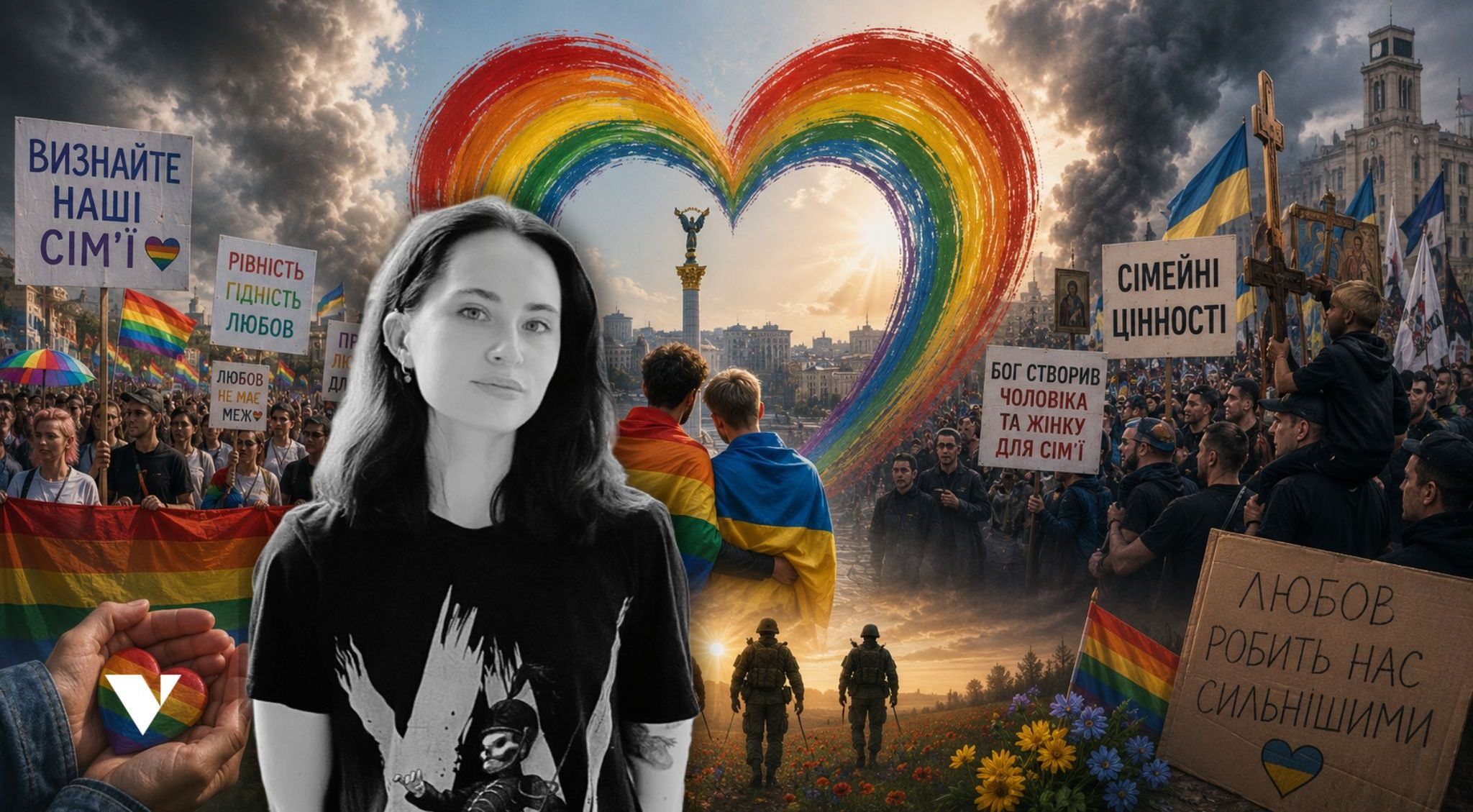
On June 21, 2026, the capital brought together two camps of people: some came for the peaceful march organized by the NGO KyivPride, while others organized a protest against it. Everything is quite simple, with none of James Cameron’s complex plotlines. The goal of the first group was to emphasize the need to recognize LGBTIQ+ families, protect people from hate crimes, bring legislation on transgender transition into line with modern international standards, and finalize the Civil Code of Ukraine, since same-sex couples today cannot even officially register their relationships. The goal of the second group was to support, quote, “the Ukrainian family” and speak out “against degradation,” whatever that means.
While participants in the peaceful march held posters with rainbows and the request “Recognize our families,” their opponents prepared banners which, in addition to the classic “Family values unite generations,” “God created man and woman for the family,” and so on, included frightening and unacceptable slogans such as “Nation, race, family.” They were held by both men and women with children. A kind of Eastern European version of the Ku Klux Klan. Military personnel who do not like Ukraine’s course toward Western values also joined the protest. Overall, thanks to coordination by the authorities and enhanced security measures, both, so to speak, celebrations passed without pain — unless, of course, verbal insults are considered something serious. And so we live: endure it, and maybe you’ll grow to love it…
It would be very naive to count on complete mutual understanding between two camps when the very existence of one completely obstructs the existence of the other. The first see the example of the freedoms of the Western world and try to fight for broader boundaries of what is considered normal, while not canceling the existing rules for everyone else. The second cling with all hands and feet to the old and well-known principles written in all the great books, forbidding even the thought of moving in that “evil” direction. By the way, there is actually a third camp as well — those who, in general, do not care “who sleeps with whom,” and in general say: “Let them do whatever they want, why shout about it?” and eventually: “Personally, I don’t care about all those gays or transvestites, as long as they are not near my child.” These ladies and gentlemen also like to invoke the mantra of the Ukrainian universe: “Is this really the time?” every time the issue of same-sex marriage appears somewhere in the news.
And it even seems logical, in a way, because the country is now fighting for its right to exist, living in survival mode and giving its best lives for it. Speaking of those who are fighting for Ukraine’s freedom — do you think they all belong to the second group of people? Or perhaps to the third? Are there no representatives of the LGBTIQ+ community there, on the front line? Not a single gay man whose faithful husband is waiting for him at home, or not a single lesbian who writes messages to her girlfriend at night? How are they supposed to feel, knowing that if something happens, their loved one will not even be able to visit them in the hospital as an official partner? Or receive state payments? Do they, giving their health and risking their lives every day, not have the right, at least once a year, to walk with slogans demanding recognition of their families? And this is only one example — probably the one many people should understand best, because no one is protected from misfortune, from a painful moment in which bureaucracy will play a more important role than love.
Why do we so stubbornly cling to an outdated boundary of love built for us by previous generations that starved people and destroyed entire civilizations? Of course, of course, when you talk about boundless love, someone will inevitably mention sick perverts who dream of marrying a child or a cow, but no one is asking for approval of such cruelty and immorality. Let such comparisons remain where they came from — in russian propaganda, invented by foolish and narrow-minded people. Equality does not mean violating laws. It guarantees every person the right to feel needed, protected, and right, regardless of race, eye color, physical health, sexual orientation, clothing preferences, or the number of rainbows on their bag. There is nothing wrong with expanding rights for those who are also Ukrainians and who also shape our society. Homophobia is something russian, and we supposedly began Ukrainization, did we not?
It is difficult to live life in a constant state of struggle. On one side, corruption inside the country wears us down, throwing sticks into the wheels; on the other, our dear neighbors send fiery bombs, destroying any sense of safety; and on top of that, the general state of the world does not exactly resemble a healthy atmosphere. Humanity once again turns the existence of the individual into a game where the floor is lava, making it harder and taking away the crossbars each time. But I want to believe that somewhere there, inside each of us, that great feeling of love is hiding — and all it needs is to be set free, and it will fill every cell with its strength, giving us hope for something better. And then… Then no one will care what color the neighbor’s skin is, who a colleague at work loves, how a waitress in a café identifies herself, or who has a rainbow in the sky and who has one in the soul.
Author: Viktoriia Hridina
