


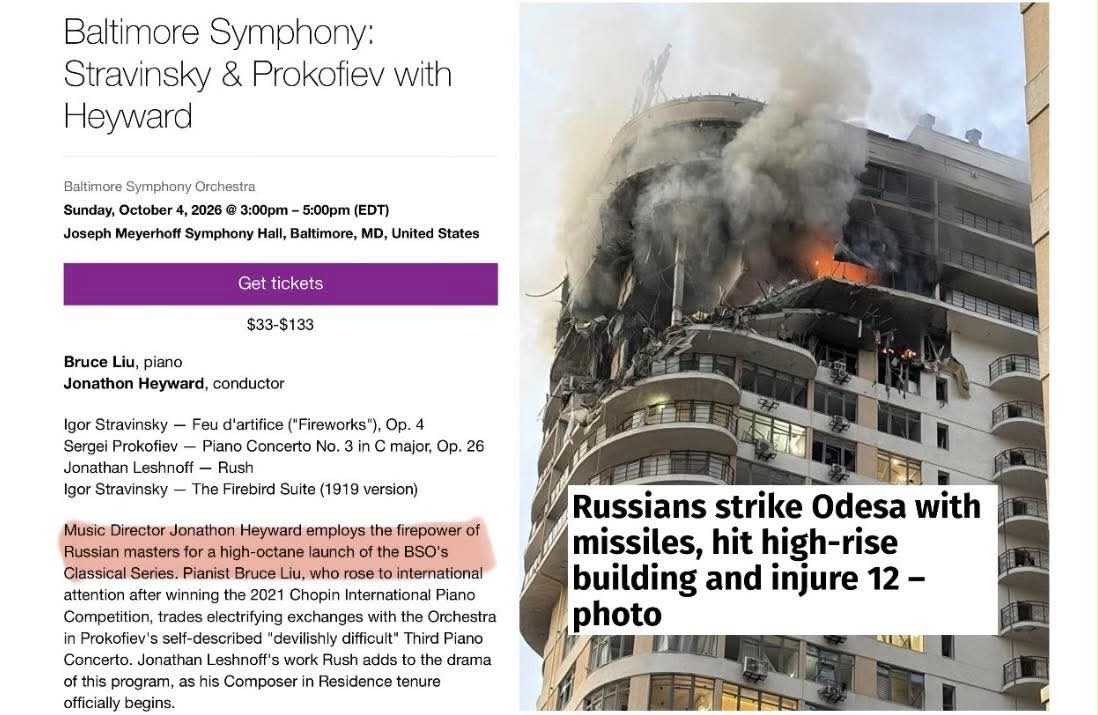
As the war in Ukraine continues to claim civilian lives and devastate infrastructure, a growing chorus of advocates is challenging the nation’s cultural institutions to re-examine their programming choices. The latest flashpoint involves the Baltimore Symphony Orchestra (BSO) and a letter from the international movement Arts Against Aggression, which argues that the continued promotion of “Russian masters” serves to normalize a state engaged in ongoing atrocities.
The letter, addressed to BSO leadership, takes direct issue with the orchestra’s upcoming October 4, 2026, concert featuring works by Igor Stravinsky and Sergei Prokofiev. Despite recent institutional apologies regarding the use of Russian imperialist symbols in promotional materials, critics argue that these measures are merely performative, failing to address the deeper issue of how Russian cultural narratives are deployed as state propaganda.
The letter notes the stark contrast between the orchestra's marketing and the reality on the ground:
"It is deeply troubling that while ‘Music Director Jonathon Heyward employs the firepower of Russian masters for a high-octane launch of the BSO's Classical Series'— as the BSO describes it —the Kremlin continues to employ the firepower of its missiles and drones to murder Ukrainian civilians daily."
The core of the argument presented by Arts Against Aggression is not necessarily a call for a total ban on Russian music, but rather an ethical demand for historical honesty. The group contends that if orchestras choose to feature these “Russian masters” during Russian genocidal war in Ukraine, they have a responsibility to educate their audiences about the composers' true identities and the current destruction of their ancestral lands.
The letter highlights two specific examples:
Igor Stravinsky: Born to a family of Ukrainian Cossack descent, Stravinsky spent significant time at his family estate in Ustyluh, in the Volyn region—an area currently suffering under the weight of Russian missile and drone strikes that are destroying Ukraine's energy infrastructure and harming its people.
Sergei Prokofiev: Born in Sontsivka, in the Donetsk region, Prokofiev’s birthplace has been under Russian occupation since 2014. Landmarks bearing his name, including the Donetsk State Music Academy and the Donetsk Sergei Prokofiev International Airport, have been devastated by the very forces whose culture the music is often used to promote.
For Arts Against Aggression, the BSO’s programming choices risk "whitewashing" the reality of the war. They argue that by presenting these works without context, American institutions inadvertently align themselves with the Kremlin’s efforts to project cultural superiority while simultaneously attempting to erase the Ukrainian identity that helped shape these very composers.
"It is time for American orchestras and musicians to cease promoting Kremlin narratives about the 'superiority' of Russian culture, which serve only to whitewash ongoing war crimes," the letter asserts. "The BSO’s current programming choices risk normalizing the culture of a state currently engaged in a war of aggression."
The letter serves as a broader indictment of the classical music industry, urging orchestras to move beyond superficial apologies.
"We urge the BSO to move beyond performative apologies and take meaningful steps to ensure its artistic mission does not align with the propaganda efforts of a regime committing atrocities against the very people who helped shape these composers' identities."
As the war in Ukraine persists, the pressure on institutions like the BSO to take a more principled stand on their artistic missions is only expected to intensify. The question remains: can the world of classical music reconcile its reverence for the past with the urgent moral demands of the present?
Author: Dmitry Smelansky
