


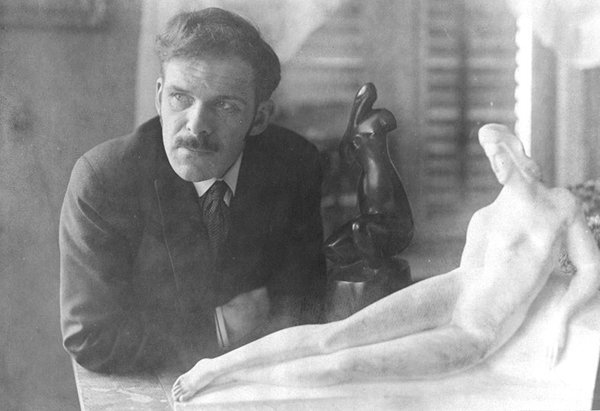
During the 1933–1934 "Century of Progress" exhibition in Chicago, a Ukrainian pavilion operated, featuring a dedicated space for Alexander Archipenko. Forty-four of his works were displayed in the "Archipenko House." Following the exhibition, one of his sculptures, *Ma*, was donated to the National Museum in Lviv.
This was reported by Archipenko at the "Century of Progress" and after the event.
The "Century of Progress" exhibition took place in the United States in 1933–1934, with displays spread across a vast area in Chicago between 12th and 39th Streets along Lake Michigan. Among the pavilions representing various nations was a Ukrainian one, constructed based on an architectural design by the Ukrainian Technical School in Lviv; it represented Chicago's Ukrainian community.
The existence of a separate Ukrainian pavilion drew objections from Maxim Litvinov, the Soviet ambassador to the United States at the time.
The Ukrainian community distributed promotional leaflets through contemporary Ukrainian newspapers, urging: "Ukrainians of America, Canada, Brazil, and other overseas lands! A great historic opportunity has arisen to help our brothers in the homeland!"
The Ukrainian exhibition ran for five months. It showcased works by artists of Ukrainian descent from France, Brazil, Argentina, and Czechoslovakia. Among the featured artists were Babii, Tretiakov, Redko, Andriienko, Savchenko-Bielskyi, Krychevskyi, Perebyinis, Tsymbal, Kryshivskyi, and Butovych.
Some of these artists exhibited their work in European capitals—notably Prague, Berlin, and Paris—as well as in Galicia. The Lviv-based art collective ANUM (Association of Independent Ukrainian Artists), active from 1931 to 1939, showcased works by these artists alongside those of select artists from Soviet Ukraine.
The "Paris Group"—comprising Butovych, Andriienko-Nechytailo, Borachok, Krychevsky, Perebyinis, and others—joined forces with Galician artists such as Kovzhun, Ivanets, Novakivsky, and Smolsky. Together, they had the opportunity to "act as a bridge between Eastern and Western culture... affirm parallel developments in art... and boldly assert their individuality" within the visual culture of the interwar period.
Oleksandr Archipenko was also invited to participate in the exhibition and was allocated a dedicated space, which came to be known as the "Archipenko Pavilion."
Scholars of his work have noted the artist's connections with the Ukrainian diaspora: "While in Berlin, he maintained close ties with members of the local Ukrainian community. The 'Ukrainske Slovo' publishing house released a major book about him in four languages: German, English, French, and Ukrainian."
At the same time, Archipenko was often perceived abroad as Russian, as his biographies mentioned that he had studied in Moscow. At the opening of the 1933 exhibition, the American press wrote: "As is well known, Archipenko has gained worldwide renown as one of the most outstanding modern sculptors; thus, his exhibits will be a true highlight of the Ukrainian pavilion, demonstrating to the millions of visitors at the Chicago fair the high caliber of Ukrainian modern art."
Archipenko presented 44 works at the exhibition. The Ukrainian press wrote of the display: "The Ukrainian House at the World's Fair in Chicago is already beckoning to both our own people and strangers alike... And throughout the House, there are large, as-yet-unpacked crates—Archipenko’s sculptures."
Particular attention was drawn to the original terracotta sculptures from the "Ma" series: "Ma-Contemplation", "Ma-Apparition", and "Ma-Distributive Force". These were life-sized sculptures dedicated to the image of woman—her all-encompassing love, essence, patience, and wisdom.
The press also described visitors' reactions to Archipenko’s works: "We arrived at the exhibition on September 11, paid the 50-cent admission, and began to look around... Regarding the works of our artist Archipenko... you look, yet understand nothing; you search for something, but find nothing. What existed before was good and clear, but that did not suit modern artists, so they set out to create something new—or at least different. That is why all the Chicago newspapers write so enthusiastically about Archipenko: the entire city seems built in the spirit of his works. A fairytale city, mysterious to the ordinary person—just like all of Archipenko’s creations."
After the exhibition concluded, a letter arrived in Lviv from Luka Myshuha—a statesman, public figure, journalist, editor, and lawyer who had been living and working in the United States since the 1920s. The letter concerned the acquisition of a work by Archipenko for the National Museum in Lviv:
"Last year, on the occasion of the exhibition of works by our renowned artist Alexander Archipenko at the World's Fair in Chicago, the idea arose to purchase his piece 'Ma' for the National Museum in Lviv. We proceeded from the premise that it was desirable for at least one of Archipenko’s works to be on native soil, in a Ukrainian museum.
When Mr. Archipenko learned of this, he agreed to part with the piece for one-third of the price set at the exhibition...
I am very pleased that we, for our part, were able to contribute—even with this single work—to enriching the National Museum, which is so dear to us..."
Archipenko’s work was known in Lviv as early as the 1920s. Lviv art critic Mykola Holubets wrote a study on this Ukrainian-born sculptor and painter. In 1926, his oil painting "On the Terrace" was acquired for the National Museum’s collection.
In July 1934, following an exhibition in Chicago, Oleksandr Archipenko’s work *MA* was transferred to the National Museum in Lviv through the efforts of Luka Myshuha. That November, Archipenko wrote to Ilarion Svientsitsky: "…I am very happy that my work will be preserved forever close to the Ukrainian heart…"
In the "Chronicle of the National Museum in Lviv for 1934", its director, I. Svientsitsky, noted the holding of an exhibition "marking the relocation of the modern art gallery to the ceremonial hall of the old building, comprising 218 paintings by 46 artists and a sculpture by Archipenko."
The same publication cited Archipenko’s own words regarding the work "MA": "To every mother; to everyone who loves and suffers through love; to all those who create in art and science; to everyone who hears and knows eternity and infinity… MA knows and hears infinity and eternity, for she is a part of them. The instinct and feeling of MA are boundless. And in her wisdom, she sees things hidden in the womb of the future."
In 1935, Archipenko wrote about the works of his currently on display at the museum and the possibility of their acquisition:
“… I am very pleased that my works in the current exhibition at your museum are meeting with success.
I greatly appreciate your intention to acquire them for the museum.
I would consider it an honor if they—or even a portion of them—were to be purchased.
Given the current crisis, I am willing to let the museum have them for half the price I previously quoted you. Perhaps Metropolitan Count Sheptytsky could help make this happen. I recall that the Count used to support artists. I knew a Ukrainian sculptor in Paris who received a stipend from the Count. I remember this sculptor particularly well because he once saved me from starving to death when I was living on the streets of Paris and ill from hunger. This sculptor told me that the Count had done a great deal for Ukrainian artists and for art…”

Oleksandr Archipenko
Oleksandr Porfyrovych Archipenko was born on May 30, 1887, in Kyiv, and died on February 25, 1964, in New York, USA. He was a sculptor, painter, and graphic artist, as well as a pioneer of Cubism in sculpture and a theorist of the visual arts.
Archipenko was born into the family of a Kyiv University professor, mechanical engineer, and inventor. In 1902, he enrolled at the Kyiv Art School, from which he was expelled three years later for participating in the revolutionary movement. Subsequently, he continued his studies at the Moscow School of Painting, Sculpture, and Architecture, as well as in private studios in Moscow and Paris.
Archipenko left Kyiv in 1906. He lived in France until 1921, and from 1921 to 1923 resided in Berlin, where he established his own art school. Later, he moved to the United States, opening an art school in New York that he directed from 1923 to 1964. An A. Archipenko museum exists in the town of Woodstock, USA.
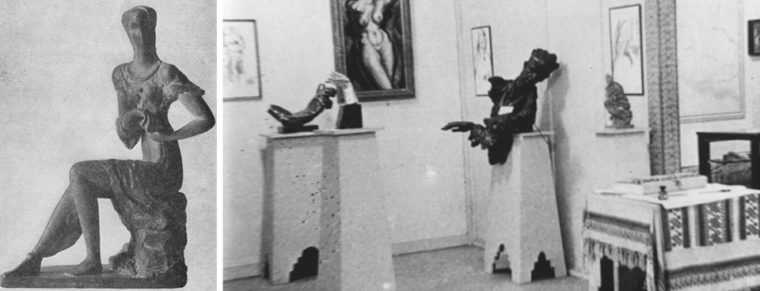
In his creative work, Archipenko gravitated toward simple forms and constantly experimented. He utilized materials such as wood, glass, metal, and celluloid, combining various shapes and incorporating color into his sculptures. Notably, he created the "Medrano" series, featuring constructions mounted in frames against painted backgrounds.
The artist worked in the realm of "sculpto-painting," blending three-dimensionality with flatness. His works incorporated open apertures, interior space, and "voids"—so-called counter-reliefs.
Reflecting on his connection to Ukraine, Archipenko said: "Who knows if I would think the way I do had the Ukrainian sun not ignited within me a longing for something I myself cannot name."
During his lifetime, 118 solo exhibitions of his work were held in Germany, Italy, the Netherlands, France, and the United States. His pieces were exhibited in museums around the world. Archipenko taught at the studios he founded, the Chicago School of Industrial Arts, and universities in Kansas City and Seattle.
His students included G. Manzù, A. Giacometti, O. Zadkine, and H. Moore.
Over a thousand sculptures and paintings by Archipenko are housed in museums around the world, as well as in the National Art Museum of Ukraine in Kyiv and the National Museum in Lviv.

Photo: Iryna Hakh
Author: Danylo Pievchev