


There are still a lot of mosaics in Ukraine. They decorate simple rural bus stops, they can be seen on the giant walls of faceless Soviet-era buildings. They are in foyers and lobbies, quite familiar to the average Ukrainian. However, among them you can often find real gems. Even an untrained art critic can see amazing paintings carefully made of small coloured smalt, stones, pieces of ceramic tiles or even wood. Their value lies not only in their skilful execution, design or composition. Behind many of them are well-known names of representatives of the Ukrainian artistic elite, often associated with tragic biographies.
Mosaics, unfortunately, have become one of the hundreds of thousands of symbols of the Soviet Union, and they mostly evoke little emotion in Ukrainians. And those that are worthy of global commemoration disappear during the war. Ukrainian artist Yana Verba, who lives in Walnut Creek, California, has been working on a series of works inspired by Ukrainian monumental art for several years. In a recent exhibition at the Walnut Creek Library, she presented paintings dedicated to a particular genre of Ukrainian cultural heritage: mosaics. Yana shares her concern for the preservation of cultural heritage and discusses the fate of famous mosaics. For example, about the works of Alla Horska that were destroyed by the Russian occupiers in Mariupol.
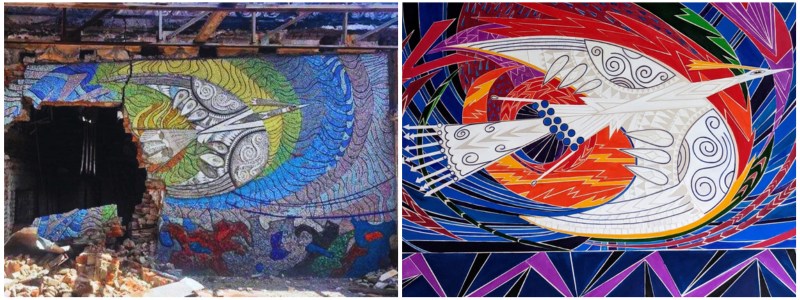
Art that inspires and destroys
L.S.: Tell us, why did you focus on mosaics?
Y.V.: Mosaics are part of our heritage, even if they were created during the Soviet period. This is our history and it is important to preserve it. Unfortunately, most of them go unnoticed or are destroyed.
L.S.: Please describe the emotion that gave you the inspiration to open the exhibition.
Y.V.: This exhibition is a way to remind us of Ukraine, of its artistic wealth, which is being destroyed by Russian bombs. When I found out that Alla Gorska's mosaics in Mariupol, such as The Tree of Life and The Boriviter, were destroyed, I felt a deep injustice. These works are not just art, they are part of history, reflecting the struggle of Ukrainians for their identity and freedom.
L.S.: Is there any way to save them?
Y.V.: It's difficult because most mosaics are monumental works in the open air. You can't just take them and move them to a museum. Through my paintings, I try to draw attention to them and make people think about how they can be preserved.

In memory of Alla Horska
Alla Horska, one of the most talented Ukrainian artists, a Sixties woman with a tragic fate, expressive and bright, was a symbol of artistic and civil resistance to Soviet rule. Her incredible oeuvre includes mosaics created in the 1960s in Mariupol, which have become part of the Ukrainian cultural heritage. Two of her works, The Tree of Life and The Boriviter, were included in the UNESCO World Heritage List but were destroyed during the Russian invasion.
Y.V.: These mosaics are a symbol of struggle and defiance. The artists who created them risked their lives to express their love for Ukraine. My works are intended, among other things, to preserve the memory of these artists, who were often harassed, imprisoned or even killed by the Soviet authorities.
L.S.: Those that I could reach. But there are also those that the Russians simply appropriated.
Y.V.: Yes. This is absolutely unfair. Ukrainian artists are often associated with Russian culture. For example, in MoMA (https://www.moma.org/artists/3710), Kazimir Malevich's works are labeled as "Russian art," although he himself was part of the "Ukrainian avant-garde scene."

Mosaics of Ukraine: How to preserve the heritage?
L.S.: I'm not sure that mosaics and their preservation are a priority for the Ministry of Culture of Ukraine, for example. What can we do without waiting for government action?
Y.V.: The war is only one of the problems. Art is often destroyed, for example, during construction - preserving the mosaic is not part of the developer's plans. Let's just recall the recent scandal in Lviv with the mosaic by the famous artist Volodymyr Patyk on the facade of the Ocean store. It outraged people and the developer was forced to restore everything. Art is destroyed without thinking about art. It is easier to plaster and paint an old bus stop than to restore it. I am very happy that today there are more and more initiatives from ordinary people who document these mosaics, take pictures of them and create books. У Інстаґрамі зараз цілий рух у підтримку мозаїк. Це спосіб хоча б якось зберегти цю частину нашої історії.
Ukrainian art in the world context
L.S.: Your exhibition in Walnut Creek is only a small part of your work. And it is entirely dedicated to Ukraine. At the same time, you have not lived in Ukraine for a long time, and you received a fantastic education in New York and Toronto. Why do you return to our roots when you work on a wide global art scene?
Y.V.: I started paying more attention to Ukraine and its contribution to art in 2014.
L.S.: Why did this happen?
Y.V.: The impetus was the Maidan and the beginning of the war. My whole family stayed in Ukraine, and it had a big impact. At that time I was studying in Canada, where Ukrainian art was not mentioned in the classroom at all. It surprised me. One day I found a book in the library about the Ukrainian avant-garde and saw names like Malevich. From then on, I started researching little-known or underrated Ukrainian artists.
L.S.: How do you see Ukrainian contribution to world art?
Y.V.: Until 2022, very few people talked about Ukrainian artists at all. Since then, more and more people in the world have been learning about our heritage. And I will continue to research the Ukrainian avant-garde and mosaics. What is important is that Ukrainian art is part of the general history of art, and our task is to preserve, honor, and, as much as we can, tell the world about Ukrainian artistic treasures.
Background: Yana Verba is a Ukrainian-Canadian artist who was born in Ukraine in 1983 and emigrated to Canada in 1999. Verba studied at the School of Visual Arts in New York City and received her Bachelor of Fine Arts from OCAD University in Toronto in 2015. She bases her artistic practice on the language of abstraction, using rhythmic patterns, colors, and movement. Inspired by early twentieth-century modernists, Verba is currently working on a series of paintings that echo Soviet monumental art and Soviet Ukrainian mosaics. Her work has been exhibited in Canada, the United States, and the Middle East, and she has been living and working in California since 2015.
Website: https://www.yanaverba.com
Instagram: https://www.instagram.com/verbasart
Author: Lukian Selskyi