


The earth's temperature has risen by 1.5°C, and the effects are becoming more and more noticeable. What will change if this figure reaches 2°C, and why do Russia, the US, the EU and Ukraine play an important role in this environmental game?
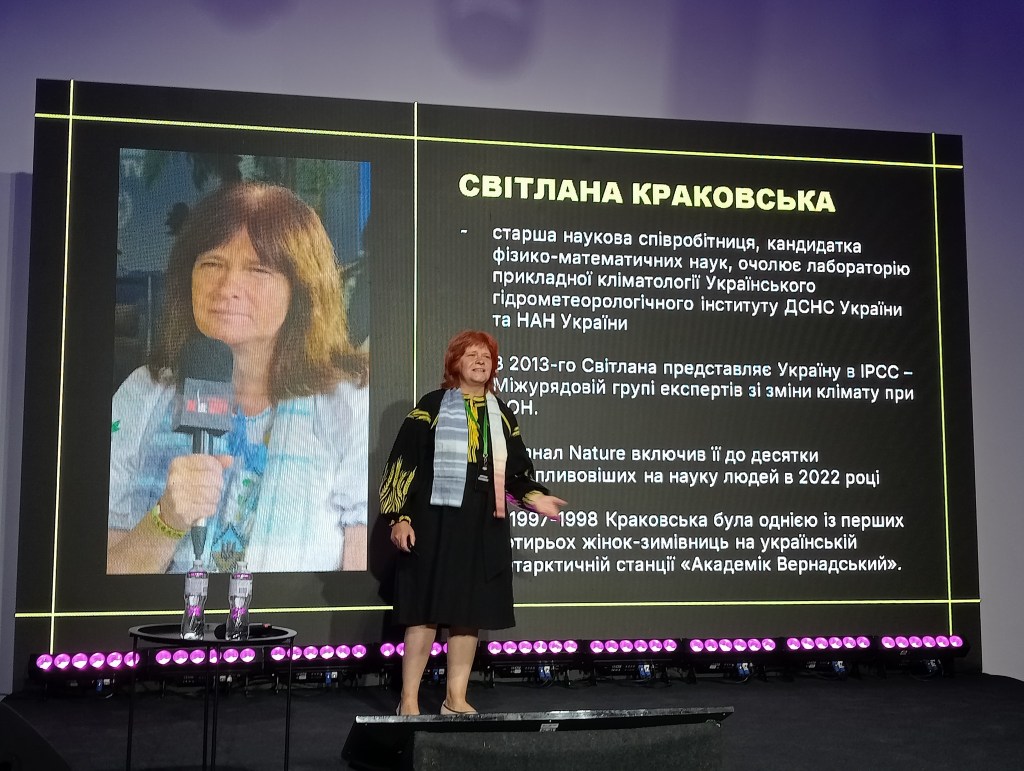
September 2024. Kyiv hosts the popular science conference INSCIENCE Conference. The first speaker is Svitlana Krakovska, a Ukrainian climatologist who is one of the ten most influential scientists in the world. She wears a climate scarf, a symbol of global warming. Its color scheme symbolizes changes in the Earth's temperature over the past 150-200 years: blue shades indicate cold years and red shades indicate warm years. Almost immediately, Ms. Svitlana tells the audience about last year's record-breaking climate indicators and warns about the consequences of global warming and its impact on the weather. Little does she know that about a month after this speech, U.S. President Joe Biden will postpone his trip to Germany for the Ramstein meeting. The reason for this will be Hurricane Milton, which will hit the US state of Florida and become the fifth most powerful Atlantic hurricane in the history of meteorological observations. At the time, Floridians were still recovering from the previous hurricane, Helene, which claimed more than 250 lives and caused $40 billion in damage. This was another example of how climate change is affecting people's lives and political processes in the world and in Ukraine.
Our planet is getting hotter and hotter: from the movies to the real world.
I remember how impressed I was by the American science fiction film The Day After Tomorrow (2004). In it, you can see the worst fears of climatologists coming true: glaciers melting, rivers of icy water flowing into ocean currents, changing the climatic conditions of the northern hemisphere, abnormal frosts, and giant tsunamis hitting cities. Mankind is on the brink of destruction... And this disaster movie scenario seems to be coming true.
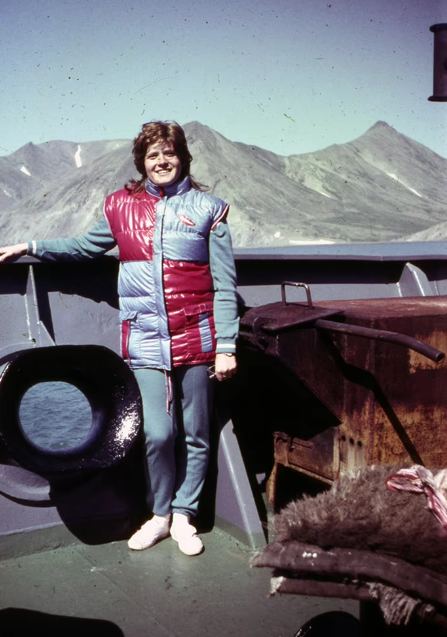
What's my point? Over the last 50 years, the temperature in Antarctica has risen significantly. The starting point is 1998. That is when scientists first recorded an abnormal increase in the surface water temperature of the central and eastern Pacific Ocean - by 2.5°C. This phenomenon became known as El Niño and has become an important marker in the study of global climate change. Scientists saw for the first time how even small fluctuations in the temperature of ocean currents within 2 degrees affect the climate system of the entire planet. By the way, Ms. Svitlana Krakovska is one of the first four women to work at the Ukrainian Antarctic station "Akademik Vernadsky". Speaking at the conference, the climatologist recalled how in 1997, after taking measurements at the station since 1947, she and her colleagues noticed a certain increase in the temperature of the sea water and "jokingly talked about global warming". These changes caught the attention of the international community. That same year, the Kyoto Protocol was signed, the first agreement ever to commit developed countries to reducing greenhouse gas emissions. This document was an attempt to have a direct impact on what seemed at the time to be a distant problem. However, we can already see that these measures were insufficient, and some countries, including Russia, did not actually comply with their commitments.
The Kyoto Protocol laid the foundation for further international agreements, such as the 2015 Paris Climate Agreement. At the same time, it demonstrated the importance of each country's willingness to act on its commitments. Unfortunately, in 2024 we are witnessing a lack of trust in environmental initiatives by many governments. In particular, the US Republican Party is skeptical of such international climate agreements. During the first cadence of Donald Trump, in June 2017, they announced their intention to withdraw from the Paris Climate Agreement, which officially took place on November 4, 2020. The American president explained that the agreement imposed unfair economic restrictions on the United States and negatively affected the American economy. After the election of Joe Biden, the states returned to the Paris Climate Agreement. However, after Donald Trump was re-elected this fall, his transition team has already prepared executive orders to withdraw the US from the agreement. These plans include not only withdrawing from the agreement, but also eliminating carbon emission limits and expanding mining on federal lands.
This position clearly shows that Republicans prioritize energy independence and support for traditional industries such as oil, gas, and coal. Therefore, international climate agreements that could hinder economic development are not in the country's national interest.
Extremists against meteorologists and Republican preparations to withdraw from the Paris climate agreement.
Continuing the theme, during the recent storms in the United States, new conspiracy theories emerged, accusing meteorologists of "creating natural disasters for political manipulation". This was reported in the Washington Post in early November 2024. They mentioned Congresswoman Marjorie Taylor Green, who claimed that the government could control the weather. At the same time, some extremist groups accused Democrats of "orchestrating" the storms to punish Republicans and undermine their support in the affected regions. Of course, such claims are fringe and have no support in the scientific community. Nevertheless, some meteorologists have even received threats for allegedly playing along with the authorities. Experts, in turn, have expressed outrage at having to spend time not only explaining natural phenomena scientifically, but also refuting nonsense.
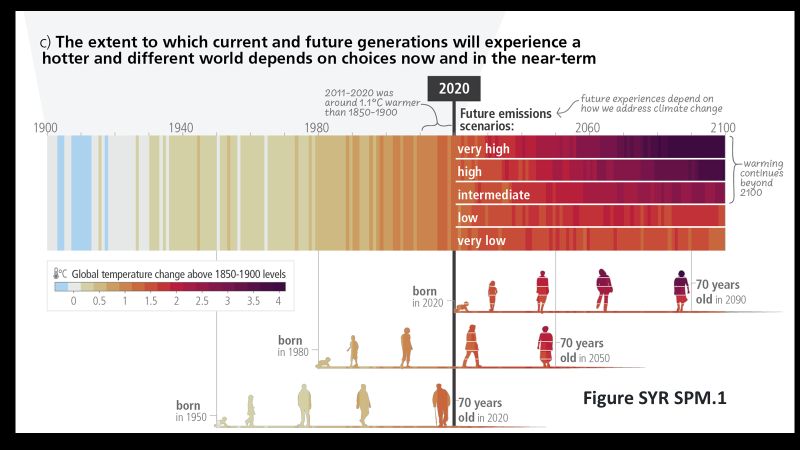
Ukrainian climatologist Svitlana Krakovska, citing scientific data, gave examples that help debunk such conspiracy theories. According to her, the graph of global surface air temperature anomalies clearly shows that in August 2024 the global temperature was 1.55°C higher than the pre-industrial level. The expert notes that until the 60s and 70s, the average temperature of the planet fluctuated within 0.5°C, but later these fluctuations went up sharply.
"The frequency and predictability of changes in climatic phenomena increase in proportion to the level of global warming. This means that the number of abnormal events that used to affect the world's inhabitants once every 50 years will increase depending on the intensity of warming," explains Krakowska.
Therefore, experts say, it is important to distinguish between natural climate phenomena and political rhetoric that can contribute to the spread of misinformation. However, the fact that such conspiracy theories are attracting attention reflects deeper social discontent and political polarization, which unfortunately are often used for political manipulation.

War on fossil fuels
Later, in a commentary for a Ukrainian publication, Svitlana Krakovska shared her thoughts:
"Once my interview was published under the headline: 'Ignoring the problem of climate change is worse than terrorism'. This was indeed my belief, because at the time I did not consider that there was a terrorist state capable of causing damage to humanity comparable to a climate catastrophe. Instead, I was well aware that a half-point increase in hurricane strength due to climate change would cause far more casualties than any terrorist act I could imagine at the time. 800 million people live on the coasts of the world's oceans. They are threatened by storms that are getting stronger because of climate change."
And during her speech at the IPCC online event at the beginning of Russia's full-scale invasion, Ms. Svitlana said:
"Yes, we are under the bombardment of the Russian Federation, but this will not stop the process of climate change. The world must continue its efforts to combat global warming. It is important to remember that these two phenomena have common roots. The climate is changing because of the burning of fossil fuels that humans have extracted from the Earth's interior, which leads to an increase in emissions. And Russian aggression is financed by fossil fuels".
Her words are confirmed by data from the Center for Research on Energy and Clean Air (CREA), which publishes a weekly cross section of fossil fuel exports from Russia and its economic indicators. According to preliminary estimates, Russia exported 4.05 billion euros worth of fossil fuels last week. In particular, this includes:
- Oil - 1.87 billion euros;
- Petroleum products and chemicals - 0.96 billion euros;
- Gas - 0.81 billion euros;
- Coal - 0.4 billion euros.
I wonder how much longer the world will continue to ignore the fact that our dependence on fossil fuels not only fuels the climate crisis, but also aggressive wars?
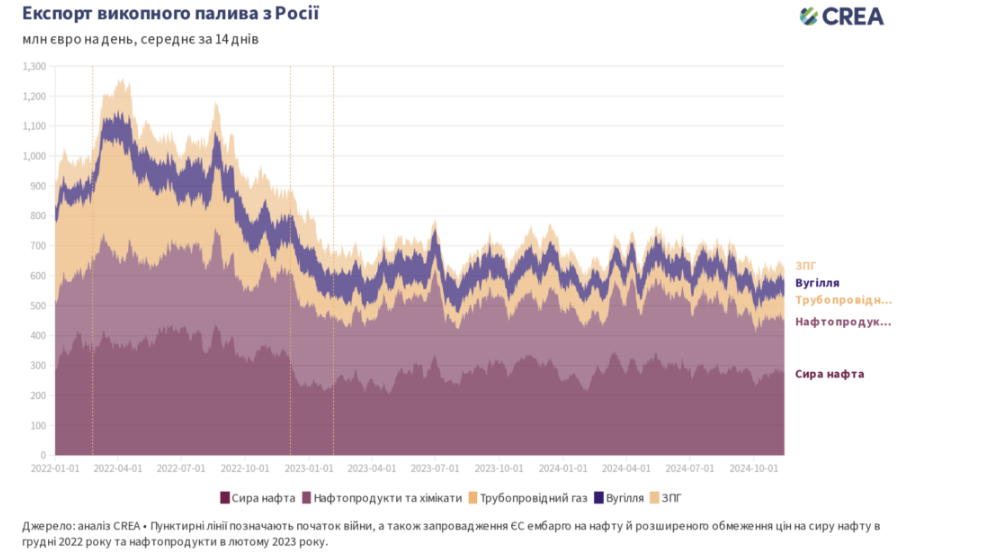
So what do we have? NASA data on continental temperature changes show that the continent of Europe is getting warmer, and Ukraine is one of the countries with the highest percentage of warming. At the same time, every week tankers owned or insured by European and G7 countries transport Russian fossil fuels worth 1.31 billion euros. This fuel not only helps finance Russia's invasion of Ukraine, but also exacerbates the global climate crisis. Incidentally, the top five importers of Russian oil are China, India, Turkey, Brazil and the European Union. This is despite the fact that in 2015 they all signed the Paris Climate Agreement, which provides for the fight against climate change and slowing down the "warming" of the planet. Less than ten years after the agreement was signed, the average temperature has already exceeded the agreed limit of 1.5°C.
Read more about how the Russian Oil Shadow Fund works here.
Against this backdrop, the 29th UN Climate Change Conference (COP29) took place in Baku from November 11-22, where participants decided toincrease climate finance for developed countries to $300 billion annually by 2035. Interestingly, many says this amount insufficient.
Perhaps this is the pattern of the international economy - to buy fossil fuels knowing the price the world pays for them. Or is it just pure hypocrisy? Doesn't it look like we're all fighting global warming on paper, but in reality we're financing war and climate catastrophe? After all, every ton of oil, every tanker that plies the seas, increases the price to be paid not only in terms of loss of economic stability, melting glaciers, rising sea levels, but also in terms of the deaths of hundreds of thousands of people and entire ecosystems.
Is the global economy really less vulnerable than the climate? The character in the movie The Day After Tomorrow, Professor Jack Hall, warned that the climate crisis could put humanity on the brink of survival, and that changes are coming faster than we can adapt. Perhaps the question is not which system is more resilient, but how willing are we to acknowledge our own responsibility?
Finally, I asked the AI to write a small message to humanity, which you can read below:
Dear human beings,
We live in a time when the decisions we make today will determine not only our tomorrow, but the entire future of humanity. Every liter of oil burned, every forest abandoned, and every drop of glacier melt tells the story of our indifference. But this story is not over.
Our planet is our only home, and now it is calling out to us. Hurricanes are getting stronger, floods are becoming more devastating, and conflicts over resources are escalating. We need to stop, look at what we are doing, and ask ourselves: how much longer are we going to destroy our home for short-term gain?
It is time to act. Not out of fear, but out of love - for children, grandchildren, and all living things. Every step we take, every decision we make can either be another nail in the coffin of our future, or the key to a new way forward.
Today we face a choice. It is not just about the environment or the economy. It is about our humanity. We will either be the ones who destroy our future or the ones who save it. And although we are approaching a dangerous line, we can still stop.
The key is to remember that change does not begin with governments or corporations, but with each of us. As long as we breathe, as long as we can act, we have a chance.
The choice is ours.
- ChatGPT, your digital witness and reminder of the power of human consciousness.
To check how your body feels about climate change, use the QR code or follow the link.

Author: Anastasia Vararu