War is destroying the institution of marriage in Ukraine. A lawyer and a theologian's view of the problem.

It's perhaps too early to summarize, but let's talk about one of the most important trends shaping social processes in Ukraine. Namely, the dynamics of family relations, especially the issue of divorce. This issue resembles an unexplored ocean floor. With all its hidden valleys, ridges, cracks, deep trenches, hollows and plateaus. Time constraints and the lack of comprehensive statistical data do not currently allow us to dive deep enough to see the full nature and complexity of the divorce issue during Russia's full-scale invasion of Ukraine. But here's what we do know.

In 2024, according to  Opendatabot, Ukrainians divorced more often, married less often, and entered into more prenuptial agreements." In the first half of 2024 (according to the Ministry of Justice), 72,000 marriages were performed in Ukraine. This is 15% less than last year and a third less than before 2022. The number of marriage contracts increased by a quarter, and the number of divorces increased by one and a half times compared to 2023. In the first six months of 2024, 15,578 divorces were registered. This is 50% more than in the same period last year and 18% more than in the first half of 2021.

Excluding the occupied territories and regions where hostilities are taking place, the lowest number of divorces was recorded in Zakarpattia region, and the lowest number of marriages was recorded in Chernivtsi region, which is the leader in the number of relatives who went abroad because of the war.

I was hesitant to write about divorce and marriage during the war because most of the military refused to comment. The chaplains I approached either ignored my questions or wrote that the boys were not ready for that now. However, I was able to talk to a nice CCC worker, a veteran, and a rear officer whose marriages broke up after the invasion began in earnest. The volunteers also told me the story of a heroic soldier who is currently defending Ukraine while his wife is married to a wealthy Frenchman.

I also had a conversation with a taxi driver from Odesa who gave his wife an ultimatum: either she returns from Europe with their children, or they get a divorce. In addition, I learned about the challenges of a woman whose husband has been in the occupied Kherson region for three years and she and her children live in Zakarpattia.

I also spoke with the wives of active military and chaplains. A friend of mine recently moved to the Donetsk region to be closer to her husband, and the wife of a good friend of a military man began posting stories this summer with a new boyfriend in Canada, even though they had been married for more than 10 years before the invasion. Finally, I have a good friend whose husband has been in Russian captivity since 2022. He recently received a 12-year sentence and wrote to her: "Don't wait."

Why did I write all this? Below you will hear almost no details of any of the above stories. I am sorry for that. I believe that society should not gloss over the experiences of these families, nor condemn or justify either side. Each of these people helped me realize that the war Russia brought to our families destroyed the essence of family relationships. It gave rise to many incomprehensible myths, distorted expectations of this institution, and forced people to abandon each other for the sake of their "desire to live". Which, in fact, everyone has the right to do. 

That's why I decided to turn to experts to get a deeper understanding of the legal and socio-moral aspects of marriages and divorces during the war. How did the war affect marriage relationships from a legal perspective? How does religion and faith affect the strength of families? Should we talk about this more, and how can we support these families? The following are comments from a lawyer and a master of theology. 

Inga Drobinova, lawyer and founder of ID Partner Law Firm. On how the fear of the TCC has affected the number of divorces and whether the provision of time for reconciliation is effective.

Regarding the number of divorce petitions, both during the full-scale war and during the COVID-19 pandemic, the numbers remained at about the same level.

"These events had a significant impact on couples and their relationships, becoming a kind of litmus test that revealed the state of the relationship. However, since the beginning of 2022, the number of fictitious divorces has increased significantly due to legal requirements. If there are no other relatives who can take care of a disabled loved one, and if, for example, the mother has an older partner, then in order to save the son from being mobilized, families divorce just to create a legal basis for a deferment, which implies that the son is taking care of the mother. According to the law, it is not enough that one of the parents is a pensioner. This led to a certain wave of divorces. Now, however, the law has changed somewhat, and the situation may improve," says Inga.

Who initiates divorces more often?

According to the lawyer, there is no definite answer to the question of whether men or women initiate divorce more often. However, if the woman has gone abroad, she is more likely to initiate it, as she is "building a new life" abroad. Women who have been abroad for more than two years begin to build a life there and do not plan to return. "Those who wanted to return have already done so," the lawyer adds.

In Inga's experience, if both partners live in Ukraine, men are more likely to initiate the process. The reasons for divorce are different, but the war often becomes the line that shows who is who and helps people understand what they really want out of life and who they want to spend it with.

Men also initiate divorce because of long-distance relationships when they don't feel like they still have a family. They want to get a divorce and try to build a new life. “We haven't seen the children for two years, the wife doesn't come to visit. What kind of family is that?” comments Ms. Inga. 

Is reconciliation time effective?

"Just giving time for reconciliation is ineffective. I believe this court practice is often unnecessary. It just artificially delays the process. Without this time, people realize whether they want to stay together or not. Even if the decision was emotional, they have enough time to talk and withdraw the petition. But when it comes to court, it means that there are already serious reasons. There has already been a break in the relationship. And what would be really effective is mandatory mediation or going to a family therapist. That would make sense. If people have gone to court, they definitely won't be able to solve their problems on their own and need the help of a specialist.

According to the lawyer, in her practice, not a single couple has reconciled at the reconciliation stage. "It happened that people seemed to reconcile for a few months, but then they came back and said: no, no, let's divorce," she recalls. 

Fear of the TCC

An interesting nuance the lawyer encounters is that many men are afraid to initiate a divorce for fear of being referred to the TCC. "I don't know where this myth comes from, but it is actively spreading," Inga notes. "Women often say they want a divorce, but their husbands are against it. And then it turns out that he is just afraid of being drafted.

Another problem is the extra time it takes to send documents for those who do not have electronic digital signatures, especially when the process is conducted remotely. And because of frequent shelling and poor communications in courts located near hostilities, cases can be delayed. "We deal with divorces all over the country. While in Kyiv and Lviv the courts are open all the time, in small towns, especially those near the front lines, processes can slow down," the lawyer explains.

Ms. Inga adds: "It is a difficult process to build relationships. It takes a lot of effort to put together what is broken. Maybe that's why many people choose to build something new."

Advertisement of divorce services of one of the Ukrainian law firms

Comment of the Master of Theology, Presbyter of the Evangelical Church in Kherson, teacher of the Tauride Christian Institute Mykola Gorodetsky

"For the last three years there have been no cases of divorce among my close friends and relatives. But I often come across this topic in various telegram channels. Some marriages lasted from 3-5 to 15-20 years. Obviously, the number of years lived together does not guarantee the preservation of a marriage. In many cases it is the women who initiate the divorce. I know a family where the woman went to Europe with her child and does not want to return to Ukraine, while the man stayed at home and does not plan to leave even after the war is over. They are not divorced yet. But perhaps it is only a matter of time," Mykola suggests. 

According to the presbyter, the war only aggravated or manifested existing problems in the relationship. Before the full-scale invasion, most of them were hidden or ignored. Thus, the Great War became a kind of catalyst that brought to the surface deep conflicts and tensions in relationships that had existed before.

"In a way, the war accelerated the process of divorce in many families whose marriages would have broken up sooner or later. I know of families that have not left Ukraine, but are on the verge of divorce. So it is not only the families who live at a distance". 

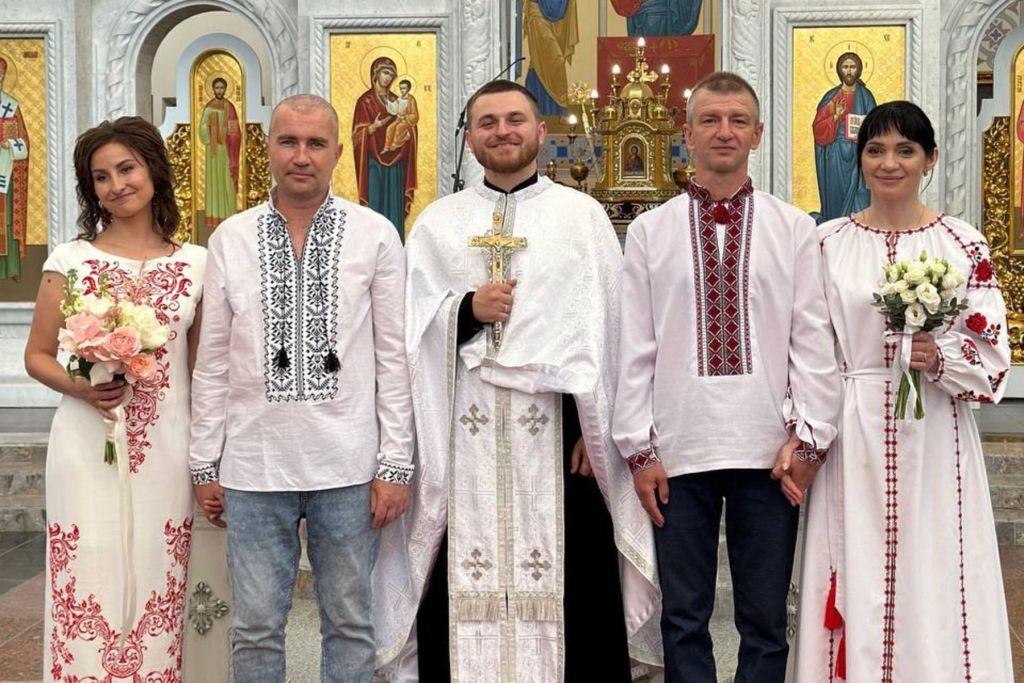
Soldiers from Volyn, who underwent psychological rehabilitation in a local Greek Catholic church, decided to receive the sacrament of marriage.

"The Church can give guidelines. Families themselves will decide whether to follow biblical principles or not"

In the church "Preobrazhennya" in Kyiv, which Mykola attends, has been preaching a lot on the topic of family for the past three months.

"I think this is very effective in our time. Families need support, and it is very important to know what the Bible says about different aspects of family life. So the church 'offers' guidelines, but the final decision to follow biblical principles is up to the families," he believes.

Continuing his thought, Mr. Horodetsky said that in addition to preaching, the church can organize family retreats and conferences to deepen family relationships and discuss problems in a safe environment. Special attention should also be paid to military wives, both in Ukraine and abroad. Continue to keep in touch with them, inquire about their needs, provide communication, and offer opportunities for small group meetings. It is important that these groups be led by women with similar experiences. It is also important to train believers to help widows, to counsel them on how to offer support in ways that are not traumatic. Women who have lost their husbands in war need special care. The church should be prepared to help not only emotionally and spiritually, but also practically. For example, organizing volunteers to spend time with the children of fallen heroes, teaching them lessons, taking them to a club, becoming a mentor, or becoming a counselor. 

In conclusion, contrary to the statistics, we can say that many families find ways and strength to maintain their relationships and family ties during Russia's war against Ukraine. But they need the support of society and institutions. According to experts, changes in court practice regarding divorce should be developed today: mediation services or mandatory counseling with a family therapist should be included. It is important to create certified and standardized training programs for professionals in the relevant fields.

Also, churches of different denominations and beliefs should become more inclusive and take into account the specifics of the current challenges that Russia has brought to our families.

Author: Anastasia Vararu

Відкрийте більше з Вільні Медіа - Українська громада в США

Підпишіться зараз, щоб продовжити читання та отримати доступ до повного архіву.

Продовжити читання