The Ukrainian diaspora in the United States and other countries around the world has provided exceptionally strong support for the Olympic movement in Ukraine. During the years when Ukraine was subjugated by the Soviet Union, the diaspora called on the world to help liberate it and stop the genocide of the Ukrainian people. To do this, Ukrainians in the free world used various methods and means: press conferences, demonstrations, protests, interviews, radio and television appearances, articles, competitions, tournaments, and more. All of this took place in different countries around the world, including the United States, Canada, Australia, Argentina, Brazil, Mexico, France, Germany, and others.
Recognizing that international attention required an appropriate setting or major event, representatives of the Ukrainian diaspora turned their attention to the Olympic movement. Throughout the 1950s–1980s, the Olympic Games and Winter Olympic Games grew increasingly large-scale and global, gaining prestige, public interest, and popularity. Several factors confirm this: first, the growing number of competitors; second, the increasing number of participating countries; third, the expansion of competition programs; fourth, the rising geopolitical significance of Olympism; fifth, the staging of competitions on different continents; sixth, the growth of spectator audiences, and so on. Thus, Ukrainians around the world had an excellent opportunity, while living in different countries, to organize various actions and events that drew international attention to the Ukrainian question.
Among the many initiatives of the Ukrainian diaspora directly connected with the Olympic Games, the idea of publishing unique Olympic books stands out particularly vividly. Incidentally, they were published in English and French, the official languages of the international Olympic movement. These languages are also widely used for international communication. Thus, specialized Olympic literature produced by the Ukrainian diaspora could be read by millions of people around the world. The scale on which the world was introduced to the fact that Ukraine was a subjugated nation is truly remarkable.
1956 – Games of the XVI Olympiad (Melbourne, Australia)
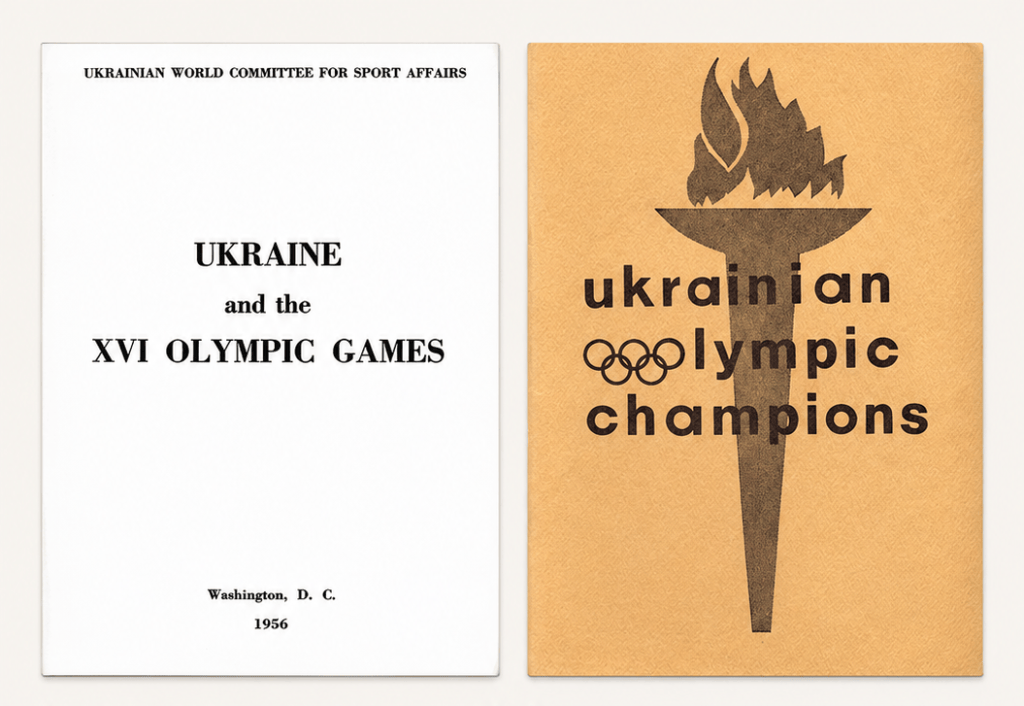
In 1956, the Ukrainian World Committee for Sports Affairs, which continued the work of the Ukrainian Olympic Committee, published a unique book titled Ukraine and the XVI Olympic Games. This name for the organization was chosen because the International Olympic Committee and the U.S. authorities did not approve the original name — Ukrainian Olympic Committee — since a single country cannot have two or more Olympic committees.
The publication was initiated by Osyp Zinkevych, a prominent diaspora civic and political activist, journalist, and founder of the Smoloskyp publishing house. The book was published in Washington in English, where the Ukrainian Olympic Committee had, in fact, been established. In this way, a multimillion English-speaking audience had an opportunity to learn more about why the Ukrainian people had fought for centuries for their freedom against their oppressors, why Ukrainian athletes did not represent their own country at the Olympic Games, and why the Soviet Union was committing genocide against the Ukrainian nation.
The book’s structure was exceptionally well thought out, moving from history to the present. The first chapter provides historical information about the origins and development of the Olympic Games in Ancient Greece. The second examines how relations between Ukraine and Russia turned into the gradual occupation of Ukrainian lands. The third chapter explains how sport was used as a political instrument in the USSR. The fourth reveals in detail why Ukraine did not participate in the Olympic Games as a separate team.
This is extremely interesting and relevant. Ukraine — then the Ukrainian SSR — was a co-founder of the United Nations and a member of many international organizations. Under the Constitution of the USSR, it should have had the right to conduct international relations and so on. But all of this was obstructed by the tyrannical and despotic position of the occupying power — the Soviet Union.
Two particularly interesting appendices were added at the end. The first contained an excerpt from a memorandum submitted by the Ukrainian Olympic Committee to the International Olympic Committee. The second included statistical information on the achievements of Ukrainian athletes competing as part of the USSR team at the 1952 Olympic Games.
Background. Games of the XVI Olympiad, 1956 (Melbourne, Australia; Stockholm, Sweden — equestrian events). 72 participating countries. 3,314 athletes.
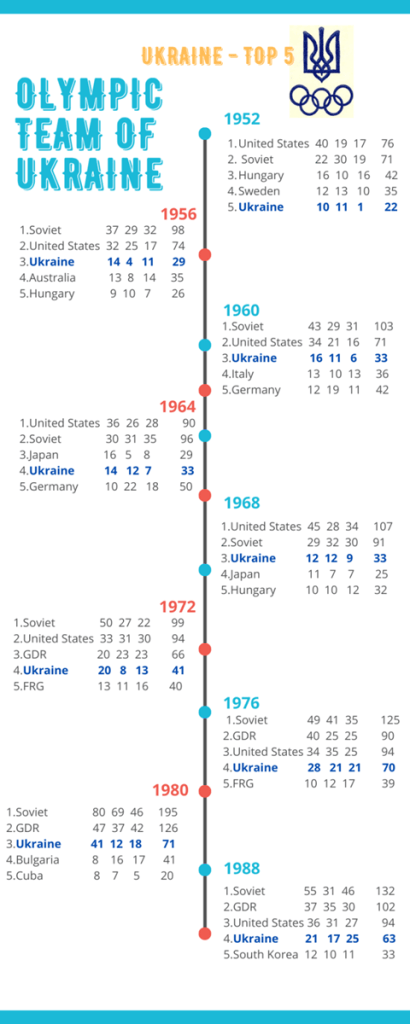
Interesting fact. The unofficial team standings at the Games of the XVI Olympiad were as follows (top five): USSR, United States, Australia, Hungary, Italy.
Had Ukraine competed as a separate team, the medal standings would have looked like this: USSR, United States, Ukraine, Australia, Hungary. Naturally, in that case, the USSR would no longer have been in first place!
1968 – Games of the XIX Olympiad (Mexico City, Mexico)
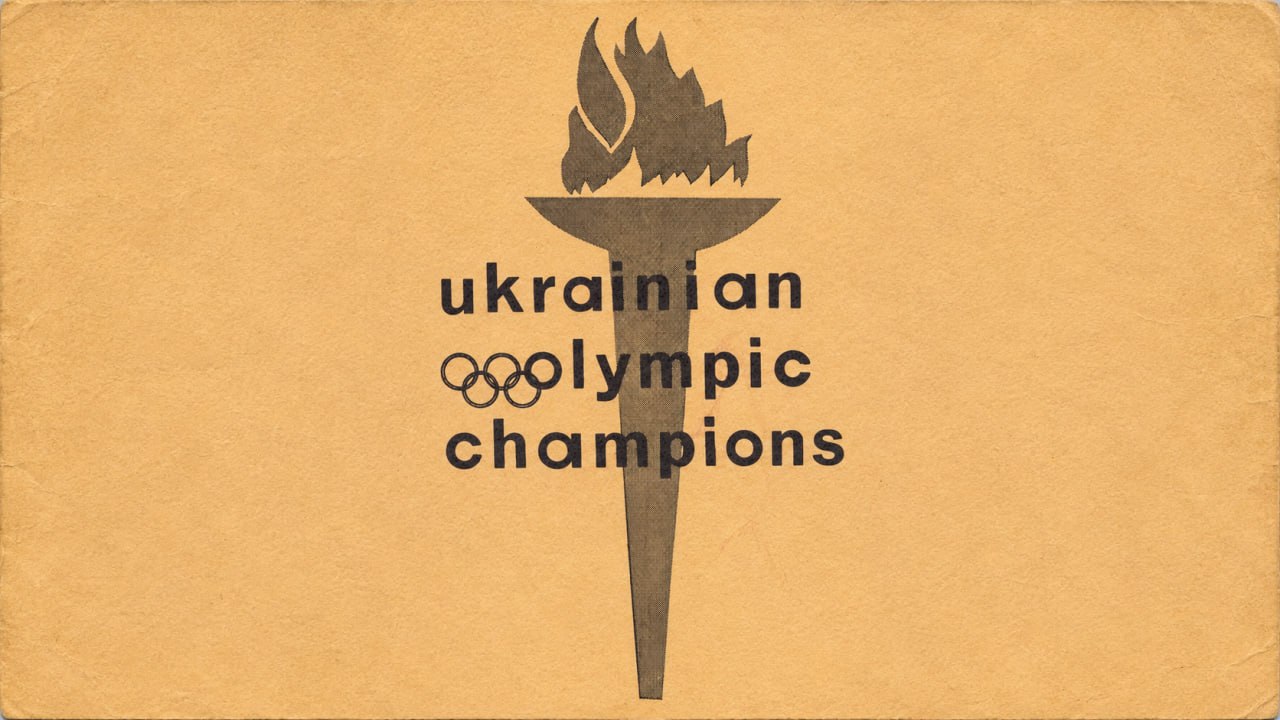
Osyp Zinkevych wrote the following in his diary about the book prepared especially for the 1968 Games: “The English-language booklet about Ukrainian Olympic champions, Ukrainian Olympic Champions, is ready; it is small, 43 pages.” Unfortunately, I personally have not been able to locate this book. Naturally, this is disappointing, as I would very much like to examine its contents. However, there is information indicating that the book was indeed published: “The first English-language edition was published on the eve of the 1968 Olympic Games in Mexico City (Mexico) and was distributed widely among representatives of the Olympic movement, press agencies, and international organizations.” Does anyone have a copy of this 1968 edition? It would be interesting to learn more.
Background. Games of the XIX Olympiad, 1968 (Mexico City, Mexico). 112 participating countries. 5,530 athletes.
Interesting fact. The unofficial team standings at the Games of the XIX Olympiad were as follows (top five): United States, USSR, Japan, Hungary, East Germany.
Had Ukraine competed as a separate team, the medal standings would have looked like this: United States, USSR, Ukraine, Japan, Hungary. You understand, of course, that in this case the USSR would not even have been in second place!
1972 – Games of the XX Olympiad (Munich, West Germany)
According to the information available to me, in 1972 a second edition of Osyp Zinkevych’s book about Ukraine’s Olympians was published. But why the second edition, if a book on this subject had already appeared in 1956? The 1968 publication should have been the second, and the 1972 edition the third. However, I personally have never found the 1968 edition anywhere. By contrast, the 1956 publication exists and is publicly accessible. It would be interesting to learn more about this.
What did the press write about the 1972 book? We read: “For the XX Olympiad in Munich, a second edition of O. Zinkevych’s book Ukrainian Olympic Champions is being prepared… The second, expanded edition of this book will appear on the eve of the Munich Olympics. The book is richly illustrated and contains documentary material about all Ukrainian Olympic champions beginning in 1952. It provides complete lists of Ukrainians who placed among the top six, as well as international championship tables and an introductory article which, based on the charter and principles of the International Olympic Committee, demonstrates that Ukraine has the full and lawful right to participate independently in the Olympic Games.”
Background. Games of the XX Olympiad, 1972 (Munich, West Germany). 121 participating countries. 7,115 athletes.
Interesting fact. The unofficial team standings at the Games of the XX Olympiad were as follows (top five): USSR, United States, East Germany, West Germany, Japan.
Had Ukraine competed as a separate team, the medal standings would have looked like this: USSR, United States, East Germany, Ukraine, West Germany. Once again, we note that with such a redistribution of medals, the USSR would not have been in first place!
1976 – Games of the XXI Olympiad (Montreal, Canada)
In 1976, the Ukrainian diaspora in the United States and Canada made a powerful statement before the international community on the issue of liberating Ukraine from Soviet occupation. Osyp Zinkevych, one of the initiators of the campaign for a free Ukrainian Olympic movement, traveled to Canada and became actively involved in the work of the newly established Ukrainian Olympic Committee in Montreal.
The Ukrainian press in the free world, reporting on the plans of the Ukrainian Olympic Committee in Montreal, mentioned the publication of a book among its important objectives: “The Committee considers the following among its main tasks: …to republish the book Ukrainian Olympic Champions in at least three languages.” I assume these three languages were English, French, and Ukrainian.
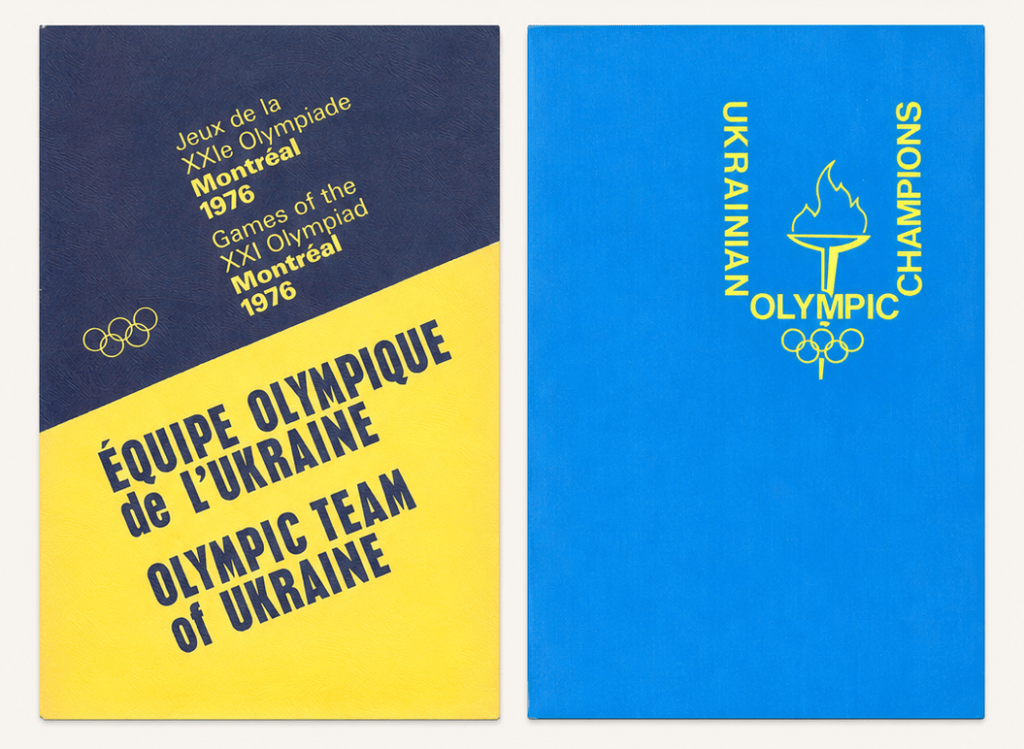
The publication was presented during a press conference held by the Ukrainian Olympic Committee in Montreal, attended by many foreign journalists. It was reported as follows: “A. Fedynsky presented and explained the brochure The Ukrainian Olympic Team, which was published by the World Congress of Free Ukrainians for the Ukrainian Olympic Committee with the assistance of UCIS, the Smoloskyp Ukrainian Information Service, and the WCFU Information Service. The brochure contains 44 pages and includes a list of 163 Ukrainian athletes from Ukraine who were part of the USSR Olympic team, as well as a list and information about Ukrainian athletes who had participated in the previous six Olympiads.”
Andrii Fedynsky’s presentation, incidentally, generated lively interest among those present: “The correspondents in attendance asked questions in French, English, German, and Ukrainian. Most of the questions concerned Andrii Fedynsky’s presentation, and in his responses in English, German, and Ukrainian he provided comprehensive information about athletes from Ukraine and about Ukraine’s participation in the Olympic Games.”
From the memoirs of the head of the Ukrainian Olympic Committee in Montreal, we learn the following about the publication of the book: “The WCFU paid for the printing of the brochure The Ukrainian Olympic Team… in a new edition with appropriate additions, the brochure was republished from its own funds as a 44-page publication titled The Ukrainian Olympic Team, in a print run of two thousand copies, in English and partly in French. This print run proved too small, so another two thousand copies were printed, bringing the total to 4,000 copies.”
This demonstrates just how popular the book about Ukraine’s Olympians was: the first print run was insufficient to meet demand. An additional edition therefore had to be printed immediately. Yaroslav Pryshliak even discussed the book in a special radio program in Canada: “We prepared and distributed appropriate informational and advocacy materials, namely 4,000 copies of a 44-page brochure about ‘Ukrainian Olympic Athletes,’ presenting all of their achievements at the previous six Olympic Games, as well as a list by name of those Ukrainian competitors who took part in the 21st Olympic Games, unfortunately under the flags of the USSR.”
In this way, the Ukrainian diaspora made a powerful statement to the entire world that Ukraine was subjugated by the Soviet Union and needed liberation.
Background. Games of the XXI Olympiad, 1976 (Montreal, Canada). 92 participating countries. 6,073 athletes.
Interesting fact. The unofficial team standings at the Games of the XXI Olympiad were as follows (top five): USSR, East Germany, United States, West Germany, Japan.
Had Ukraine competed as a separate team, the medal standings would have looked like this: USSR, East Germany, United States, Ukraine, West Germany. Had Ukraine competed separately, the USSR would not have finished in first place!
1984 – Games of the XXIII Olympiad (Los Angeles, United States)
Unfortunately, Ukrainian athletes did not participate in the Olympic competitions in Los Angeles. This refers to those who would otherwise have competed as part of the USSR national team. At the same time, athletes of Ukrainian origin did take part in the Games as members of the national teams of the United States, Canada, and other countries.
The Soviet authorities boycotted these Olympic Games. The stated reason was that the organizing committee and the U.S. authorities allegedly could not guarantee the safety of athletes from the Soviet Union. In reality, however, it was a planned response to the U.S. boycott of the 1980 Olympic Games. The difference was that the earlier boycott had a substantial reason — the Soviet invasion of Afghanistan.
Despite the absence of Ukrainian athletes among the Olympic participants, the diaspora still staged major demonstrations during the Games. An exceptionally interesting and informative book, Ukrainian Olympic Champions, was also published. It contained more than 150 pages of detailed information about Ukrainian athletes from 1952 to 1984. The book included statistical data on the Olympic Games and Winter Olympic Games, as well as on Ukrainian participation in them.
Background. Games of the XXIII Olympiad, 1984 (Los Angeles, United States). 140 participating countries. 6,800 athletes.
Interesting fact. The unofficial team standings at the Games of the XXIII Olympiad were as follows (top five): United States, Romania, West Germany, People’s Republic of China, Italy.
Had Ukraine competed as a separate team, the medal standings would have looked entirely different.
Author: Oleksii Lyakh-Porodko