The Smoloskyp publishing house is a unique phenomenon, a phenomenon of the Ukrainian people on both sides of the Atlantic Ocean. On the publishing house’s website, the “About Us” section states the following: “The Smoloskyp publishing house was created in emigration. After Ukraine gained independence, it moved its activities to Ukraine. In the United States, Smoloskyp published dissident and human rights literature, as well as works by Ukrainian writers repressed by the Stalinist regime. In Ukraine, Smoloskyp publishes debut books by the youngest authors, setting itself the goal of creating and expanding an environment for Ukrainian creative youth.”
We then read the following: “The Smoloskyp publishing house was founded in 1967 in Baltimore, United States, and named after Vasyl Symonenko. The first book published by Smoloskyp was Osyp Zinkevych’s From the Generation of Innovators: Svitlychnyi and Dziuba (1968). In the United States, Smoloskyp mainly published works of Ukrainian samizdat and works by Ukrainian writers banned in Soviet Ukraine… Smoloskyp also published a number of books in English: poems by Olena Teliha, letters from Ukrainian women political prisoners, the 6th and 7–8th issues of the samizdat Ukrainian Herald, bulletins of the Ukrainian Helsinki Group, a collection of testimonies from the International Sakharov Hearings, a collection of documents of the Ukrainian Helsinki Group, an encyclopedic reference book on the millennium of Christianity in Ukraine, and a reference book on Ukrainian Olympic champions.”
Such was the titanic work of the Smoloskyp publishing house over several decades in the field of preserving Ukrainian identity and fighting for Ukraine’s freedom.
You probably noticed that Smoloskyp published a reference book on Ukrainian Olympic champions?! Perhaps this surprised you, the readers? After all, sports or Olympic themes are not represented at all at the current stage of the publishing house’s development. And yet here we encounter information about a reference book on Ukrainian champions of the Olympic Games. It is unfortunate that the “About Us” section contains only such a brief mention of the large-scale, many-year activity of Smoloskyp activists in the Olympic field. Still, at least such a mention exists. This is precisely what prompts me to write in more detail about the unique Olympic activity of the Smoloskyp publishing house.
What Are Smoloskyp’s Olympic Documents?
Thus, indeed, throughout the 1960s–1990s, Smoloskyp activists carried out an enormous amount of Olympic-related work. I will now focus on one aspect of their multifaceted, tireless, and fruitful activity — “Smoloskyp’s Olympic Documents.”
A natural question arises: what are “Smoloskyp’s Olympic Documents”? I provide the explanation from the pages of the newspaper Svoboda. Here is what was written about it: “The collection Smoloskyp’s Olympic Documents has appeared. The collection of Smoloskyp’s Olympic documents has already been published. The collection includes: all materials from the press conference of August 2, 1984 — the opening statement, a statement on the mortality of Soviet Olympians, a statement on Ukraine’s participation in the Olympic Games and the national discrimination of Soviet athletes, a complete list of deceased USSR Olympians, comparative tables, a transcript of the press conference, a transcript of an interview with A. Karkots on Channel 9 television, a transcript of Ray Brim’s radio program, on which A. Sorokovsky appeared, and clippings from the foreign-language press.”
What an array of materials! Just imagine: several large-scale projects and events were included in one collection.
The Press Conference of August 2, 1984, Los Angeles, USA

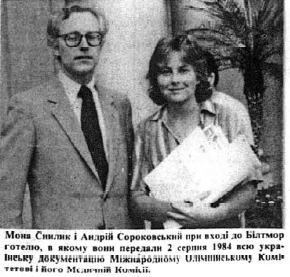
The brief chronology of preparations for the press conference was as follows: Monday, July 16 — the opening of the Ukrainian Olympic Information Bureau in Los Angeles. Andrii Sorokovskyi was chosen as head of the bureau. I am pleased to note that I had a wonderful opportunity to interview Mr. Andrii. He shared extremely interesting and little-known facts about those events: Friday, July 27 — Osyp Zinkevych, correspondent of the Smoloskyp information service, received full press accreditation for the Olympic Games. He took part in a banquet honoring American Olympic champions who were admitted to the Pantheon of Olympic Glory; spoke at the first press conference of the International Olympic Committee at the main Olympic press center; Saturday, July 28 — thanks to Daria Chaikovska, Ukrainian ensembles performed in the cultural and artistic program of the Olympic Games at Expo Park: Kobzar, led by V. Bozhyk; Yavir, led by Y. Hrynda; and the Cossack dance ensemble Tuman, led by H. Montero. Later, these ensembles also performed in other Olympic programs; Monday, July 30 — preparations were completed for all materials on the premature deaths of USSR Olympians, on the issue of Ukraine’s participation in the Olympic Games, and on the national discrimination of Soviet athletes. In the morning, a ten-minute interview with Andrii Karkots aired on television, on Channel 9. The press conference scheduled for August 2, 1984, was announced. The first telephone conversations took place with representatives of the IOC Secretariat and its Medical Commission. It was decided that the official representatives of Smoloskyp at the Games of the XXIII Olympiad would be A. Sorokovskyi, A. Karkots, M. Snylyk, O. Zinkevych, L. Verba, L. Sokil, Ya. Zinkevych, and others; Tuesday, July 31 — telephone conversations with the IOC took place, as well as visits to press agencies and newspaper editorial offices in Los Angeles by groups of two people from the Smoloskyp activist circle. The first meeting of A. Sorokovskyi and A. Karkots with representatives of ABC also took place. The Ukrainian bureau was visited by the well-known American columnist Rick Talley; Wednesday, August 1 — popular newspapers, the Chicago Tribune and the Daily News in Los Angeles, published Rick Talley’s articles on the mortality of Soviet Olympians, the issue of Ukraine’s participation in the Olympic Games, and the national discrimination of athletes in the USSR. The Moscow Telegraph Agency TASS distributed, in various languages, a report about Smoloskyp’s press conference at the main Olympic press center. TASS sharply criticized the Ukrainians and the press conference they had organized.

This is a brief description of the activities of Smoloskyp activists before the famous press conference of August 2, at which many unique materials and little-known shocking information were presented and made public. The subject of the press conference and its significance, of course, did not please the Soviet authorities. Therefore, a propaganda campaign was launched to discredit it, distract attention from it, or counteract it. Their efforts not only failed to harm it, but even gave it momentum and publicity throughout the Olympic world.
Thus, the events of August 2, 1984, attracted the attention of a multimillion-strong Olympic audience, the political community, and many concerned observers. The Ukrainian press in the United States described the event as follows: “Los Angeles, UIS Smoloskyp. — On Thursday, August 2 of this year, a major press conference was held at the prestigious American Press Club of Los Angeles, where, for the first time, a long list of 59 USSR Olympians who had died prematurely, under mysterious circumstances, and at a young age was made public. The press conference was organized by Smoloskyp. It was chaired by Mona Snylyk of Los Angeles, and speakers included Andrii Sorokovskyi, head of the Ukrainian Olympic Information Bureau in Los Angeles, and Andrii Karkots, Smoloskyp’s spokesman at the XXIII Olympiad.”
It turns out that this conference was organized to address several important issues. Among them, a central place was occupied by the investigation and exposure of the Soviet system’s crimes against athletes, which led to their premature deaths. Indeed, this remains an important and relevant issue to this day. After all, the terrorist regime of the russian federation still uses doping as an instrument of state policy.
To achieve broader publicity, the organizers invited a significant number of foreign media representatives. In particular, the press conference was covered by five television channels, eight radio stations, and numerous accredited journalists from the United States, the USSR, Israel, Germany, France, the Netherlands, Mexico, Czechoslovakia, Bulgaria, Hungary, Romania, and other countries. It was truly a large-scale information campaign at a time when the global Internet did not yet exist. Representatives of the International Olympic Committee, the IOC Medical Commission, and National Olympic Committees also joined the press conference. The active informational support of several powerful radio stations should also be noted: Radio Liberty, Radio Free Europe, and Voice of America.

Opening the press conference, Mona Snylyk said the following: “At one time, we organized demonstrations. They were always peaceful and were never directed against athletes, but against the Soviet Union’s violation of Olympic principles. In carrying out our activities, we often heard that we were mixing politics with sports. On the contrary, we are deeply convinced that it is precisely we who are fighting the politicization of the Olympics by demanding that states not interfere in the Games. As supporters of Olympic ideals, including the participation of the greatest possible number of competitors in the Games, we are convinced that noninterference by the Soviet Union would have allowed Ukraine to join the Olympic family… We have called today’s press conference for two reasons. Both are connected with state interference in sport, practiced by the greatest violator of the Olympic Charter — the Soviet government. We want to believe that, in view of the political events of recent years, as well as the current Olympic boycott, the IOC and the mass media will more readily recognize the destructive role of the Soviet Union in the Olympics, something to which we have been drawing attention for years. Therefore, we want to focus attention on the issue of national discrimination and Soviet colonialism in sport, on the exclusion of Ukraine from the Olympic movement. The second issue — which we are presenting today for the first time — is the shocking discoveries indicating that the Soviet Union is literally sacrificing its Olympic athletes in the name of gaining glory and international prestige for itself.”
The powerful opening of the press conference gave it a global scale and unprecedented relevance.
The following speakers addressed the problematic issues in greater detail by topic. In particular, Andrii Sorokovskyi spoke about national discrimination in sport in the USSR and the issue of Ukraine’s participation in the Olympic Games. To support his words, Andrii Sorokovskyi used demonstration materials that had a considerable impact on the participants: “On the basis of graphically presented tables and statistical data, he pointed out how the russians exploited athletes of different nationalities, violating the statute of the International Olympic Committee by not allowing Ukraine and Belarus, members of the UN, the Baltic peoples, and all other republics of the USSR to represent their nationality and their peoples at the Olympics.”
Indeed, for decades in the USSR, in the “evil empire,” genocide on national grounds was carried out among athletes. Ukrainians suffered the most. Andrii Sorokovskyi himself said the following: “In the conviction that national discrimination and colonialism should have no place in the Olympic movement, we demand that the IOC revoke its recognition of the National Olympic Committee of the USSR and require the government of the USSR to establish national Olympic committees for all 15 republics of the USSR, including Ukraine. We are deeply convinced that at a time when the destructive role of the Soviet government in the Olympic movement will be most evident, this proposal will be accepted as the first step away from the abyss.”

It was a strong speech and an appeal to the international community to pressure the Soviet Union over the violation of human rights and the oppression of entire nations.
The most dramatic part of the press conference was the publication of a list of 59 Olympians from the USSR, including 24 Olympic champions, who had died prematurely, at a young age, and under undetermined circumstances. The organizers showed the conference participants materials containing statistical data. For example, in 1976–1982, compared with 1952–1975, the mortality rate among Olympians in the USSR increased by 420%. At the same time, in West Germany and East Germany combined, it increased by 100%, while in the United States it increased by only 9%. Another table showed that in the period from 1952 to 1982, for every thousand members of Olympic teams, 45 Olympic medalists died in the USSR, 17 in the United States, and 15 in Germany.
After the publication of these shocking statistical data, speaker Andrii Karkots declared the following: “We challenge the Soviet government and demand that it explain, if it can, why 59 Olympians died who, at the time of death, were on average only 41 years old. We challenge the Western mass media, especially American journalists: pick up what we have begun here. Ask tough questions, do not be easily reassured, and be willing to be outraged.”
A powerful speech, striking information — and all of this was done by Ukrainians in the diaspora. As we can see, the Ukrainian community in the United States prepared thoroughly for marking the 1984 Olympic Games in Los Angeles. And this was only one part of its Olympic activity that year.
The Olympic Games in Los Angeles were marked by large-scale actions by the Ukrainian diaspora. Smoloskyp activists played a key role in this struggle for a free Ukrainian Olympic movement. Smoloskyp’s Olympic documents testified to the titanic work carried out by Ukrainians who fought for justice on the international Olympic stage.
We have people and achievements to be proud of! After all, when you know history, you win victory!
Author: Oleksii Lyakh-Porodko