


The fourth year of Russia’s full-scale invasion of Ukraine has begun. This grim milestone served as a catalyst for numerous rallies and events across the United States. One such event took place in the heart of Silicon Valley.
According to The Stanford Daily and its author, Sofia Williams, nearly one hundred Stanford students and local residents gathered on campus for the Rally for Ukraine to mark three years since Russia launched its full-scale aggression against Ukraine. The event began with the Ukrainian national anthem and a moment of silence to honor fallen Ukrainians. Placards reading “Stop War” and “Stand with Ukraine,” as well as blue-and-yellow flags, painted faces, and shouts of “Slava Ukraini!” became the hallmarks of this year’s Rally for Ukraine.

Stanford political science professor and former U.S. ambassador to Russia, Michael McFaul, sharply criticized the position of current President Donald Trump on the issue of Ukraine during his speech:
“I find his actions shameful, immoral, and contrary to America’s national interests. They weaken us in terms of security and well-being,” McFaul stated. “That is why I want to stand in solidarity with these students.”
Those present also actively discussed the official U.S. stance on the war against Ukraine. Andrii Torchylo, co-president of the Ukraine Support Alliance at Stanford (USAS), called it a telling and concerning sign that the new administration has yet to make a clear public statement on Russia’s invasion.
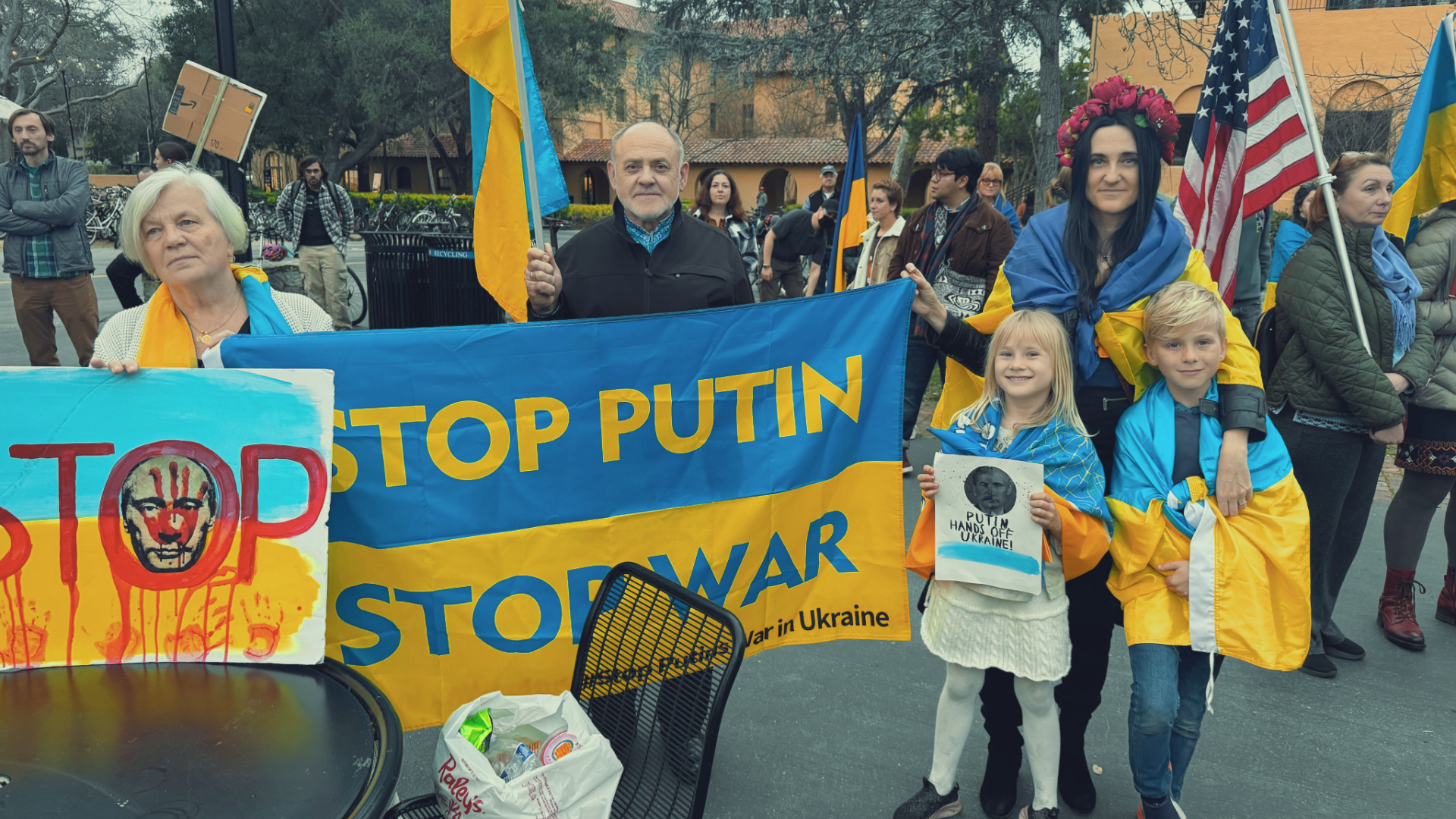
Alyssa Virker, co-president of USAS and a doctoral student specializing in Ukrainian literature, stressed in her speech the importance of continuing to speak out about the crimes Russia is committing in Ukraine:
“If we remain silent and fail to share what is obvious to us, then Russian propaganda wins,” Virker emphasized, adding that Ukraine continues to symbolize the fight for freedom and democracy.
Rally participants also mentioned Stanford’s role in disseminating information about the situation in Ukraine and Eastern Europe as a whole. Kyrylo Korol, a law student and member of USAS, noted that the university is dedicating increasing research and academic attention to the war, while urging the expansion of geopolitical studies to consider not only Russia but also Ukraine, the Baltic states, and other countries in the region from historical and cultural perspectives.
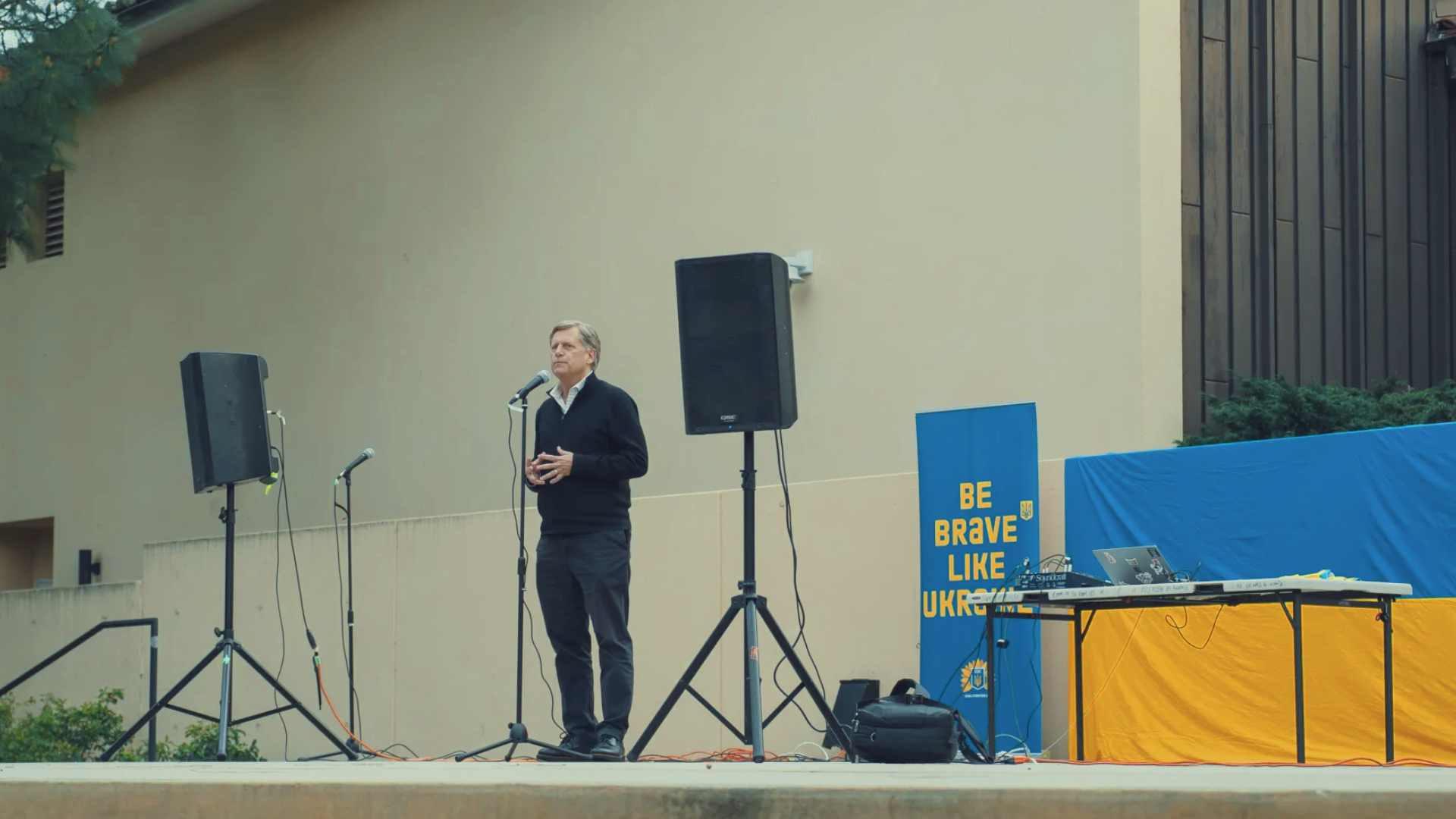
Local artists and university professors who had personally traveled to Ukraine during the war also spoke at the rally. Among them was Sasha Samuels, an artist who shared her impressions from trips to the front lines and discussed creating portraits of Ukrainian soldiers. Professor Dan Klein from Stanford’s Graduate School of Business, who teaches theatrical arts, spoke about his encounters with Kyiv residents in the summer of 2024, emphasizing that despite constant air-raid threats, people in the capital continue to live as normally as possible. Journalist and documentarian Alem Kent, an M.F.A. ’25 student, shared her personal story of evacuating from Sloviansk and presented an audio recording of folk singing from Kramatorsk, underscoring that even in active combat zones, Ukrainians have not lost their capacity for creativity and for preserving their cultural heritage. Many rally participants, including a significant number of Ukrainians, recounted enduring bombardments, losses, and yet, at the same time, an unyielding thirst for life and resistance to Russian aggression.
The event concluded just as it began—with the Ukrainian national anthem. In response to the rallying cry “Slava Ukraini!” came the unanimous reply “Heroiam Slava!” (“Glory to the heroes!”).