


A loud concert and an almost imperceptible meeting. Two events that, at first glance, seem unrelated. Yet both times I returned home with the feeling that I had heard something unnecessary.
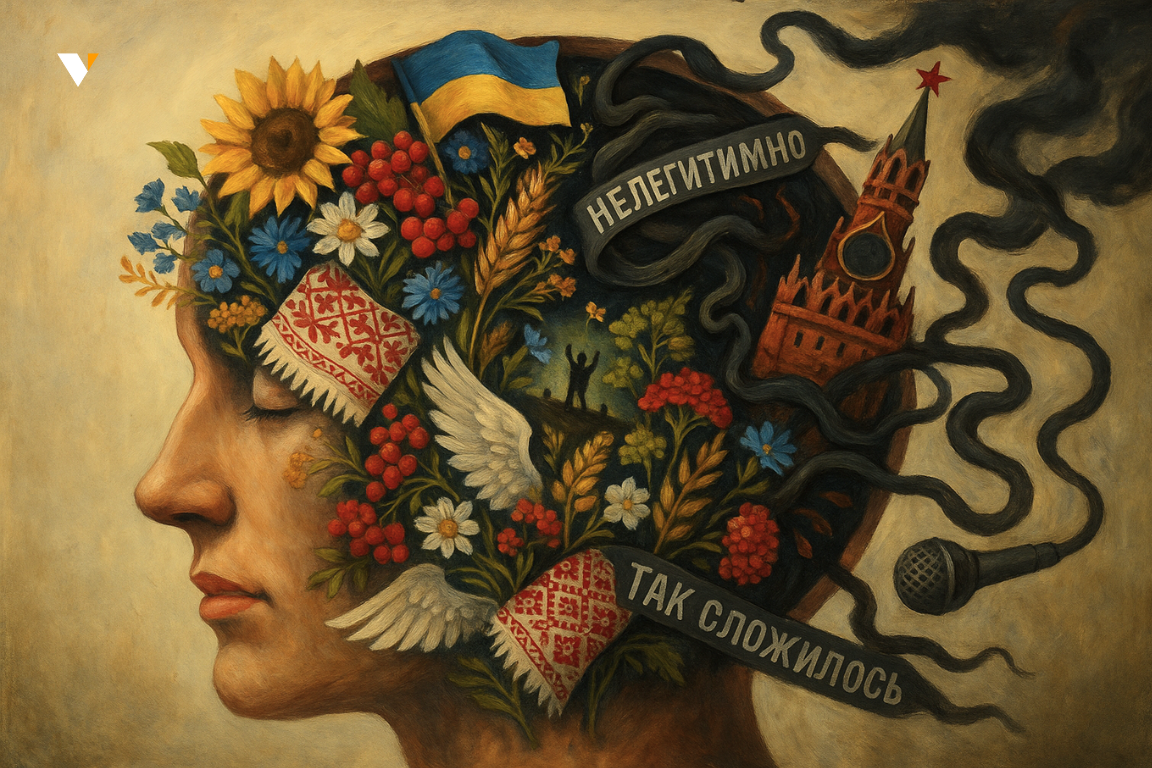
Act One. The Unconscious
The VV concert, part of their American tour, was remarkably successful. The vibrant Oleh Skrypka with his extraordinary energy, powerful music, and recognizable, lively movement—he moved across the stage freely, effortlessly, naturally. A unique combination of intimacy and drive at the same time.
“Nothing else can survive genocide, global catastrophe, except poetry and songs. No one can memorize an entire novel. No one can describe in detail a movie, sculpture, or painting, but as long as people exist, songs and poetry will live.” (Jim Morrison)
It was hard to stand still—music wasn’t just around; it was inside each person, vibrating from within.
The line for the concert stretched along the street, people dressed in embroidered shirts, an old sign with a white background and black letters, placed manually. The kind that displays the names of Ukrainian performers—I’ve seen these more than once. There have been plenty over the past three years: Druha Rika and Latexfauna in San Francisco, DakhaBrakha in Berkeley. But this time, there was something different in the line—more people speaking Russian. Many Russians, Belarusians, Jews, and Ukrainians came to the concert.
June is almost over, with the highest number of shellings of Ukrainian cities since the beginning of the war—although that's not certain, since each week “breaks” the previous record. Russia is trying to destroy Ukraine by all available means—missiles, drones, torturing our prisoners of war, distorting and twisting facts, information attacks, and language.
I hear from Ukrainian bloggers how many teenagers in Ukraine speak Russian, gathering in groups in the centers of different cities and listening to Russian rap—Kyiv, Odesa, Poltava, Kremenchuk, Dnipro. I recall a thought that poetry isn’t published much because it doesn’t sell well. But songs are much easier—poetry set to music reaches the listener more easily. Especially when the listener is vulnerable, yearning to hear music about “real” life, necessarily in a minor key, so it hurts. In the best traditions of the Russian poetic school: to glorify inevitable decline, loss, “decay,” preferably with someone dying. The main thing is not to act, not to change anything, but to observe from the sidelines, savoring the tragedy of the moment.
It is naïve to think that Russian music is just about music. It’s about what a person lets into their consciousness, about the thoughts and narratives that will occupy their mental space and influence their actions. It’s about what a person will consider their own. Several generations—from the older ones to mine—consider their own those Russian songs they listened to in their youth, which they still associate with important events in their lives.
Returning to the VV concert, I must admit, it was quite upsetting to hear Ukrainians I know well speaking Russian. And it felt strange, because at previous Ukrainian concerts I had barely heard any Russian. But after reading that Oleh Skrypka is sixty-one (!) years old, I realized something—there were quite a few of his peers in the audience, give or take ten years— the generation of Russian rock and bard songs, a whole cultural layer seemingly designed to numb the conscience and muffle critical thinking. And then, the playground rule kicks in: if among ten Ukrainian children there is even one Russian-speaking child, all the Ukrainian children switch to Russian.
Act Two. The Conscious
The beginning of July. I take an oath to join the Santa Clara County and Ukraine Public Diplomacy Commission. The Commission promotes cultural, artistic, and educational exchanges. It has an interesting history—it was established in 1994. However, back then it was the Moscow Commission. On October 8, 2024, the Santa Clara County Board of Supervisors officially renamed it. This decision was a logical continuation of the Board’s resolution on March 2, 2022, which severed ties with the Moscow government and condemned the actions of the Russian government against Ukraine and the Ukrainian people.
In 2023–2024, the Commission expanded its activities, establishing ties with Ukraine and beginning to host Ukrainian delegations with the support of the U.S. Congress’s Open World program grants. Previously, it had already cooperated with this program by hosting delegations from Moscow, but this June, it organized the visit of a Ukrainian delegation involved in investigating war crimes of Russia in Ukraine. The meetings are open to the public, just like city council or county board meetings—anyone can attend in person or join online, listen to discussions and initiatives, ask questions, or share their opinion.
A large hall with a high ceiling and the typical cold, neutral lighting. Along the front wall is a semicircular table where 15 commission members are seated, each with a microphone and a nameplate. On the side, there is a large screen showing the faces of those who joined remotely. In front—rows of chairs for the audience.
We were actively discussing the visit of the Ukrainian delegation, sharing impressions, and coordinating the schedule of upcoming events. Then came the time for commissioners’ remarks. Some spoke about plans, others shared personal reflections. A man sitting two seats away from me took the floor. Later, after the meeting, I was told that he was from Kyiv, a Ukrainian. He began his speech with the words: “Do you know that Ukraine is the most corrupt country in the world?” I glanced at his nameplate—it was written in the Russian style—almost always a red flag. The man continued: “We are sending them money, weapons, and their government and president are illegitimate. They are profiting from the war!”
Interrupting someone’s speech is considered bad manners, but this was not the time for manners. I was the first to interrupt, saying that this was not true, and that according to the Constitution of Ukraine, both the Government and the President are legitimate. The man became indignant and asked to finish his speech. After that, other people also tried to interrupt and stop him, but he stubbornly continued voicing his points—about the illegitimacy of the Ukrainian government, and dramatically questioned “why we were even hosting the Ukrainian delegation, since they are police, judges, and prosecutors, and in Ukraine, they kidnap people right from the streets and send them to their deaths.” For a moment, it felt like we were not at a commission meeting but at a UN briefing. All that was missing was a “Russia” nameplate in front of him and a stony-faced simultaneous interpreter.
Eventually, his speech was interrupted by other commission members, who explained the issue of martial law, the impossibility of holding elections, the constitutional basis for these actions, and the futility of further discussion. In response, the man expressed his concern about the situation, but the chair of the commission advised continuing the conversation after the meeting. And indeed, after it ended, the man was politely and eagerly chatting with at least two commission members, continuing to spread his “concerns” around the table with the microphones.
It was an unpleasant experience—to encounter someone who not only consciously repeats Russian narratives but stubbornly and diligently follows a script straight from the playbook.
What’s the common thread?
A loud rock concert, an atmosphere of unity… and at the same time, a crowd speaking Russian. A meeting with a person in a Ukrainian commission who deliberately pushes Kremlin narratives. In both cases, there is a similar feeling—something is happening that shouldn’t be. Both situations have a common denominator—the only difference is that in the first case it’s unconscious, and in the second, it’s entirely deliberate.
Russian propaganda is cunning. It plays on language, history, and identity to subtly weave its narratives into conversations, social media posts, even community events. Language is not just a tool of communication; it is about dignity, and also about security and responsibility.
Russian propaganda doesn’t work without those who unconsciously transmit foreign messages, who unwittingly pick them up and spread them further. It needs those who allow this propaganda to live in everyday life, in dialogues, in things that sound familiar but, in reality, are not truly ours.
As I was editing this text, an interview with Vitaly Portnikov about linguistic schizophrenia appeared. Mr. Portnikov talks about the difference between the Russian and Ukrainian languages. In Russian, depersonalizing constructions are often used, blurring the line between the actor and the action. For example, they say “the circumstances turned out that way” or instead of “I decided,” “it happened that way.” It’s the grammar of irresponsibility, where the action exists but the doer seems to disappear.
In Ukrainian, on the contrary, grammar and syntax often compel you to clearly name the subject: “I did,” “They came,” “We decided.” This difference in language matters. It shapes thinking, worldview, the habit of taking responsibility. And one thought really stuck with me: “It doesn’t matter what language a person speaks—but not in our time.” “Не має значення, якою мовою розмовляє людина, але не в наш час”.
About Author:
