


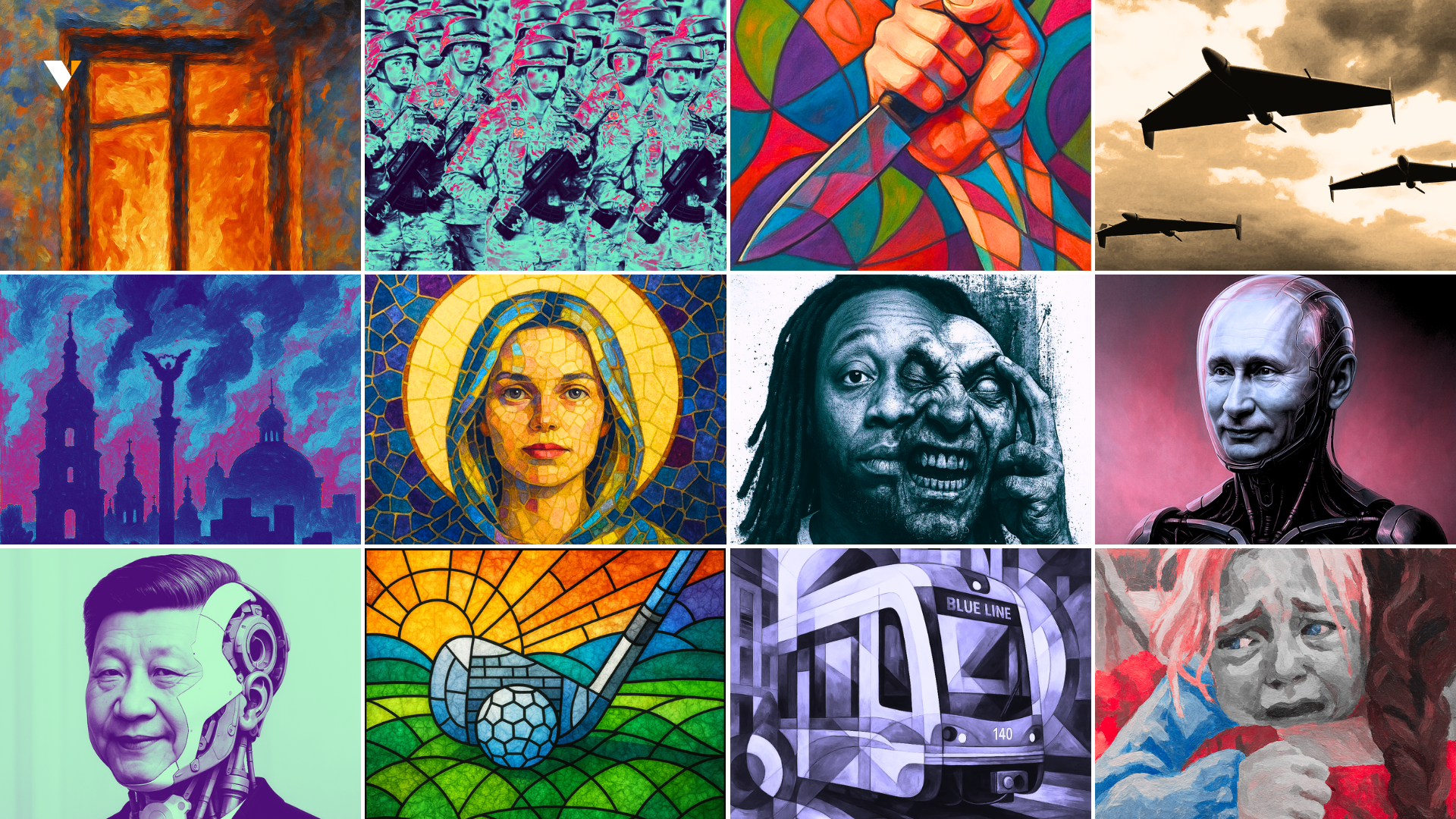
In Charlotte, North Carolina, a Ukrainian woman was murdered. Iryna Zarutska, 23 years old. She arrived under the Uniting for Ukraine program, worked at a pizzeria, and dreamed of building a life after fleeing Kyiv. Beautiful and young. She sought safety but found death in a Lynx Blue Line train car, when a homeless man with a criminal past drove a knife into her neck.
Just a few days later, thousands of kilometers from the site of this tragedy, dictators Xi Jinping, Vladimir Putin, and a handful of lesser allies seemed to joke—yet in fact seriously discussed—how to live to 150 years by transplanting organs. And this was no comic book scene. A journalist’s microphone “accidentally” caught their direct words: “Biotechnologies are constantly developing. Human organs can be transplanted endlessly. The longer you live, the younger you become, and it is even possible to achieve immortality,” a Chinese interpreter said, following Putin. Xi then replied: “Some predict that this century people may live to 150 years.”
This is the current reality of the world, where tyrants dream of immortality, while a Ukrainian refugee is robbed of decades of her very human life. This was not a “domestic dispute killing.” It was a senseless, random death that ripped a piece out of the Ukrainian community’s heart.
The cynicism of the situation was underlined by another fact: in the U.S., a fundraiser appeared for the attacker’s legal defense. Decarlos Brown—an African American—whose defenders tried to present the case as racial prejudice. Yes, the GoFundMe platform deleted this campaign, confirming that it does not allow fundraising for the defense of individuals accused of violent crimes, and refunded the donors. But the focus is not on the platform—it is on those who had already donated.
The reaction of American media and public figures to the murder of Iryna Zarutska proved symptomatic. Traditional mainstream outlets—The New York Times, CNN, The Washington Post—virtually ignored the tragedy, while right-leaning media, such as the New York Post, put it on the front pages, accusing Democrats of silence. Social media amplified the scandal: Elon Musk asked why the country remained silent about the death of a Ukrainian woman who fled war only to be killed on American soil. Republican politicians used the case as proof of failed security policies and leniency toward criminals. Meanwhile, Democratic leaders limited themselves to sterile formulas about a “tragedy we must mourn,” avoiding specifics about responsibility or causes. Such asymmetry in coverage only reinforced suspicions that the case was “uncomfortable” for the liberal camp: the victim was a white Ukrainian woman, the attacker—an African American with a long criminal record. In the end, Iryna’s death became another test for the American information space, revealing its political selectivity and inability to objectively respond to obvious evil. The mayor of Charlotte issued a formal statement, democracy fell silent, and major TV networks turned their attention back to the elections.
The naked truth is harsh and uncomfortable to acknowledge: America has ceased to be the country that guarantees safety—neither in the dimension of a defenseless young woman, nor in that of a great European state.
Just days earlier, Russia had carried out the largest airstrike since the beginning of the war: more than 800 drones and dozens of missiles attacked Kyiv and several other cities. Among the victims—a mother with her infant. In city courtyards—entire floors of apartment blocks collapsed. For the first time, the Cabinet of Ministers building was struck, and once again the Trypillia Thermal Power Plant, which powers Kyiv, was shattered. Smoke, destruction, horror, and exhaustion—now beyond measure.
How did the U.S. respond? President Trump announced a “second phase” of sanctions against Russia. What this means is unclear, but statistically it signaled yet another attempt to manage the information space—and a categorical unwillingness to take practical steps.
In stark contrast, the words of German Chancellor Friedrich Merz rang out. He directly called Putin a “war criminal” and declared that there could be no leniency. Without diplomatic courtesies, without tweets, without rhetorical terrorism. He simply said the truth. And it felt as if the world suddenly regained at least one moral compass. Someone said what everyone thinks but fears to articulate. And for a moment, it became easier to breathe.
It is clear that Europe understands how rapidly threats are developing. Every country is now rearming, truly preparing its armies for war. All this is happening at the expense of Ukrainians, who prepare daily for new bombardments.
Meanwhile, Putin in Beijing has bought himself another six months. China is not complicating financial schemes and is buying Russian oil—Moscow loses not 30% of revenues, but only 10–15%. This generosity is a trap. China has become the buyer of last resort and dictates maximum discounts. Russia, which once dreamed of being an “energy empire,” has finally become a discount country for the Middle Kingdom.
A truly alarming signal was the SCO’s decision to create a “Universal Center for Countering Threats.” This is not NATO-2, but it is a first salvo. It is also a blow to Russia’s positions in Central Asia. The Kremlin, dreaming of being the “elder brother,” has turned into the younger fool in a foster family.
America is visibly tired from the role of elder brother and leader of the free world. It now systematically responds with words but not deeds. And in this pause, in this inertia—lies Putin’s almost daily win. He lives from one offensive to the next, from deal to deal, from discount to discount. His strategic horizon is a few months. After that—flexible obstinacy and shell games.
The world, where dictators dream of immortality and democratic leaders lose themselves in caution, is dangerously destabilizing. In this wobbling, Moscow and Beijing see room for maneuver, while the West sees time for preparation. But this time—this is the aggressor’s resource. It may appear a sensible pause for diplomacy, but in reality it always works for those who attack. And until the democratic world begins to act faster, more decisively, and in unison, it faces great calamity. If Ukrainians remain silent victims, then the rest of the world, losing its moral right to call itself free, will continue its monotonous and powerless refrain: “We understand.”
About Author:
