


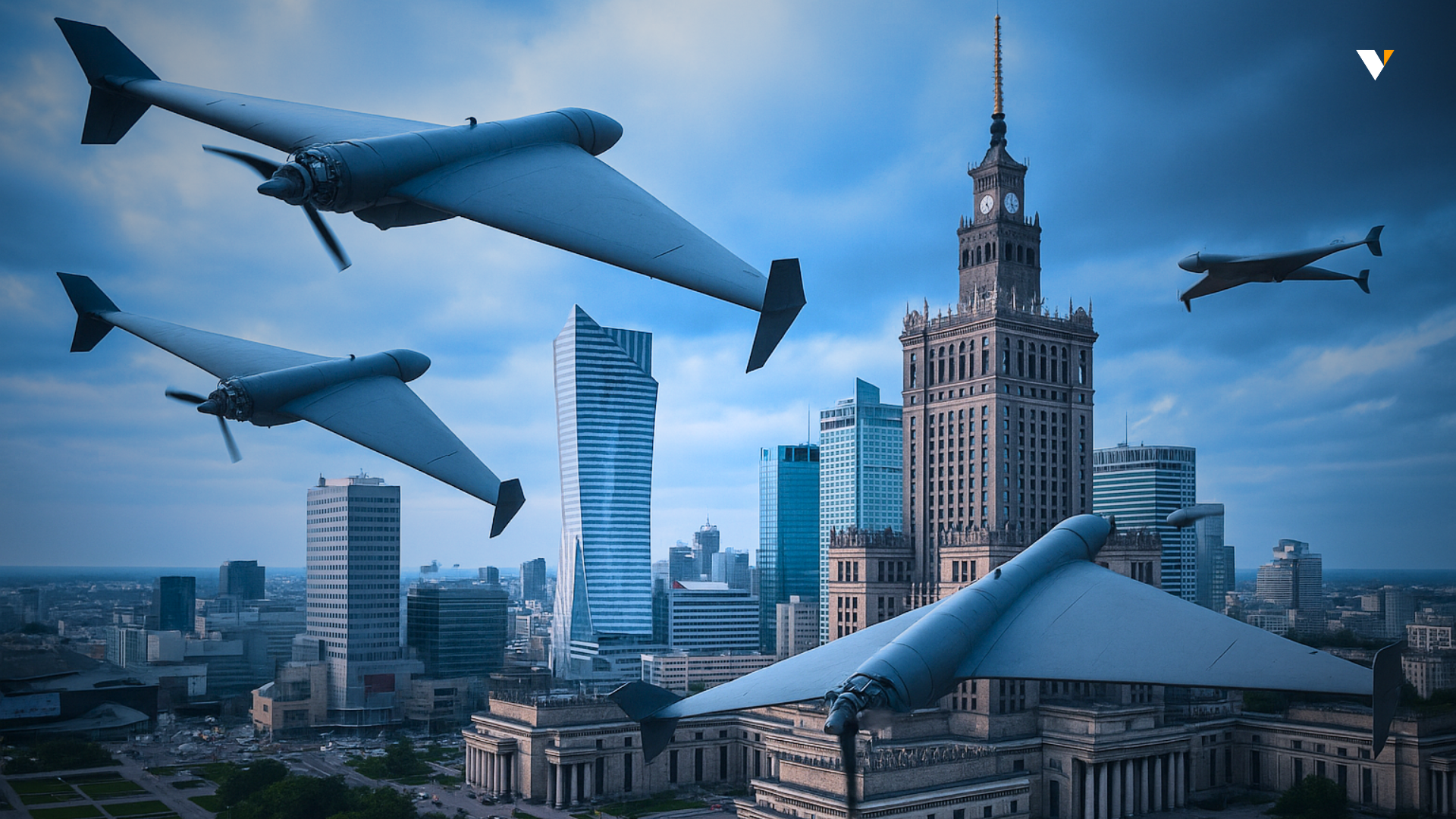
On the very day I was working on this text, Poland and Romania declared air raid alerts and scrambled their aircraft. In Romania—because of the appearance of a Russian drone that remained in the country’s airspace for nearly an hour. In Poland—because the drone was already approaching the Polish border, flying over the Ukrainian city of Kovel. And after, just a few days earlier, two dozen Russian drones entered Polish airspace at once, Warsaw decided not to take chances: they declared an alert, scrambled jets, and even shut down the airport in Lublin.
These incidents clearly demonstrate that Vladimir Putin’s air war against Europe is acquiring a systemic character—and all of this is happening against the backdrop of another round of Russian–Belarusian military exercises, which are also causing concern among neighboring states. There is no need to explain again that the appearance of Russian drones in the airspace of NATO countries has been a genuine shock for their citizens and governments. And not just for them. I myself, though I had warned of the possibility of such a scenario, that night—as I watched from a shelter in Lviv how the “Shaheds” flew simultaneously toward the city and the Polish border—could not believe my own eyes. What was happening turned theoretical assumptions into reality: the war that was said to inevitably spill beyond Ukraine’s borders had, in fact, crossed them. For this is not just Russia’s war against Ukraine, but Putin’s war against the West, against everyone who supports Ukraine.
Western politicians, to be sure, try to act as if nothing extraordinary is happening, while Ukraine’s neighbors respond with dignity to Russian provocations. But everyone understands perfectly well: this is an illusion. If the Kremlin continues to attack Europe with cheap drones, whose presence in the skies over Poland or Romania “officially” no one acknowledges, then NATO will be forced each time to scramble aircraft and shut down airports. And quite quickly, Central Europe will turn into a region of chronic instability. At the same time, as before, no one seeks a direct conflict with Russia. But what can be done when she is prepared to attack—even “anonymously”?
Some steps are already being taken. For example, Polish troops are beginning to train with Ukrainian instructors in methods of countering drones. But this is not enough. A logical solution would be joint patrolling of Ukrainian airspace. In Kyiv they have been speaking about this since 2022. And at that time, to some extent, I understood the arguments of Europeans who did not want to shoot down Russian aircraft over Ukraine, so as not to provoke a direct clash with Moscow. But Russian aircraft have long since disappeared from Ukrainian skies. Missiles are launched from Russian territory itself. So the only explanation why Western allies are still not prepared to shoot down Russian drones and missiles over Ukraine is fear. And it is precisely this fear that is Putin’s greatest advantage.
For in terms of resources, money, technology, the West outweighs Russia by many times. But fear cancels out this advantage. Fear allows Putin to carry out one provocation after another, crossing new “red lines.” And yet the logic seems simple: joint patrolling of Ukrainian skies in the west and south would remove the threat of “Shaheds” for Poles and Romanians, and give Ukraine the opportunity to concentrate on defending the center and the east. But the logic of fear is a poor ally. Therefore, European capitals will continue to request more air defense systems for themselves, avoiding the solution that could truly stop Putin. And here again, it is impossible to manage without the leadership of the United States. Only if this becomes a joint plan of America and Europe can fear be made to retreat.
The same applies to sanctions. The beginning of Russia’s drone war against Europe should have made sanction pressure even harsher. President Donald Trump is demanding that Europeans impose sanctions on China, India, and other sponsors of the Kremlin’s economy, declaring that the United States is ready to join in. And this is logical: Moscow’s energy revenues can only be cut off together. Otherwise sanctions will again turn into a demonstration of helplessness before the Moscow–Beijing alliance. But while Washington and European capitals weigh their own losses from new sanctions, Putin moves forward step by step.
In this game of fear and excuses, so far there is only one winner. And he is in the Kremlin. If the West does not change its logic of action, the “Shaheds” will continue to fly not only over Kovel and Lviv, but also over Warsaw and Bucharest. And perhaps even further—to places where just yesterday it seemed impossible.
About Author:
