


On November 16, the 92nd anniversary of the Holodomor—the genocide of the Ukrainian people—was commemorated at the San Francisco Main Library. The event featured a lecture by Nataliya Hoshylyk, Associate Professor at the University of California, Berkeley, followed by a screening of the documentary film “Hunger for Truth.” The event was organized by the California branch of the Ukrainian American Coordinating Council (UACC).
In the opening remarks, Mykhailo Pashkov, head of the library’s foreign literature department, and the event’s organizer from UACC, Maria Cherepenko, expressed gratitude that the library has provided space for commemorating the tragic Holodomor anniversaries every year since 2010. This annual event was founded by San Francisco Ukrainian community activist Nadiia Derkach, who has since passed away; however, the tradition lives on.
Any mention of this tragedy in the USSR was strictly forbidden, and even here, in the free world, many survivors did not dare speak of the horrors. “My father, who survived the Holodomor, never spoke about it,” confessed Maria Cherepenko.
The Consul General of Ukraine in San Francisco, Dmytro Kushneruk, also spoke at the event.
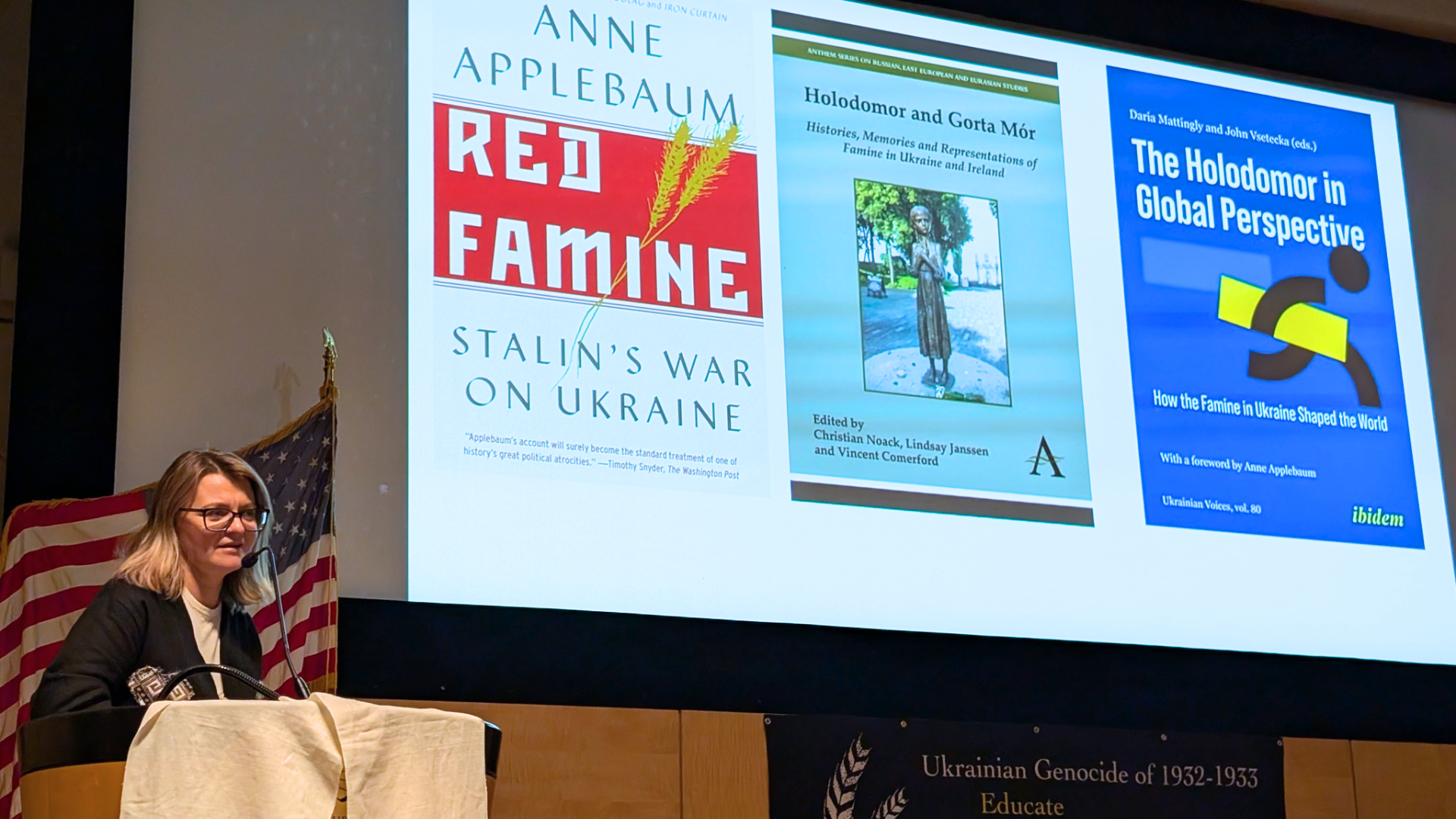
Nataliya Hoshylyk, Assistant Professor at the University of California, Berkeley, presented an overview of new fiction and non-fiction books about the Holodomor. In particular, she showed books that may interest children and teenagers.
Family stories or fictional narratives are the best way to help children and young people learn about these tragic pages in the history of their own people, noted Nataliya. “Grandma’s Chickens,” “Tell Me a Story, Grandma,” “Threads: The Ukrainian Shirt of Zlata”—the titles speak for themselves. Most of the books presented by Nataliya are bilingual: in Ukrainian and English.
Nataliya also presented books for adults. First and foremost is the documentary study by the prominent American expert on the history and contemporary politics of Russia, Ukraine, and the post-Soviet region, Anne Applebaum, Red Famine. There are also memoir genre books: Erin Litteken, The Memory Keeper of Kyiv (2022); Cynthia LeBrun, Black Sunflowers (2024); the psychological novel by Tania Piankova The Age of Red Ants, and others.
All speakers emphasized the connection between the Holodomor and the present-day war of aggression waged by Putin’s Russian Federation against Ukraine. Both the red Soviet empire and modern Russia have sought—and still seek—to destroy the Ukrainian people for refusing to submit, for resisting forced incorporation into an empire, and for their desire for freedom.
These parallels are vividly depicted in the documentary film Hunger for Truth, which was presented at the event. The film is based on materials left for history by Canadian journalist Rhea Clyman.
This courageous young woman became one of the first North American journalists to expose the true face of the Soviet “paradise,” including the horrors of famine in Soviet Ukraine.
Born into a Jewish family in Poland, she emigrated to Canada with her parents, Solomon and Anna, at the age of two in 1906. At 24, in 1928, she traveled alone to the USSR as a young journalist, enthralled by stories about the “socialist paradise.” She intended to report on the achievements of a workers’ and peasants’ state—where there was no unemployment, where women and men were equal, and where everyone was happy.
Rhea found a job as an assistant to New York Times correspondent Walter Duranty (the very one who praised the Soviet paradise). However, Rhea formed a completely different view of life in the USSR. She broke away from Duranty and became a correspondent for a London newspaper, while freelancing for many Canadian, American, and British outlets. She wrote what she saw with her own eyes.
The brave young woman traveled throughout the Soviet Union. First—to the north, to Stalin’s camps—to verify the rumors that the Soviet authorities were using prisoners as slaves. She confirmed it when she saw the living conditions in the closed town of Kem. “A prison city where no one smiles”—this was the headline of one of her articles about the camps.
In 1933 she and two American girls set off south to seek the truth. They reached Kharkiv, then the capital of Soviet Ukraine. In the film, we see a long line outside a bread store. The naïve adventurers had not stocked up on food—but there, they found nothing but endless queues. They left the city—surely in the villages there would be something to eat! But instead—they found deserted houses, unharvested grain, villages seemingly dead. Finally, in one village, locals surrounded them: “Could you deliver our pleas to the Kremlin? We are starving here… our children are eating grass because we cannot give them anything else…” One peasant woman, to prove her words, undressed her children, showing their swollen bellies and thin legs. “They took away our bread, the livestock died. They took everything.”
Footage from the 1930s alternates with contemporary scenes. The film, made in 2018—before the full-scale invasion—shows fighting still unfolding in the Donbas. A close-up of one family: that of Serhii Hlondar. Leaving behind his wife and newborn daughter, he went to defend Ukraine in a special forces regiment and was taken prisoner... Only in 2020 was he finally exchanged and returned home.
Meanwhile, scholars in the film explain the context of the events that the young Canadian journalist documented so bravely. Rhea Clyman wrote that the cause of famine in Ukraine and the Kuban was “not only drought, but also wrong decisions made at the top of the Soviet government,” excessive collectivization, and the expropriation of all peasant property. Anne Applebaum, Serhii Plokhii, and other scholars in Ukraine, the USA, and Canada point to the connection between the defeat of the Ukrainian National Republic in 1922 and the famine engineered by Stalin’s regime: the goal was to eliminate defiant Ukrainians who fiercely resisted the forced seizure of their farms and the destruction of the Ukrainian nation’s foundation—industrious peasants labeled as “kulaks.”
…After traveling across Ukraine (they also visited Donetsk, where they witnessed the terrible living and working conditions of miners) and the Kuban, the young travelers crossed the Caucasus into Georgia. A completely different life! One could rest and… eat! But soon the valiant Soviet “organs” arrested them. They showed them Rhea’s articles. “False articles about the USSR! Lies!” They were deported. First to Moscow, then put on a plane and expelled from the country.
Indefatigable Rhea, as soon as she returned to Canada, flooded newspaper editorial offices with articles telling the truth about Soviet life. Soon afterward she departed… to Germany, where she documented the rise of Hitler’s Reich. A Jew—in the Nazi capital—again writing about another tragedy unfolding before her eyes. She lived in Germany until the infamous Kristallnacht—the pogrom in November 1938. She finally fled Berlin with a group of Jewish refugees. Their plane crashed while landing in Amsterdam. Rhea broke her spine, but somehow survived and even avoided paralysis.
However, from then on she became quieter. She published articles but no longer traveled. She settled in New York, where she lived until 1981.
…The film interweaves history and the present day through individual human lives. Here is the NKVD case against Mykola and Kostia Bokan—a father and son who created a family photo album during the Holodomor… Files that were declassified only recently—in independent Ukraine, the dark secrets of the Soviet secret police finally came to light.
The talented film director Andrii Tkach created a portrait of a remarkable journalist and, at the same time, a sweeping account of the genocide of the Ukrainian people. A story stretching from Stalin’s Holodomor to Putin’s war.
“It is quite difficult to find a film about the Holodomor, especially in English, short enough to be shown at an event commemorating this tragedy,” noted Maria Cherepenko. Hunger for Truth is exactly such a film. It deserves the widest possible distribution—and not only within the Ukrainian community.
About Author:
