


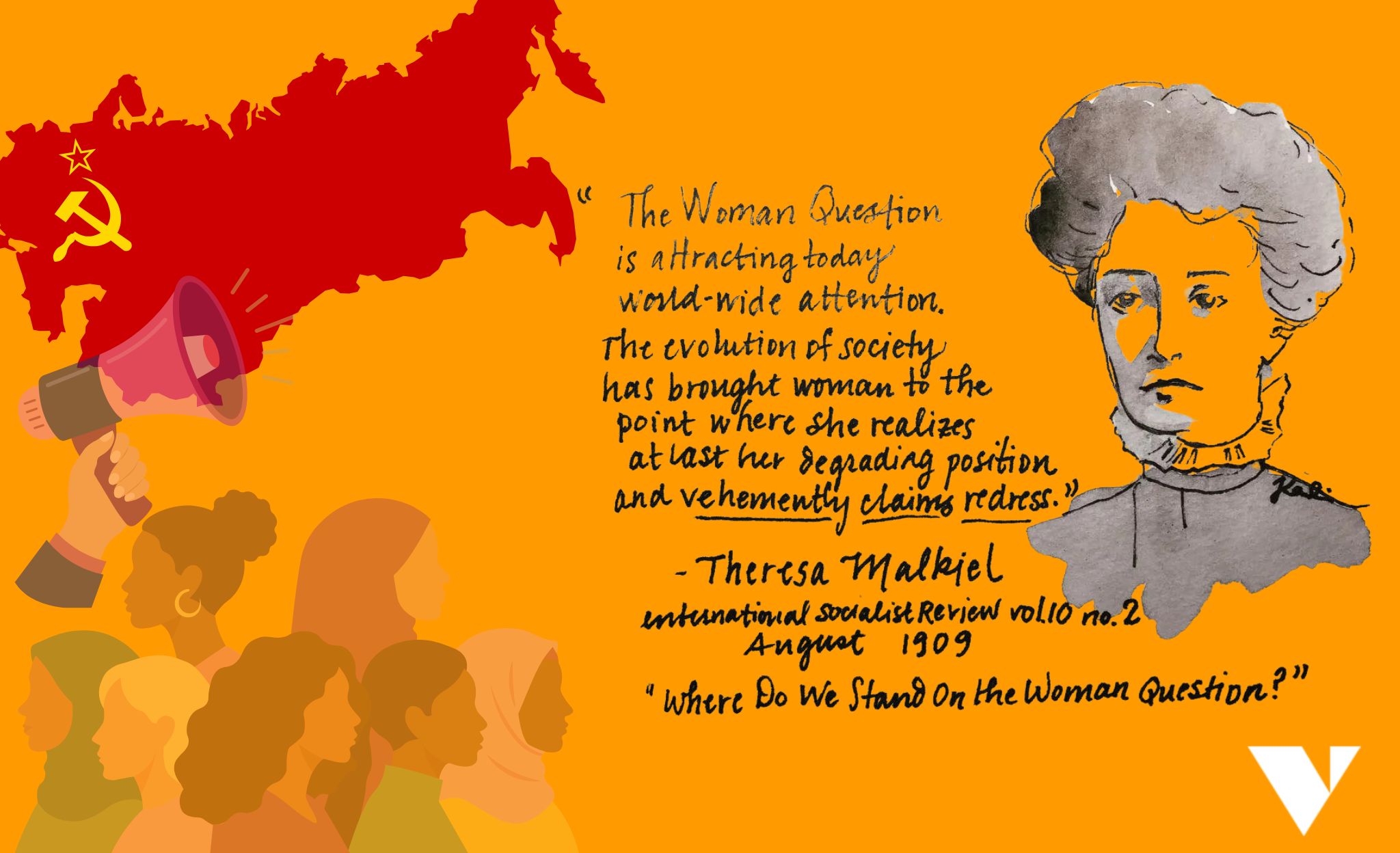
March 8 in Ukraine is associated with flowers, gifts, and compliments to women. However, historically, this date originated as a day of struggle for women’s rights and was not associated with the image of “femininity” that the Soviet tradition had imposed for decades. The history of International Women’s Day dates back to the 20th century, and one of the first initiators of Women’s Day was a native of Vinnytsia, Teresa Serber Malkiel, an activist in the labor movement in the United States, who proposed celebrating National Women’s Day. Later, the idea was supported by European activists, and March 8 became an international date of women’s solidarity in the fight for equality.
This was reported by dreamschool.
Yes, Teresa Serber Malkiel is one of the first initiators of Women’s Day. She was born in the city of Bar in Vinnytsia, which at that time was part of the Russian Empire. In the 1890s, her family emigrated to the United States. Despite her good education, Teresa, like many immigrant women, worked in a textile factory in the slums of New York. The working day lasted 16-18 hours, the working conditions were difficult, and the salary was half that of men.
In 1908, thousands of textile workers took to the streets in New York City demanding shorter working hours, decent pay, and voting rights. The demonstrations were dispersed by the police, and the strikers were persecuted by their employers, but the protest movement did not stop.
Teresa Malkiel was an active participant in the labor movement. She founded a textile workers' union and became one of the leaders of the Socialist Party of America. In 1909, it was she who proposed celebrating National Women's Day. That same year, on February 23, a mass demonstration of women took place in New York, demanding changes - from labor rights to political voice.
The protests in the United States became an example for activists in Europe, who also began to demand equal rights. As the women's movement in the United States gained strength, European activists began to discuss the need for joint action. One of the key roles in this process was played by the German socialist and journalist Clara Zetkin.
At the beginning of the 20th century, women in Europe received lower wages for the same work, did not have the right to vote, and in many countries could not even independently manage their own property.
In 1910, the International Socialist Women's Conference was held in Copenhagen. It was there that Clara Zetkin proposed making Women's Day international - so that on one day every year women in different countries could declare their rights.
The proposal was supported. On March 19, 1911, International Women’s Day was first celebrated in Austria, Germany, Denmark, and Switzerland. More than a million women took part in the demonstrations. They demanded: the right to vote, equal pay, the right to hold public office, and protection from discrimination and exploitation.
In the following decades, women began to receive the right to vote in many countries.

One of the most resonant events associated with this date was the events of 1917 in Petrograd (now St. Petersburg, Russia). On March 8 (new style), women took to the streets demanding “bread and peace.”
These protests marked the beginning of the February Revolution, which led to the abdication of Tsar Nicholas II. After that, the Provisional Government granted women in the Russian Empire the right to vote.
In 1975, the United Nations officially recognized March 8 as International Women’s Day. In 1977, a resolution was passed calling on all countries to celebrate this day as a day of struggle for equality.
But after World War II, the Soviet authorities began to shape the image of the “ideal woman” – a caring mother, a faithful wife and a responsible worker. Open discussions about equal rights did not fit into the official ideology, so the context of March 8 was changed.
Control over society. The Soviet state sought to eliminate protest movements that could be independent of party ideology. Feminism with its demands for equality was seen as a potential threat.
Preservation of the patriarchal order. Despite official statements about equality, women had no real political weight. They worked on an equal footing with men, but remained responsible for everyday life and raising children.
Transformation into a controlled holiday. March 8 became an official public holiday. Instead of demonstrations for rights, concerts, ceremonial events, and greetings from party leaders began to be held.
A tool of propaganda. The authorities spread the thesis that in the Soviet Union women already had all the rights, so the feminist movement was supposedly not needed.

In the West, the women's movement continued to develop, and March 8 retained the meaning of the day of struggle for women's rights. But in Ukraine, until recently, the Soviet narrative about March 8 as a "holiday of femininity" was spreading. But the Soviet authorities failed to take root.
Today, Ukraine plans to finally abandon the celebration of March 8 in favor of a new national holiday. The Verkhovna Rada has registered a draft resolution on the establishment of Ukrainian Women's Day, which is to replace the holiday with a Soviet past. Currently, discussions are still ongoing around the advisability of celebrating March 8. However, due to the processes of decommunization and society's rejection of Soviet traditions, it is not the first time that proposals have been made in Ukraine to completely cancel this day.
Photo: dreamschool ,Американська історія та політика
Author: Danylo Pievchev
read us in
Instagram