Ukrainian boxing in the United States truly has a glorious history. Boxers with Ukrainian roots — Chuck Wepner, John Gudenko, Viktor Litkevich, Louis Kaplan, Benny Bass, Steve Hamas, Stefan Halayko, Oleksandr Borshchuk, John J. Jedick, Vasyl Kliuchka, Johnny Mykhasiuk, Ben Moroz, Gus Lesnevich, Leo Rodak, Mike Koranicki, and many other distinguished figures of the past and present — have left a notable mark on the history of boxing in the United States.
A vivid example of the significant influence Ukrainians had on the development of boxing in the U.S. is the life and athletic career of the legendary Stefan Halayko. Notably, he never changed his surname and always associated himself with the Ukrainian community.
It is unfortunate to note that many managers in the United States demanded that Ukrainians change their first or last names so they would better fit the American boxing scene. This was done even against the wishes of the Ukrainians themselves. Yet they agreed to it because they depended on their “patrons” within the boxing world.

The beginnings of his boxing career
The early years of Stefan’s life are described as follows, and I quote: “Stefan Halayko was born on December 27, 1908, in the city of Auburn, New York, into a family of Ukrainian immigrants. Stefan’s father was a laborer who worked at one of the enterprises that manufactured various types of agricultural machinery. Incidentally, it is worth recalling that the first wave of Ukrainian immigrants arrived in Auburn from Lemkivshchyna in 1894. In 1901, the Ukrainian Greek Catholic community — fourteen families — built the city’s first Greek Catholic Church of Saints Peter and Paul, and in 1910 a brick church was constructed, with a Sunday school operating alongside it. It was at this school that Stefan Halayko studied. Having lost his father at an early age, the full responsibility for raising the boy fell on his mother’s shoulders.”
Thus, his beginning was far from easy. The family had migrated to a new country, leaving behind their native land. From an early age, Stefan lost his father and was deprived of male upbringing, life guidance, and protection. As a result, he found himself alone in the rather harsh real world of a young boy, where he had to constantly stand up for himself.
Father D. Kulmatytsky recalled this period of Stefan’s life as follows: “Stefan Halayko is the son of honest Ukrainian parents. His father died when Stefan was still a child. His mother took care of the boy, sending him to a Ukrainian evening school. From an early age, he was very gifted and quick as lightning in boxing. After Ukrainian evening school, the boys would go out to the community grounds, and there, putting on boxing gloves, ten-year-old Stefan boxed skillfully and even defeated boys older than himself. He boxed carefully, usually with a smiling face, for which he was greatly loved by everyone. Watching him, I would say that one day Stefan would become a clever boxer.”
So Father Kulmatytsky spoke prophetic words. And that is exactly what happened later — Stefan reached the heights of boxing glory. In truth, life forced Stefan to be strong, brave, courageous, and unyielding. Through boxing, he was able to overcome all the challenges in his life. This story is an example for many Ukrainians.
The Olympic path
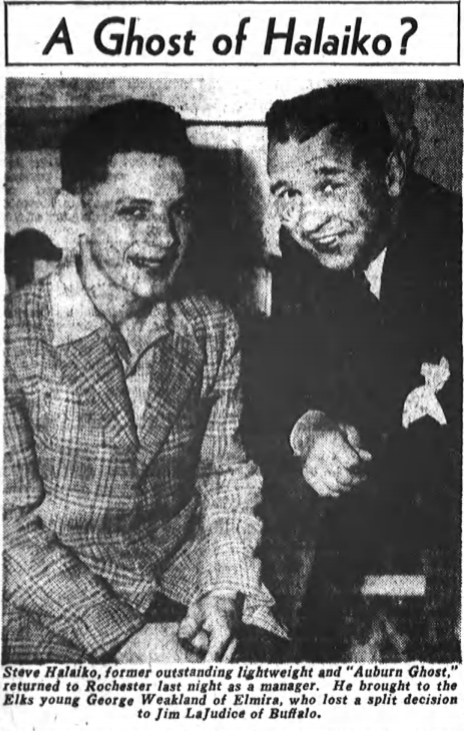
The 1928 Olympic Games were held in Amsterdam, the Netherlands. Although, to our great regret, athletes from Ukraine did not have the opportunity to take part in them, Ukrainians in emigration competed successfully — naturally, representing other countries.
That year’s Olympics had many interesting moments, one of them being the boxing tournament. It was in these lightweight competitions that a Ukrainian from the United States — Stefan Halayko of Auburn — took part.
Looking ahead in the story, I will say frankly: this was Stefan Halayko’s Olympic moment of glory. But certain obstacles prevented him from reaching “Olympus.”
I will not reveal everything right away. Read to the end — and you will find out everything. It will be interesting, impressive, and even a little shocking.
For now, it is worth telling how Stefan’s path to Olympic Amsterdam began. In truth, the beginning was bright, patriotic, and grand in scale. The Ukrainian community in the United States organized phenomenal events before Stefan’s departure for the Olympic Games. Perhaps no one in the United States had ever been sent off to compete in such a way.
The Ukrainian press in the United States devoted considerable attention to this event, as well as to Stefan’s participation in the Olympic Games in general. Newspapers wrote about each of his bouts.
So Stefan was seen off in this way: “The Ukrainian Athletic Club in Auburn, New York, bade farewell on July 5 of this year to its member Stepan Halayko, who left for New York to complete his training before departing for the Olympic Games in Amsterdam, Holland. Stepan Halayko is going to these Games as one of the lightweight boxers, having won this opportunity against a long line of opponents. Upon his departure, the Club organized a grand reception for him, consisting of a banquet at Springside Inn, a parade through the city streets, and an ovation at the railway station. Together with him, the Club also said farewell to Ivan Namisnak, who was to take part in the races as a runner.”
Can you imagine the scale of the events organized by Ukrainians? A banquet, a parade through the city streets, and ceremonies at the railway station. It was truly grand.
At the same time, a note should be made regarding Ivan Namisnak. Although the quotation states that he was to go to the Olympic Games as a runner — that is, I assume, to take part in track-and-field competitions — there is no athlete by that name listed among the members of the U.S. Olympic team.
This, first of all. Secondly, Ivan Namisnak was a boxer, just like Stefan Halayko. Ivan also competed in the boxing trials for the Olympic Games, but lost to his opponent. Therefore, he was unable to qualify for the U.S. boxing team. Nor is he listed among the members of the U.S. track-and-field team. Thus, the question remains open as to why he was described that way in the post.
Unlike Ivan, there are no misunderstandings concerning Stefan. He truly took part in the Olympic Games and won an Olympic medal. But let us return to the program of the celebrations. Here is what followed: “At the reception in honor of those departing, the toastmaster was the club president, citizen Pete Pysnak. The first to speak was citizen Ivan Kokovsky, who, in his Ukrainian-language address, presented Halayko’s and Namisnak’s dedication to sport; he said that both were bringing great honor to the Ukrainian people. Afterward, Mike Kresko spoke. The reception ended with an ovation in honor of the departing athletes.”
It is gratifying that the American press also noted Stefan Halayko’s Ukrainian roots: “…in the bulletin about Stepan Halayko, issued by Cook’s Academy in Montour Falls, New York, it is clearly stated in the very first sentence that Stepan Halayko is of Ukrainian descent. The local newspaper The Auburn Citizen of Friday, July 6, published the following longer news item, which the editors of Svoboda kindly reprinted as proof to readers that sport and athletics can bring considerable recognition to our people.”
Accordingly, Svoboda published an English-language article about Stefan Halayko. This was truly powerful, as it stated that Stefan had Ukrainian roots and excellent prospects for a successful performance. And that is exactly what happened.
Now, to his participation in the Olympic Games itself. On his path, Stefan Halayko defeated all his opponents one after another. The newspaper Svoboda in the United States helps us trace the Ukrainian boxer’s victories, as it reported on his participation in the Games and described Halayko’s wins in detail.
On August 8, Stefan Halayko defeated the Polish boxer Witold Majchrzycki. I quote Svoboda: “During the fight, the Ukrainian kept the Pole under terrible pressure and, each time, with powerful blows to the head, knocked his opponent to the floor. Especially in the third round, Stefan Halayko developed an intense attack.”
On August 9, the Ukrainian’s next opponent was the Argentine Pascual Bonfiglio. I quote Svoboda: “In the second round, Halayko knocked the Argentine to the floor. The third round ultimately brought victory to the Ukrainian.”
On August 10, Stefan Halayko fought the Swedish boxer Gunnar Berggren. Notably, in the lightweight division, the Ukrainian was defending the honor of American boxing, as the other boxers had already been eliminated. I quote Svoboda: “In the first two rounds, the Swede Berggren fought quite correctly, but after losing the third, he began using illegal tactics and pressed the Ukrainian against the ropes. But Halayko handled him and quickly dealt with the enraged Viking.”
In issue No. 188 of August 14, 1928, the newspaper Svoboda carried the following headline: “THE END OF THE OLYMPIAD. HALAYKO RECEIVED THE SILVER MEDAL. AMERICANS TOOK SECOND PLACE. THE COMMISSION DID NOT RECOGNIZE HALAYKO AS THE WINNER. INDIGNATION OF AMERICAN ATHLETES.”
This is precisely where many interesting facts and events arise, prompting the question: what happened? Why did the commission refuse? How did the Americans defend Halayko?
In the final boxing bout, Stefan Halayko faced the Italian boxer Carlo Orlandi. I quote Svoboda: “In the final meeting of the boxers, the commission declared the Italian the winner, although Halayko had the advantage throughout and fought far better than the representative of Italy.”
According to American correspondents, the commission made an unjust decision by awarding the victory to the Italian. This caused outrage among the American athletes present. In protest against the judges’ arbitrariness, Czech spectators also became involved in the clash. Police even had to be called in to calm the passions.
Winning glory and the respect of Americans and Ukrainians in the United States
Thus, Stefan Halayko should have won the highest Olympic title, but judicial injustice intervened, and he took second place. Yet this did not break the Ukrainian boxer — it only gave him even greater strength to continue toward his goal: to become a champion.
In the United States, Stefan Halayko’s successful performance was duly appreciated, and the Ukrainian community was sincerely grateful and constantly supported the Olympian. This is evidenced by numerous positive articles in the press.
In particular, Vasyl Bobriv wrote the following: “On Sunday, August 12, the 9th Olympiad ended in Amsterdam, Holland, where the best athletes of various nations competed for first place. At first glance, it may seem that all kinds of games are nothing but a waste of time. This is mainly how Ukrainians of my age and older think about sports… Our nation needs healthy, strong people — both physically and spiritually — so that when the time for struggle comes, we will have our strength. Just as the Greeks once cared for the health of their young men, so should we Ukrainians care for ours… At the latest Olympiad, Ukrainians are taking part — we know of three: Halayko, Namisnak, and Kotsai — but in the wider world they are regarded as Americans, while their Ukrainian origin is passed over in silence. If Halayko had been sent, even by America, but from some Ukrainian gymnastic group or society, the matter would have looked different. The same applies to Kotsai, whose sisters even sing in the Ukrainian church, and people who know him say that he is a sincere Ukrainian.”
Father D. Kulmatytsky wrote the following about Stefan Halayko’s achievements: “He is a true athlete. Ukraine needs such sons, because such sons carry the name of Ukraine everywhere. May Stefan Halayko become an example for many Ukrainian sons, from whom glory could grow not only for America, but also for Ukraine.”
These were prophetic words from Father Kulmatytsky. And that is exactly what happened. This is truly an example for Ukrainian youth to follow, both in the United States and in Ukraine.
Interestingly, once in 1930, after the Olympic Games, Stefan Halayko and Ivan Dziadyk were invited to a friendly dinner at the Ukrainian Citizens’ Society in Philadelphia following their boxing battles. In their speech, their managers confidently assured everyone that both men would soon become world champions.
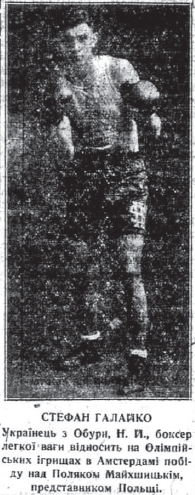
Later, Stefan Halayko went on to compete in the professional ring. There, he earned glory and the respect of both Americans and Ukrainians in the United States.
So we truly have people and achievements to be proud of.
Author: Oleksii Lyakh-Porodko