


This year marks 150 years since the birth of the outstanding conductor, composer and leader of the Ukrainian Republican Chapel Oleksandr Koshyts, who opened the world to Ukrainian song. It was under his leadership that the “calling card” of Ukraine – “Shchedryk” by Mykola Leontovych, which later became the world-famous “Carol of the Bells” – was first heard. Thanks to Koshyts’ tours of Europe, America and Mexico, Ukraine first appeared before the world as a cultural state with a powerful spiritual tradition.
This was reported by candidate of historical sciences Halyna Parasyuk..
Oleksandr Antonovich Koshyts was born on September 12, 1875 in the village of Romashky, Zvenyhorod district, now Kyiv region, in the family of a priest. In his memoirs, the conductor recalled that he grew up in a large family - among eight brothers and sisters. His childhood was spent near Kaniv region, in the same region where Taras Shevchenko was born. Already in his youth, Koshyts showed exceptional musical abilities, which is why, after studying at the theological seminary in Boguslav, he entered the Kyiv Theological Academy, and later - at the Mykola Lysenko Music School. It was his friendship and cooperation with Lysenko that became decisive for his formation as a musician.
Having received a solid education, Koshyts began conducting the student choir of St. Volodymyr's Kyiv University. It was this group that first performed Mykola Leontovych's "Shchedryk" - a work that would later become famous all over the world.

In early 1919, during the liberation struggle, the head of the UNR Directorate, Symon Petliura, instructed Koshits and Kyrylo Stetsenko to form a choir for tours abroad. The goal of this mission was to show the world that Ukraine is not only a state, but also a nation with a deep spiritual and cultural tradition. Thus was born the Ukrainian Republican Chapel, which was called “Petliura’s cultural army”.
In just a week, eighty of the best singers were selected for the chapel. In May 1919, they began a tour of Europe, which became a real triumph. Prague, Vienna, Berlin, Paris, London, Barcelona – everywhere the choir was greeted with ovations. The audience was delighted with Ukrainian songs, especially “Shchedryk”, which was often performed as an encore. The European press wrote: “If song were a state, Ukraine would take first place in the world!”
In 1922, the group went to North America under the name Ukrainian National Choir. Thanks to the famous impresario Max Rabinov, the tours took place in the most prestigious halls of the USA and Canada.
Ukrainian song under the leadership of Košice conquered the American public. “Lullaby” (“Oh, the Dream Goes By”) became especially popular in his arrangement - it was she who inspired George Gershwin to create the famous jazz composition “Summertime”.
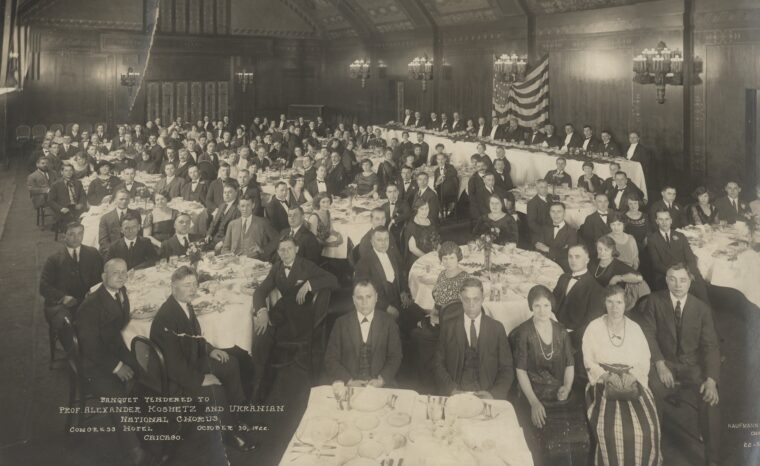
In the fall of 1922, the choir performed in Chicago. The city solemnly welcomed the group: the Ukrainian community organized a parade of cars with flags, the concert was attended by thousands of spectators, and after it - a solemn banquet at the Congress Hotel, where Metropolitan Andrey Sheptytsky was sitting next to Košice. In his memoirs, the conductor wrote:
“We arrived in Chicago… we were met by a deputation from Ukrainians, who number about 50,000 here. They welcomed us and brought us many flowers… After the concert, there was a banquet in some luxurious hotel. Wonderful dishes and food, as well as the inevitable boring and trite speeches. There were about 500 guests… Metropolitan Count Andrei Sheptytsky gave a wonderful speech.”
Košice also recalled performances in the Chicago suburbs – in Evanston and Winnetka – and his concert in the magnificent Medinah Temple, where the hall with a capacity of several thousand seats was filled to the last.
“The audience was almost full, we were received wonderfully. They brought us flowers,” he wrote.
The American newspaper Chicago Daily Journal in October 1922 responded to these performances with the words: “What do Americans know about song? It does not flow in their veins instead of blood… And for these Ukrainians, song has no less weight than bread.”
After the USA, the choir went to Mexico, where it set a world record: 46 thousand spectators listened to the concert at the Plaza De Toros “El Toreo” stadium. The Mexican song “Perkhura”, which Koshyts heard and learned with the choir on the way, was performed an encore six times.
So, thanks to the Koshyts choir, “Shchedryk” became famous in the world. In 1936, the American composer of Ukrainian origin, Petro Vilhovsky, wrote an English-language text for it, creating “Carol of the Bells” - a song that became a symbol of Christmas in America.
The triumph of the Ukrainian National Choir under the leadership of Koshyts brought glory to Ukraine on three continents, even when its statehood was lost. After the tour ended, the conductor and most of the participants remained in exile. Some of them settled in Chicago, where they continued to develop Ukrainian choral art and support culture abroad.
The life and work of Oleksandr Koshyts is an example of how the power of art can become a voice.
Author: Danylo Pievchev