


How a program in Oklahoma allows Ukrainian surgeons to operate alongside American colleagues – and how the exchange is reshaping both sides.
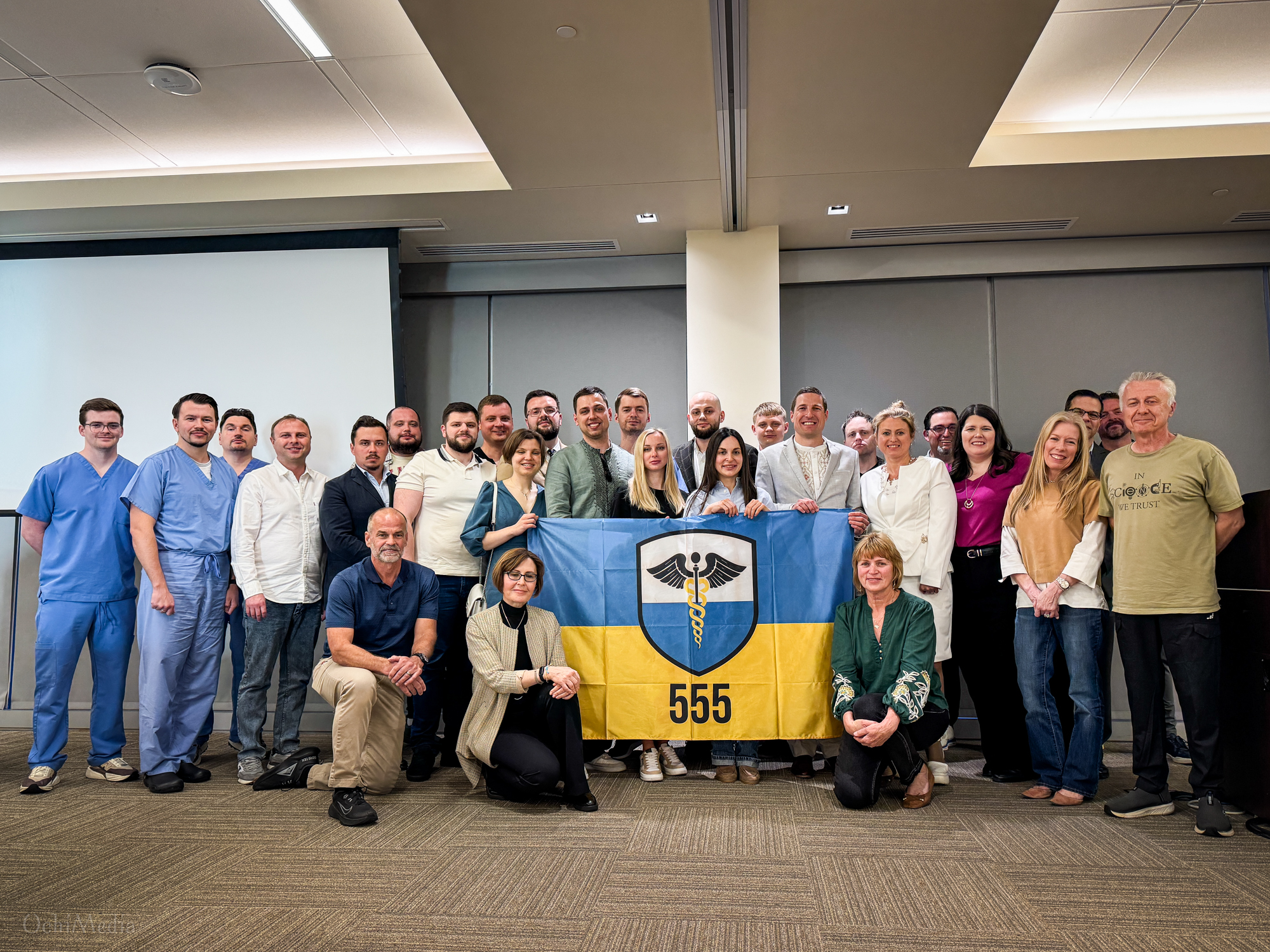
On April 9, 2026, Ukrainian surgeons presented wartime cases to their American colleagues at the University of Oklahoma College of Medicine. The session – Ukrainian Grand Rounds at Oklahoma University Health – was part of a month-long program that has quietly become one of the most significant examples of Ukrainian-American medical collaboration since the full-scale invasion began.
THE ONLY PROGRAM OF ITS KIND
So far, Operation Ukraine at OU Health is the only program in the United States that grants foreign surgeons hands-on surgical privileges – not merely an observership.
Getting there required Dr. Mark Mims, a facial plastic and reconstructive surgeon at OU Health and the program’s founder, to navigate the Oklahoma State Medical Board, OU Health executive leadership, risk management, and legal counsel. He told each of them what Ukrainian surgeons were facing since the full-scale Russian invasion, and moved the conversation from “why” to “how.”
“It was always a matter of: how do we make this work?” Mims said. “How do we make sure the surgeons are getting what they need to learn, but we also keep our patients safe?”
They found a way. Now Mims receives calls from programs across the country asking how to replicate it. His answer is the same one he gave to administrators: find a champion, and tell the story.
HOW IT BEGAN – AND HOW IT GREW
When American surgical teams began traveling to Ukraine after the full-scale invasion, they quickly ran into a hard reality. “You could treat maybe seven or ten patients in a week, but there were maybe seven to ten thousand who needed treatment,” said Dr. Mims, whose colleagues at the American Academy of Facial Plastic and Reconstructive Surgery were among the first to make those trips.
The conclusion was clear: American doctors needed to pass their knowledge to Ukrainian colleagues, not just their hands.
Some expanded their missions, others organized observerships in the U.S., but Dr. Mims chose the least traveled path: bring Ukrainian surgeons to Oklahoma, give them a full month, and give them something no other program in the country offered – actual surgical privileges.
Planning for Operation Ukraine began in September 2022, and in May 2023 the program welcomed its first cohort of Ukrainian surgeons to OU Health. With each cycle, the numbers and range of disciplines have grown. The seventh cohort – the largest in the program’s history – brought seventeen surgeons from across Ukraine, covering six disciplines: head and neck surgery, neurosurgery, ophthalmology, orthopedics, trauma surgery, and vascular surgery. Since its launch, 49 surgeons have come through the program, assisting in 223 surgeries at OU Health.
The cohort reflects the geography of a country at war. Surgeons come from Kyiv, Lviv, Odesa, Kharkiv, Dnipro, Vinnytsia, Zaporizhzhia – including physicians working in military medical centers near the front lines.
THE PARTNERSHIP WITH RAZOM’S CO-PILOT PROJECT
The program’s scale would not have been possible without a U.S.-based nonprofit, Razom for Ukraine, and its Co-Pilot Project – an initiative dedicated to building Ukraine’s medical capacity through training, observerships, and exchange programs.
Last year the relationship was formalized: Razom became an official co-sponsor of Operation Ukraine. The impact was immediate – in all of 2025, seventeen surgeons came through the program. The most recent cohort alone matches that number.
Operation Ukraine is 100% externally funded through donations, grants, and in-kind contributions. Razom covers travel from Ukraine to Oklahoma – airfare, visa support, and stipends. Once the surgeons arrive, OU Health takes over: housing, transportation, cadaver lab fees, and credentialing. According to Mims, the total cost runs approximately $3,000 per surgeon. The market value of a comparable observership in the United States is $20,000.
Yuliia Shama, U.S. Co-Pilot Project Lead at Razom, and Alexandra Domaradsky, Co-Pilot project coordinator, are the program’s primary partners on the Razom side. Every OU Health faculty member involved volunteers their time.
WHAT THE SURGEONS CAME TO LEARN
The program combines clinical and academic work. Surgeons spend one to two days per week in cadaver labs, and whenever they are not there, they are in the operating rooms alongside American colleagues – observing or scrubbing in. They also participate in Grand Rounds, journal clubs, and morbidity and mortality conferences – the full apparatus of American academic medicine.
The cadaver lab access alone is significant. In Ukraine, cadavers are prohibited for use in medical training after medical school. A surgeon wanting to learn a new reconstructive technique must rely on textbooks, online videos, or informal instruction.
Dr. Liubov Petruk, an ENT surgeon who has worked at Odesa’s military hospital for twenty-three years, said what struck her most was watching Dr. Mark Mims work alone through an entire complex reconstruction.
“Doctor Mims and his colleagues, they don’t ask for thoracic surgeon to harvest the rib for the reconstruction of the nose. They don’t ask for maxillofacial surgeon – they can do the whole operation, only the ENT surgeon.”
She paused.
“I would like to do it by myself. I find it astonishing, amazing, awesome.”
Dr. Vasyl Kaban, an ENT surgeon from Ivano-Frankivsk Central City Clinical Hospital, described a similar moment – watching a facial nerve reinnervation procedure for the first time.
“Something I heard about, something I read in a book – but here I understand it better. When you work a few years in your specialty, you think you know. But it’s the little things that make a difference.”
Dr. Vasyl Voronets, a military traumatologist from Dnipro’s Eastern Region Medical Center, works in a Role 3 hospital – a high-level facility providing advanced surgical care for complex trauma.
When asked how he would apply what he learned in Oklahoma without access to American-level equipment, his answer was immediate.
“Equipment is secondary,” he said. “The surgical approaches come first. And we will stay in contact with our American colleagues. They will always help us with the most difficult cases.”
The professional connections formed in Oklahoma, he said, are capital he intends to use.
WHAT FLOWS THE OTHER WAY
The exchange is not one-directional. At the Ukrainian Grand Rounds on April 9, Ukrainian surgeons presented wartime cases to their American hosts – injury patterns and clinical experience that American medicine is only beginning to encounter.
Dr. Mims is direct about what Ukrainian surgeons bring to the exchange. They are, he said, currently the most experienced surgeons in acute and advanced trauma in the world – especially with FPV drone injuries, wounds that American hospitals have rarely encountered.
“While they’re here in Oklahoma, not only are they in the operating rooms trying to learn techniques from us,” Mims said, “but we are asking them to share their knowledge with us – that we can learn from them and take the hard-earned experience that they have and help our patients as well.”
WHAT GOES HOME
The program is built around an explicit goal: train the trainers. Every surgeon who completes it is expected to teach what they learned. The ambition, as Mims described it, is for Ukraine’s medical community to become self-sufficient – for OU Health to eventually step back, and let Ukrainians take care of Ukrainians.
Dr. Tetiana Pavlichuk, who completed the program in its second cohort and now works at Bogomolets University in Kyiv, is the clearest proof of concept. She learned free flap jaw reconstruction in Oklahoma – taking bone from a patient’s leg to rebuild a jaw destroyed by a drone strike. She went home and performed the procedure successfully, and was subsequently invited to speak at a national American reconstructive surgery conference.
“She has gone back and done several of these operations with very good success rates,” Mims said. “We are very proud of her.”
Dr. Voronets is already planning teaching evenings for his colleagues in Dnipro upon his return. Dr. Bohdan Sirko, a trauma neurosurgeon also from Dnipro, offered a different explanation for why he will share what he learned.
“No one can be safe in our country,” he said. “Maybe it is possible I will be wounded, and other surgeons will help me. This is the first reason. The second is that this war will be long, and we need new generations of surgeons.”
Author: Tatyana Bessmertnaya