


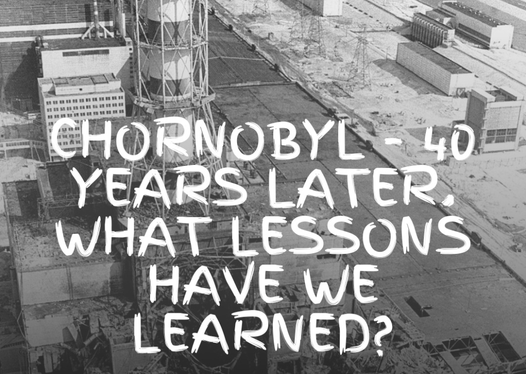
NEW YORK, NY (April 26, 2026) -- To commemorate the 40th anniversary of the April 26, 1991, disaster at the Chornobyl Nuclear Power Plant, the Ukrainian Congress Committee of America (UCCA) Energy Task Force convened the webinar, “Energy Under Fire: Lessons from Chornobyl to Modern Ukraine.” International experts in energy policy, national security, and environmental affairs participated in the webinar held on April 22, which is Earth Day in the United States. Panelists included Drs. Ariel Cohen, Yuri Shcherbak and Benjamin Schmitt, all of whom spoke to the central topic of the webinar: the strategy of using civilian energy infrastructure as a battleground in modern geopolitical conflict.
Moderated by Irene Jarosewich, WFUWO UN Civil Society Representative, the webinar was the second installment in UCCA’s ongoing energy series that examines the unprecedented threats to, and destruction of, Ukraine’s civilian energy infrastructure by russia’s war of aggression against Ukraine. In her opening remarks, noting that the purposeful destruction of civilian energy infrastructure is a war crime, Jarosewich underscored the enduring relevance of the lessons of Chornobyl and the critical importance of energy security in geopolitical strategy.
Speaking from Kyiv on the topic “Lessons from Chornobyl – 40 Years Later,” Ambassador Shcherbak, an academician and physician, Ukraine’s first Minister of Environmental Protection – appointed in 1991, a distinguished diplomat, internationally recognized Chornobyl expert and most recently, in March, recipient of the 2026 Taras Shevchenko National Award for prose, delivered a sobering presentation. He summarized the long-term and far-reaching environmental, health, and geopolitical consequences of the 1986 Chornobyl disaster, while drawing urgent parallels to present-day risks. He warned that ongoing military activity has already compromised the protective structures at several nuclear power plants in Ukraine, which has five such plants, including damage at the Chornobyl site, The modern (second) sarcophagus, built in 2017 over the Chornobyl plant to encase and isolate the continuing release of radiation, has suffered severe damage caused by russian missile and drone strikes. He emphasized the international nature of the risks to nuclear power plants, not only those in Ukraine, and criticized the UN’s International Atomic Energy Agency, and the IAEA’s director Rafeal Grossi, for not doing more to condemn the “nuclear terrorism that russia has unleashed against Ukraine.”
Notably, Shcherbak offered sobering information about the facts of the design Chornobyl reactor: “Soviet agents in the United States and the United Kingdom provided Moscow with thousands of pages of top-secret documents from The Manhattan Project in 1942 - 1945. Later, many of these so-called technical ‘solutions’ used in Soviet designs were ‘borrowed’ from the stolen American designs and put into practice. The design of the RBMK reactors, of which there were 14 throughout the USSR, were a copy of the US military reactor Hanford B (1944), a reactor that was designed specifically and exclusively for the industrial production of Plutonium 239 used in atomic bombs.
“I. Kurchatov, the father of the Soviet A-Bomb, in a 1946 memo addressed to V. Abacumov, then Minister of State Security of the USSR, wrote this hard-to-believe statement, ‘Some features of the operation of the nuclear reactors of the Hanford (design), in my opinion, are plausible and of great interest for our domestic work.’ - (see: Intelligence and the creation of the Atomic Bomb, SVR. gov. ru\history\stages\stage06.htm ) The RBMK weapons-grade reactor was then adapted in the USSR to the needs of ‘peaceful’ nuclear energy with the inherent design flaws that led to the explosion of the 4th unit at the Chornobyl NPP.”
Shcherbak also noted that he believes that the Chornobyl explosion was a critical factor that led directly to the breakup of the USSR five years later. Only a few months before the explosion (February 2026) in a widely promoted, televised speech at the 27th Congress of the Communist Party, General Secretary Mikhail Gorbachev had promised to revamp the USSR system of governance, promising restructuring (perestroika) and openness (glasnost). However, only a few months later, the lies about, and the coverup of, the extremely dangerous explosion at a nuclear power plant, located 80 miles northwest of Ukraine’s capital city Kyiv, along with the unwillingness to accept international aid and unwillingness to establish longitudinal medical studies further fueled already existing anger and resentment among the people of Ukraine towards centralized power in moscow. This deep anger, along with other long-standing grievances, led to the declaration of Ukraine’s independence in August 1991.
Professor Benjamin Schmitt, senior fellow with the University of Pennsylvania, holds a dual academic appointment at the university and has served as European energy security advisor at the U.S. Department of State. Dr. Schmitt, who was unable to stay for the discussion following panel presentations, in his presentation addressed the current state of russian sanctions and export controls, stressing the importance of maintaining sanctions against russia for international security in order to limit russia’s economic ability to continue the war that is not only destroying Ukraine, but is threatening European security, as well. He discussed the weaponization of the energy infrastructure in Ukraine, highlighting the critical role of international support in strengthening Ukraine’s energy resilience and addressed a topic that receives little general media coverage, russia's ongoing shadow war of sabotage against onshore and offshore energy and critical infrastructure in Europe. He encouraged civic engagement in support of Ukraine, urging webinar participants in the United States to advocate with their elected representatives to ensure continued monetary and policy support for Ukraine, noting that Ukraine’s security, despite political claims to the contrary, is inextricably linked with America’s security.
Dr. Ariel Cohen, a nonresident senior fellow at the Atlantic Council’s Eurasia Center and a member of the Council of Foreign Relations, addressed the topic, “Ukraine Between Two Theaters of Global Confrontation.” Dr. Cohen noted that in the course of four years, Ukraine has made technological breakthroughs in war technology, both in the development of defense and attack drones, and robotics in warfare. He explained that from the necessity to protect Ukraine from the Iranian-made Shahed drones used by russia, the Ukrainian military developed anti-drone systems that only a few years after they had been designed and built were now being used by nations in the Middle East to protect their lands against the very same Iranian Shahed drones. He commented that he, along with other experts, was not convinced in 2022, at the beginning of russia’s increased aggression against Ukraine that Ukraine would be able to withstand russian pressure. However, he added, that Ukraine’s need to invent technologies and strategies to protect itself has not only caused great harm to russia, but has positioned Ukraine to be a leader in global innovation of defense technologies. He noted with admiration the determined resistance of the people of Ukraine, adding that this one factor alone was critical in defining current geopolitical security and international relations.
All panelists noted how civilian energy infrastructure has evolved into a focal point of global conflict –from the 1986 disaster to current wars in Ukraine and the Middle East – and underscored potential worldwide health and environmental consequences of the weaponization of regional energy systems. As an example, the dangerous situation at the russia-occupied Zaporizhzhia Nuclear Power Plant in south central Ukraine, Europe’s largest NPP, the vulnerability of which amid active conflict presents serious global security risks. Besides damaging Ukraine, a disaster at the ZNPP would carry airborne radioactive particles towards America’s allies in southern Europe, the Caucasus and the Middle East.
As russia's genocidal war against Ukraine continues, the lessons of Chornobyl remain starkly relevant, underscoring the imperative to protect critical infrastructure and prevent future catastrophes.
Author: Executive Director of the Ukrainian Congressional Committee of America (UCCA) Tamara Oleksiy