


For over a century, imperial Russian narratives worked to suppress, absorb, or erase Ukraine's distinct cultural identity. Reclaiming that identity is itself an act of resistance, and May has become the moment many organizations dedicate to doing exactly that.
In 2025, UNWLA established its annual Ukraine Decolonization Month, joining a growing movement that deliberately emphasizes Ukrainian culture and intellectual heritage. At its core is a conviction: that Ukraine's authentic literary and cultural tradition must be disentangled from the distorted lens of russian imperialism and made visible to the world on its own terms.
One of its most vital ongoing initiatives is the UNWLA Book Club which focuses specifically on Ukrainian literature available in English translation. Opening up these works to non-Ukrainian readers is not a secondary goal – it is the point. Every reader who discovers Ukrainian poetry, fiction, or nonfiction through these pages encounters a culture that is ancient, distinct, and alive, not a simplified version imposed by its colonizer.
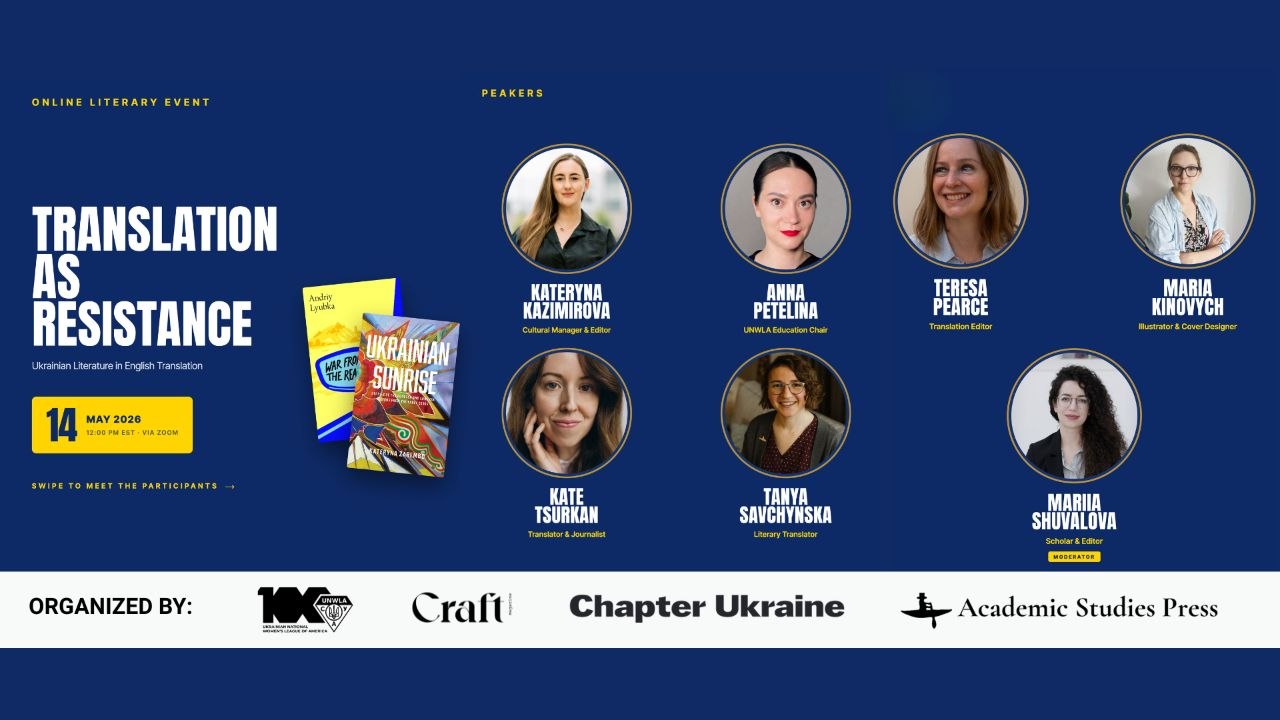
The successful launch of the UNWLA Book Club inspired us, together with Craft Magazine, Chapter Ukraine, and Academic Studies Press, to organize the panel discussion "Translation as Resistance." The event brought together translators, editors, and cultural advocates to examine how Ukrainian literature moves from the page into the hands of a global readership and what it costs to get it there.
The conversation was grounded in two recent books that exemplify what is at stake.Ukrainian Sunrise” by Dr. Kateryna Zarembo is a work of political scholarship and storytelling that dismantles the myth of a russian-speaking, russia-aligned Donbas. Drawing on four years of field research, Zarembo documents the Ukrainian civil society that existed in Donetsk and Luhansk up until February 2022 – activists, artists, pastors, students – a world the war has since occupied or destroyed.
“War from the Rear” by Andriy Lyubka takes a different angle: a non-fiction road-essay collection following the author and his volunteer team as they raised $1.5 million and delivered over 4,000 vehicles to the front lines. It is, deliberately, a Ukrainian book with a happy ending – something nearly unheard of in wartime literature.
Both authors are now serving in the Armed Forces of Ukraine. They wrote their books before they enlisted. The books help explain why they did so and where the roots of Ukraine’s resilience and will to stand tall, facing a much bigger aggressor, lie.
Getting Ukrainian literature into English is only the first obstacle. Translator Tanya Savchynska, who translated Ukrainian Sunrise, described facing over a dozen rejections before finding a publisher willing to take on the book – despite its rigorous scholarship and elegant writing. The reason was rarely quality. Publishers worried about market timing, about appearing opportunistic, about whether Anglophone audiences would sustain their interest. The window that opened briefly after February 2022 was already closing.
"Ukraine is a treasure trove of stories," Sachchinska said. "It is our responsibility as translators and agents of translation to get these stories across – even when there are obstacles on the road."
Translation editor Tereza Pearce spoke to the demands of this work: the false linguistic friends, the untranslatable cultural references, the difference between a sentence that is technically correct in English and one that actually lands. Her goal, she said, is not to fix mistakes but to bring Ukraine closer and to make the leap of imagination easier for readers who have never been there.
Cultural advocate Kateryna Kazimyrova presented the Chapter Ukraine project – infrastructure built specifically to help Ukrainian books reach readers abroad. Chapter Ukraine maps all available Ukrainian titles in translation and gives readers tools to create curated book lists to share with local libraries and bookstores. Since its launch, over 2,000 lists have been shared – a grassroots campaign that has turned individual readers into advocates.
UNWLA Chair of Education Anna Petelina outlined the principles and importance of the community’s work with libraries, noting:
“There is a tremendous opportunity for Ukrainian literature in local U.S. libraries. By building relationships with librarians, connecting thematic displays to national moments, and making the case – book by book – that Ukrainian literature belongs on every shelf and in the hands of American readers.”
To support this effort, UNWLA has released a special outreach toolkit and a set of read-alike posters designed for display in local libraries, giving librarians and community advocates ready-made tools to introduce Ukrainian books to new readers.
Translation as Resistance session took place following another night of relentless russian attack on Ukrainian cities. Several panelists came online after little to no sleep. That context was not incidental – it was the point.
Translation is resistance because Ukraine's fight is not only military – it is a fight to ensure that Ukrainian stories are told truthfully, in full, and by Ukrainian voices. In a war that targets culture as deliberately as it targets infrastructure, every book that reaches a new reader is an act of reclamation: proof that Ukraine's intellectual tradition is alive, sovereign, and impossible to erase.
The challenges are real: publishers are hesitant, budgets are scarce, and attention spans are short. But also, there is a growing momentum. More Ukrainian titles are being translated each year. Libraries are adding them to their shelves. Readers who came for the headlines are staying for the essence.
Translation as resistance is not a metaphor. It is the work, and all of us, as readers, librarians, book club members, and advocates, are part of it.
UNWLA's Book Club reads Ukrainian titles available in English translation and meets regularly throughout the year. Recordings of past sessions are available on the UNWLA YouTube channel. To get involved with Chapter Ukraine's library and bookstore outreach, visit their platform to explore titles and advocacy tools.
Author: Anna Bereznyak, Marketing and Communications Director of Ukrainian National Women's League of America