


Ukrainian immigration to the United States began in the mid-1870s. It was during this period that the first Ukrainians began to arrive in the country, which was rapidly transforming into an industrial state and needed a large number of laborers. Most of the immigrants from Ukrainian lands were unskilled workers who found work in factories, mines, and industrial enterprises.
This was reported by Halyna Parasyuk.
According to statistics, as of 1905, 14,473 immigrants had arrived in the United States who declared themselves Ukrainians. Only seven of them had higher education. At the same time, among the arrivals were miners, shoemakers, tailors, blacksmiths, carpenters, joiners, and representatives of other professions, although 98 percent of Ukrainian immigrants belonged to the category of unskilled workers.
Ukrainian emigration researcher Julian Bachynsky noted that Ukrainians worked in almost all areas that required hard physical labor. Due to the lack of knowledge of the English language, funds, and professional training, most newcomers settled in the eastern states of the United States, where it was easier to find work.
In the state of Illinois, Ukrainians worked in metallurgical enterprises, railway car factories, leather processing enterprises, carpentry factories, and cigar factories. The daily wage was from $1.35 to $2.
The first official mention of a Ukrainian in Illinois dates back to 1889. Then, farmer Hryhoriy Gordan, through the Ukrainian newspaper "America", called on his compatriots to leave dangerous work at enterprises and move to the rural areas of the state, where it was possible to buy land and engage in farming. He proposed creating a Ukrainian settlement in Illinois, but there were no supporters.
Instead, the Ukrainian community began to form directly in Chicago. The first Ukrainian immigrants settled in the industrial areas of the city, mainly in the area between Division, Racine, Orleans, and Twelfth Streets.
In the late 19th century, immigrants from the Lemko region and Transcarpathia attended the Orthodox church at the intersection of Madison and Racine streets. In 1892, the community was influenced by a former Greek Catholic priest, Father Alexei Tovt, after which the church came under the jurisdiction of the Moscow Patriarchate. In 1903, the community moved to a new building at the intersection of Levitt and Haddon Streets, where the Russian Orthodox Greek Catholic Church of the Holy Trinity operated. The construction of the church was supported by the Russian Emperor Nicholas II, and the project was developed by the famous architect Lewis Henry Sullivan.
A separate Greek Catholic community of Ukrainians was forming in the southern part of Chicago. In June 1903, a new parish was founded there, and on October 30, 1904, the Church of St. Mary was consecrated. It became the first Ukrainian Greek Catholic church in Chicago. Its pastor was Father Victor Kovalytsky.
One of the key figures in the history of the city's Ukrainian community was Volodymyr Simenovych. A native of Ternopil region, a graduate of Lviv University and a friend of Ivan Franko, he arrived in the USA in 1887 at the invitation of Father Ivan Volyansky. At first, he worked in Pennsylvania, where he was engaged in public activities, published the newspaper "America", organized a school for children and adults, created a church choir and a drama club.
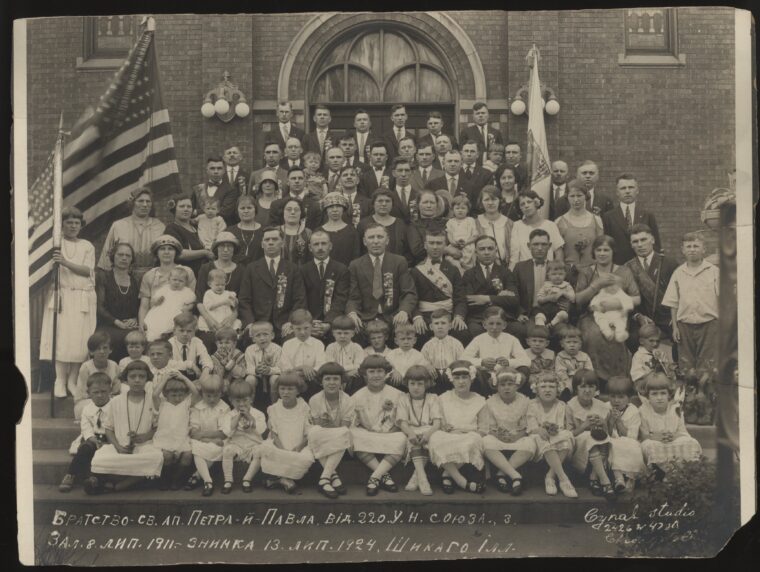
After visiting the Chicago World’s Fair in 1893, Simenovich decided to settle in the city. In 1903, together with Stefan Yanovich, he founded the Brotherhood of St. Nicholas, the first Ukrainian organization in Chicago and the first local branch of the Ukrainian People’s Union.
Thanks to statistics published by Volodymyr Simenovich, it is known that in 1930, 26,176 Ukrainians lived in Chicago. Representatives of the community worked in livestock processing enterprises, in railway companies, in the metallurgical industry, in hotels, in agricultural machinery factories and in other industries. Women worked in enterprises producing radio equipment and electrical products.
By the early 1930s, the Ukrainians of Chicago had already created an extensive network of their own institutions and businesses. The community employed seven doctors, five dentists and six lawyers. There were also funeral parlors, grocery stores, bakeries, restaurants, hairdressers, beauty salons, a pharmacy, shoe repair shops, and other businesses.
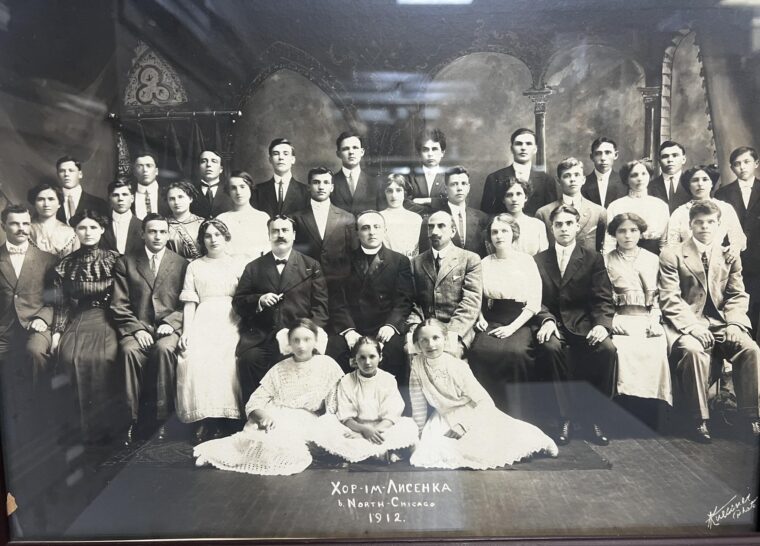
Cultural activities played an important role in the life of the community. According to researcher Myron Kuropas, two Ukrainian choirs were already operating in Chicago in 1909. Drama groups, orchestras, and music and dance groups appeared in the following decades. The Ukrainian choir, led by Yu. Benetsky, became the winner of music competitions, and in 1932, with the participation of Vasyl Avramenko, the Ukrainian Festival was organized. Theater groups staged performances such as "Catherine", "Zaporozhets Beyond the Danube", "Sorochynsky Fair", and "Marusya Boguslavka".

Researchers note that the Ukrainian community of Chicago actively developed even in difficult economic conditions. According to Professor Myron Kuropas, the city's Ukrainians built one of the best churches in the United States, supported projects in Europe, organized a Ukrainian pavilion at the 1933 World's Fair, created a school, cultural groups, and took an active part in public and political life. These efforts laid the foundation for the further development of one of the largest centers of the Ukrainian diaspora in the United States.

Photo: Halyna Parasyuk.
Author: Danylo Pievchev