


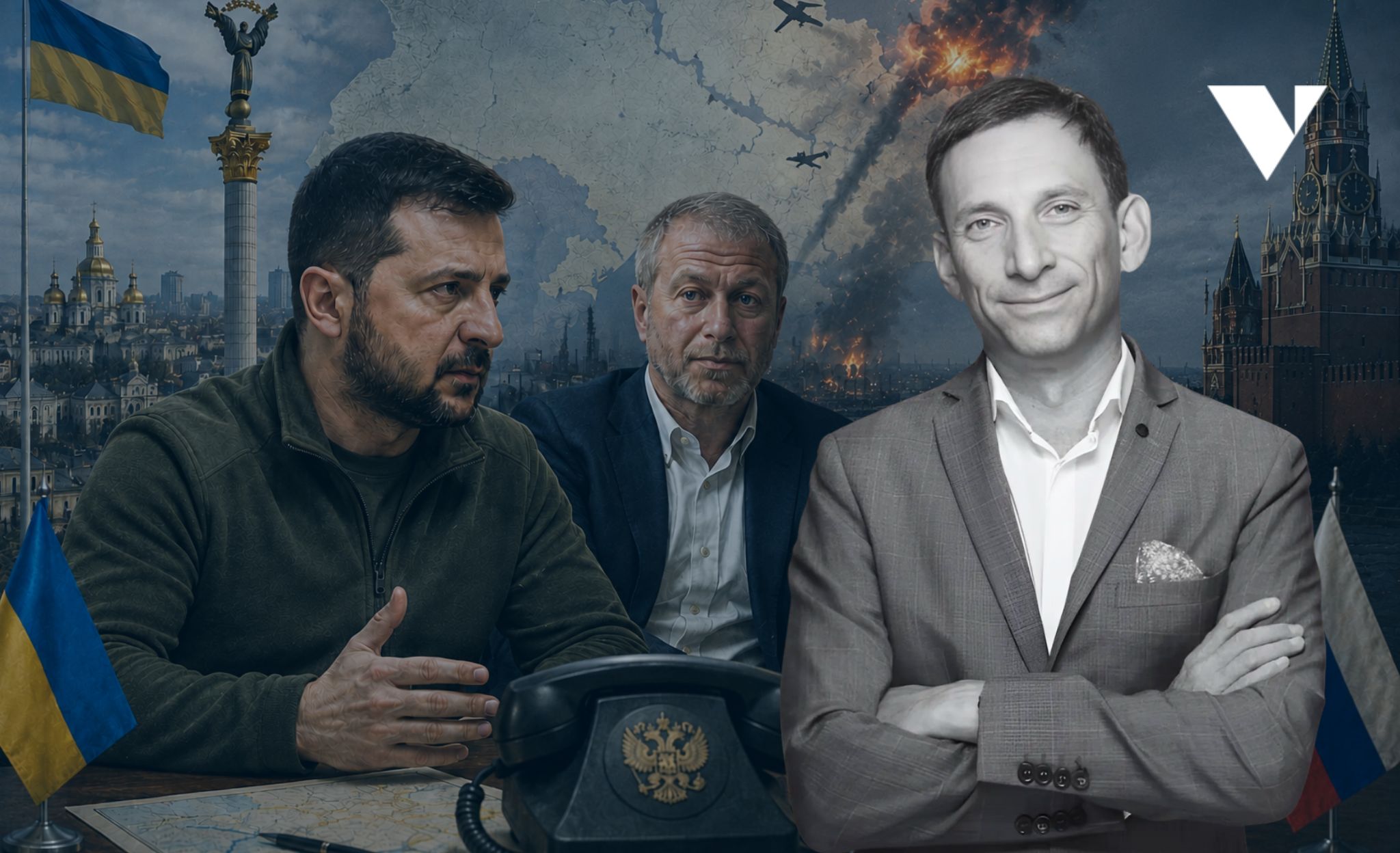
Volodymyr Zelensky has confirmed reports that Russian oligarch Roman Abramovich came to Kyiv for talks with the Ukrainian president and other members of the country’s leadership — the same Abramovich who was already involved in the negotiation process in 2022.
The first information about the arrival of a “Russian businessman” in Kyiv was made public by Putin during the St. Petersburg International Economic Forum — as evidence, he claimed, that Ukraine was hoping for negotiations and a meeting between the presidents. However, Putin once again refused to meet with Zelensky, and many even questioned whether the “businessman” had actually come to Kyiv at all. Yet in the very first minutes after Putin’s statement, many suggested that if anyone had indeed come, it could only have been Abramovich.
Because Abramovich is not merely a “businessman.” It is no coincidence that when Putin spoke about his visit to Kyiv, he referred to the anonymous visitor as “our colleague” — presidents do not usually speak that way about businesspeople. Abramovich has been an integral and important part of Putin’s system for 26 years. He was a member of the State Duma and even governor of one of the federation’s regions, Chukotka — in other words, a state official, not just some entrepreneur. Since the 1990s, he has been considered a person responsible for safeguarding the wealth accumulated by those in power. That is why Abramovich can call Putin, and Putin can call Abramovich. Putin does not have that kind of phone connection with just any “businessman.”
We will not try now to determine who initiated the trip. Kyiv and Moscow will have opposing versions of that. However, even if we accept the Russian version — that Zelensky invited Abramovich to the Ukrainian capital — the very fact that Putin allowed the oligarch to go already indicates the Russian president’s interest in dialogue. The only question is: what kind of dialogue?
The main problem in the Russian-Ukrainian dialogue is the way both sides perceive reality. Zelensky may believe that Ukrainian strikes on Russia should convince Putin to agree to peace, or at least to a ceasefire along the front line. Putin, however, may have a completely different view of how events are developing. From his perspective, the Russian army continues to advance, Russian ballistic missiles and other rockets continue to destroy, and the Americans are bogged down in the Middle East, clearly having little time for helping Ukraine.
Zelensky was ready to present Abramovich with his picture of reality. Putin was ready to use the oligarch to check whether Zelensky was prepared for capitulation. Of course, this is exactly the same picture we observed during the last Normandy-format summit in Paris in December 2019, when Zelensky and Putin met. It is also the same picture we saw in 2022 during the talks in Istanbul. And it is the same picture that appeared again in the attempt to launch negotiations after Trump’s victory. Ukraine keeps offering Russia its picture of reality, while Putin keeps trying to understand when Kyiv will capitulate. It is a real Groundhog Day.
Still, it cannot be said that nothing is changing. In 2022, and even in 2025, no one could have imagined such strikes on Russia, or that the war would be taking place on the territory of both countries, creating the prospect of the gradual destruction of Russia’s military-industrial complex and oil refineries. The fact that Putin is ready for his own oligarch’s mission to Kyiv means that he, too, is looking for ways to pause the war and minimize losses — on his own terms, of course, but he is looking.
The only question is whether, at some point, Putin will be ready for such a pause not on the terms of Ukrainian capitulation, but on fair terms. At the moment, such possibilities look unlikely, and Roman Abramovich’s trip to the Ukrainian capital has only confirmed this.
However, if Ukrainian strikes on Russia are effective enough and Ukraine receives additional capabilities to defend itself from Russian attacks, a situation in which Putin begins to retreat from his maximalist demands may become more realistic. Even more realistic may be a scenario in which the war gradually “fades” over the next several months or years without serious negotiations or the signing of any binding agreements.
Author: Vitaly Portnikov