


Agapiy Honcharenko, also known as Andriy Humnytsky, was a Ukrainian priest, publisher and public figure. In the 1860s, he emigrated to the USA, founded the Alaska Herald with the Svoboda supplement in San Francisco and became one of the first Ukrainians to publicly declare their national identity in America.
This was reported by the archivist of the Ukrainian National Museum Halyna Parasyuk.
Agapiy Honcharenko was called the first Cossack in America and an Alaska Men. His life was connected with Kyiv region, Greece, London, Istanbul, Egypt, Alaska and California. He lived in the USA for almost half a century, where he was engaged in publishing, translations and public work.
“Misfortune is my distinction, and poverty is my glory,” was his motto.
Origin and education
Agapiy Honcharenko, whose real name was Andriy Humnytsky, was born on August 31, 1832, or August 19 according to the old style, in the village of Kryva, Tarashchansky district, Kyiv region. His father, Onufry Humnytsky, came from the village of Kamyanka near Fastiv. According to Honcharenko’s memoirs, there “people lived freely, not under a master…”.
Bohuny’s maternal family came from Kyiv. His maternal grandfather, Oleksiy Shtefan, was a priest from the village of Kryvyn, now the village of Kryve near Brusylov in the Zhytomyr region. There is also a version that Agapiy Honcharenko could have been born in Kryvyn, since, according to his memoirs, his grandfather gave this village as an inheritance to his daughter Evdokia, Andriy-Agapiy’s mother.
Andriy was the eldest son in the family. He learned to read early, read a lot, had a talent for languages, and loved solitude. In his memoirs, he recalled the words of his grandfather Gerasim Gumnytsky:
“I was a boy of five, grandfather Gerasim came to us and made us read Chaslovets (“Chasoslov”). I read borzo. Centennial eyes cried over my head. “My child, you will be a werewolf. Kamenets people, free Cossacks!”.
In September 1840, Andriy was sent to the Kyiv Theological Seminary. After graduating on June 23, 1853, he became a monk of the Kyiv-Pechersk Monastery and took the name Agapius.
From Athens to London
Metropolitan of Kyiv and Galicia Filaret appointed the young monk to lead his office. With his assistance, on November 12, 1857, Agapiy was sent to the embassy church in Athens. There he learned Greek and became acquainted with philosophy.
After the death of Metropolitan Filaret on December 21, 1857, Goncharenko considered his stay in Greece an important coincidence for his future fate.
“Such is my luck! In Athens, Attic salt salted me well for the rest of my life,” he recalled.
In Athens, Agapiy Goncharenko read the magazines “Polar Star” and “Bell,” which were banned in the Russian Empire. Through an Odessa official he knew, he established contact with the publisher of “Bell,” Alexander Herzen, and began sending his articles to the publication.
In February 1860, Goncharenko was arrested and imprisoned in Istanbul. He was to be transferred to Russia on the ship "Oleg", but the day before, his friends helped him escape. On March 4, 1860, he arrived in London.
In the Russian-language "Kolokol", Agapiy Goncharenko published an obituary of Taras Shevchenko in Ukrainian.
"I fled to eternal and holy freedom, to be a Cossack for the rest of my life!" - wrote Fr. Agapiy Goncharenko in his memoirs.
After a year in London, he returned to Greece. In early 1862, he was on Mount Athos, and during Easter he visited Jerusalem. At the same time, persecution by the Russian authorities continued. In Egypt, an attempt was made on his life by order of the Russian ambassador. At the end of 1864, Goncharenko left Europe forever on the ship Yarington.

Emigration to the USA
On January 1, 1865, Agapiy Goncharenko arrived in Boston. On Christmas Day, he held his first Orthodox service on American soil.
Due to persecution by the tsarist government, he was unable to continue his priestly activities. Goncharenko worked at odd jobs, earning 25 cents a day.
In Philadelphia, he visited the home of John Citti, where Italian patriot emigrants gathered. There, Goncharenko met Albina Citti. They married on September 28, 1865 in New York. Albina Citti was a teacher by profession. Agapiy Goncharenko became the first emigrant in America to officially call himself Ukrainian.
During this period, he worked on translating the Bible into Arabic. The couple saved $2,500, of which $1,600 was spent on a printing press with Cyrillic script.
Alaska Herald and the Svoboda supplement
After the purchase of Alaska by the United States, Agapiy Goncharenko decided to start a publishing business. He believed that a significant part of the population of Alaska was made up of Ukrainian Cossacks who had migrated to the northern lands through Siberia.
After the transfer of Alaska to the United States, the territory was under military rule, and information from the continent arrived with a delay. For his publishing business, Goncharenko chose San Francisco as a shipping center connecting Alaska with other regions of the country.
On March 1, 1867, at 536 Market Street, he began publishing the Alaska Herald magazine with the Svoboda supplement. The publication was published in Russian and partly Ukrainian twice a month, had eight pages and a circulation of 500 copies.

The magazine was published from March 1, 1868 to April 1, 1872.
“I began to work in print and tell the truth. In my publication of the Alaska Herald with Svoboda, I was: editor, censor, deliveryman and collector. I did all the work myself. And I sent 500 copies as a gift to Alaska and Siberia, by roads known only to me, to enlighten people and bring them to the right path,” Goncharenko explained his work.
In the Svoboda supplement, he published his own prose translation into English of an excerpt from Taras Shevchenko's poem "Caucasus" under the title "Interesting Ideas of the Poet Taras Shevchenko." This was the first publication of Taras Shevchenko's works in the United States.
Goncharenko also published excerpts from the works "To the Dead and the Alive...", "Caucasus," and "My Thoughts, My Thoughts..." in the original language.
The first issues of the Alaska Herald published a Russian-language translation of the US Constitution for Alaskans. Goncharenko also prepared an English "Primer" for the indigenous population of Alaska. He sought to explain to people that the source of power in the United States is the people, not an autocratic ruler.
For his devotion to ordinary people, the locals called Agapius Goncharenko Alaska Men.
The Ukraine Farm in California
Due to health problems, Agapiy Goncharenko sold his shares in the Alaska Herald to the American publisher Henry George. At the same time, he published the magazine Svoboda for another two years. Five issues of it were published in 1872–1873.
After 1872, Goncharenko retired from publishing. He purchased 50 acres of land near the town of Hayward in California and founded the Ukraine Farm.
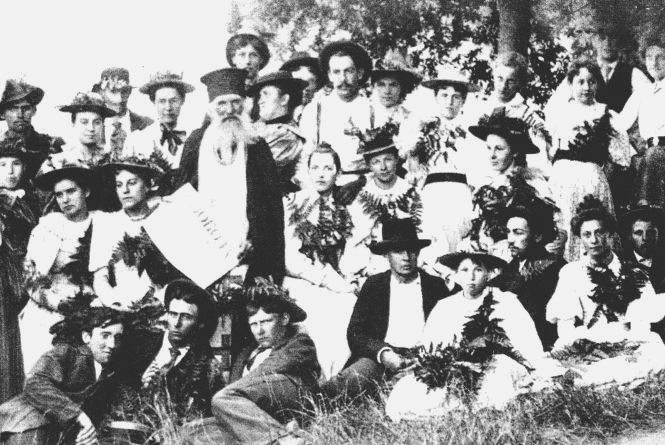
The facade of his house had the inscription “Svoboda.” On the farm, he planted pine and cherry trees that reminded him of Ukraine. Visitors came to the estate, and he performed Christian baptisms and prayers for the guests.
“Whoever came to me with faith,” wrote Goncharenko, “I take care of him. I have never been paid for such duties, because it is a pleasure, not work.”
In his memoirs published in Kolomyia in 1894, Agapiy Goncharenko wrote:
“My Nenka Ukraine and the source of Cossacks, like a phoenix, will rise again for the good of people, for eternal truth and freedom.”
Agapiy Goncharenko died on May 16, 1916, on the farm “Ukraine” in California. He was buried in the local cemetery. He did not return to Ukraine.
Photo: Halyna Parasyuk.
Author: Danylo Pievchev