


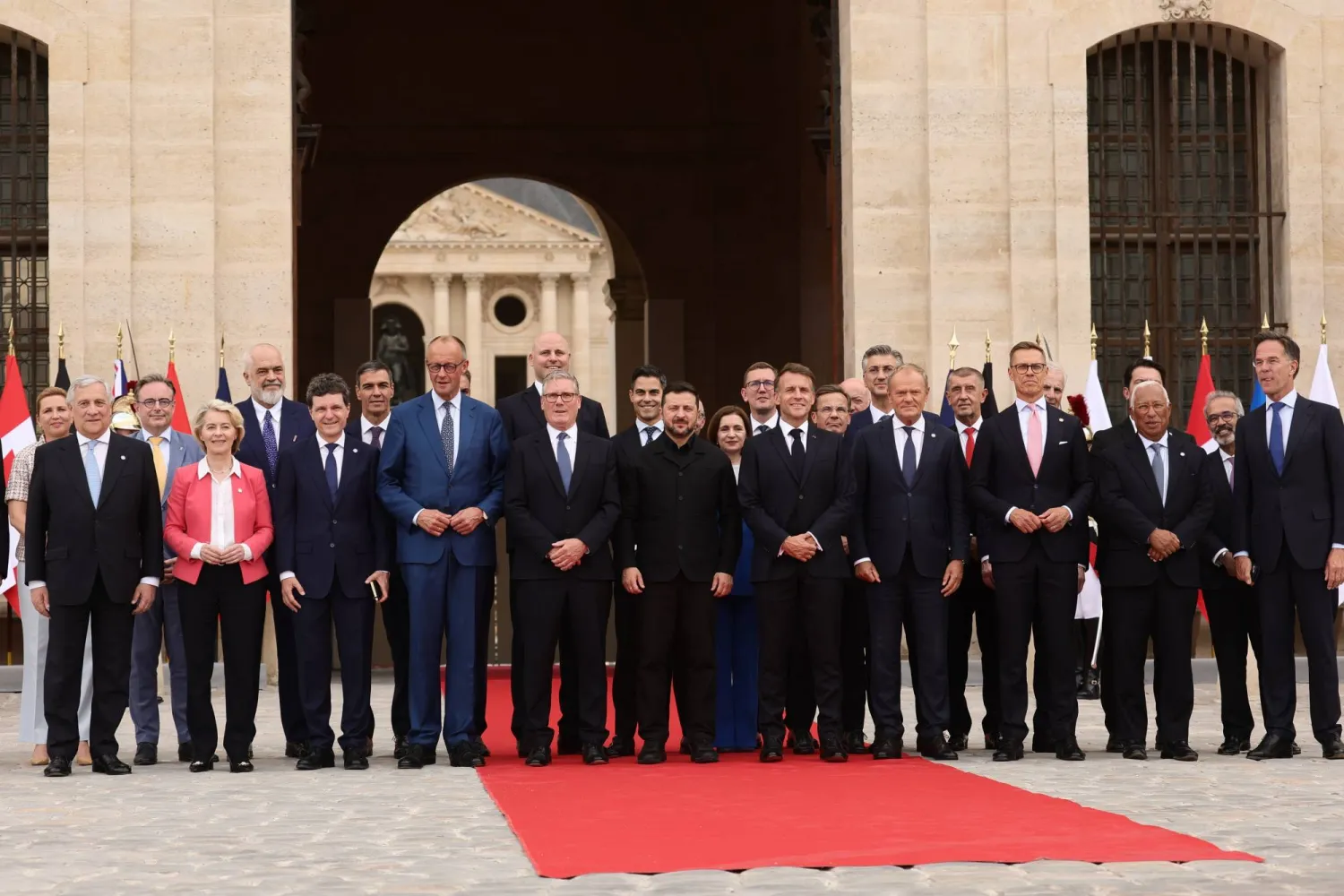
 European allies continue to expand support for Ukraine both militarily and politically. European countries have announced the creation of a new Anti-Ballistic Coalition, the EU has imposed sanctions against those involved in the torture of Ukrainian prisoners of war, and Germany is financing a large-scale purchase of strike drones. Meanwhile, Poland does not expect the war to end quickly, while russia claims it has allegedly disrupted preparations for Ukrainian strikes on its military facilities.
Anti-Ballistic Coalition
Ukraine, together with nine European countries, has announced the creation of an Anti-Ballistic Coalition aimed at strengthening Europe’s capabilities to counter ballistic missiles. This was announced on July 13 during a meeting of the Coalition of the Willing in Paris. Denmark, France, Germany, Italy, the Netherlands, Norway, Spain, Sweden, Ukraine, and the United Kingdom joined the initiative. The participants emphasized that the new system would be exclusively defensive in nature and would complement existing missile defense systems.
The joint statement reads: “We, the leaders of Denmark, France, Germany, Italy, the Netherlands, Norway, Spain, Sweden, Ukraine, and the United Kingdom, recognizing the growing threat posed by ballistic missiles and the increasing importance of defense capabilities for the security of the European continent, today announce the launch of the Integrated Missile Defense Coalition, which will be exclusively defensive in nature. We express our support for its flagship project, designed to develop effective capabilities to counter ballistic missiles as quickly as possible.”
The founders of the coalition stated that “the defense of Europe requires a comprehensive solution in the form of an integrated missile defense architecture capable of deterring and neutralizing future missile threats.”
The document also provides for the creation of technical working groups, the definition of common operational requirements, the development of scientific and industrial cooperation, and the preparation of a roadmap for achieving initial operational capabilities.
The statement also emphasizes: “By combining our defense-industrial capabilities, scientific developments, and operational experience, we aim to create a joint missile defense capability for Europe and support the relevant areas of activity. We are doing this not against any people, but to protect our own security.”
Ukrainian President Volodymyr Zelensky noted that the FREYJA system would not replace existing systems, but would complement them in order to “create a reliable shield over all of Europe and do all of this faster and cheaper.”
He also said: “Strong and sufficient anti-ballistic capabilities are needed to end russia’s war against Ukraine. They are no less important than deep or middle strikes against russia’s war economy or active operations on the front line. The more means Ukraine has to shoot down russian ballistic missiles, the higher the likelihood that putin will sit down at the negotiating table, because his last argument in this war will no longer work.”
In addition, Zelensky emphasized: “Our calculation is that there will be more ballistic missiles in the world. And there must be at least enough anti-ballistic systems. This is exactly what we are working on. Europe can become a global leader in the production of high-quality anti-ballistic systems without political dependence.” According to Zelensky, FREYJA is expected to begin operating within the next 12 months.
The EU Imposed Sanctions Against Those Involved in the Torture of Ukrainian Prisoners
The Council of the European Union has imposed sanctions against 15 individuals and one institution it considers responsible for serious human rights violations against Ukrainian prisoners of war and unlawfully detained civilians on the territory of the russian federation and in the temporarily occupied territories of Ukraine. The sanctions list includes individuals involved in the terrorist attack in Olenivka and in the death of Ukrainian journalist Viktoriia Roshchyna.
Among them is Dmitry Neyolov, first deputy head of the colony in Olenivka, whom the EU considers involved in the torture, beatings, and humiliation of Ukrainian prisoners, as well as responsible for delaying the evacuation of the wounded after the strike on the colony in July 2022. Sanctions were also imposed against five other employees of this institution, the head of security at Penal Colony No. 7 in russia’s Vladimir Oblast, Alexey Khavetsky, and FSB officer Yan Zanevsky, who is accused of the illegal detention and torture of civilians in the temporarily occupied territories of Ukraine.
The EU applied separate sanctions to SIZO-2 detention center in Taganrog, where, according to the Council of the EU, Ukrainian prisoners of war and civilians, including journalists and women, were systematically tortured. It was in this institution that journalist Viktoriia Roshchyna died after a year of imprisonment; numerous signs of torture were found on her body.
In addition, the sanctions list includes the head of Penal Colony No. 10 in the settlement of Udarny, Alexander Gnutov; five of his deputies; and the head of the medical unit, Galina Mokshanova. According to the Council of the EU, hundreds of Ukrainian prisoners of war and civilians were held in the colony without trial or official status, while former captives reported the use of electric shocks, beatings, sexual violence, mock executions, confinement in painful stress positions, and denial of medical care.
All those included in the sanctions list are subject to asset freezes, and EU citizens and companies are prohibited from providing them with funds or other economic resources. Natural persons are also subject to a ban on entry into and transit through the territory of the European Union.
Donald Tusk Does Not Expect Peace in Ukraine to Be Achieved Quickly
Polish Prime Minister Donald Tusk saidhe does not see any prerequisites for peace or a ceasefire in Ukraine in the near future. He made this assessment on July 14 in Paris after talks with NATO Secretary General Mark Rutte and Ukrainian President Volodymyr Zelensky. According to the Polish prime minister, russia’s current position gives no grounds to expect a quick end to the war. He also suggested that russia would try to continue hostilities at least until winter.
Speaking to journalists, Tusk said: “At this stage, it seems unlikely that a ceasefire or peace agreement will be reached in the near future, given the hardline position of russia and putin.” He also noted: “Everyone expects an escalation of actions by russia during this period, and it is quite likely that russia will want to continue this war at least until winter.”
The Polish prime minister said that in the fall, Poland will host joint military exercises involving French and British troops. According to him, “These exercises will prepare the entire coalition of the willing, which gathered in Paris today, to provide real security guarantees for Ukraine, as well as for the entire region.”
Germany Will Finance 50,000 Strike Drones for Ukraine
Germany will finance the purchase of 50,000 strike FPV drones for Ukraine, making it one of the largest known drone orders for Kyiv by a Western state. Reuters reported this, citing a source familiar with the details of the deal. The drones in question are Shrike drones produced by the Ukrainian company SkyFall and equipped with software from the U.S. company Auterion, which allows them to autonomously track and strike moving targets during the final stage of flight. Against the backdrop of the war, Ukraine is actively using drones and already produces millions of such systems annually, carrying out thousands of strikes every day.
Auterion CEO Lorenz Meier confirmed that the contract is worth approximately €90 million and is financed by one of the European countries. According to him, some of the drones have already been delivered to the Ukrainian government, while the rest are planned for delivery by the end of this year. SkyFall confirmed Germany’s involvement in the financing but declined to disclose details of the agreement, while the German and Ukrainian defense ministries declined to comment on the information for security reasons.
In addition, Meier said that this year Auterion is involved in supplying a total of 100,000 drones to Ukraine together with various manufacturers, including fulfilling a Pentagon contract for 33,000 drones. The United Kingdom had earlier announced the transfer of 150,000 drones to Ukraine as part of a separate aid package.
russia’s fsb Claimed Alleged Preparations for Ukrainian Drone Attacks Deep Inside russia
russia’s federal security service saidthat it had prevented alleged preparations for Ukrainian FPV drone attacks on military facilities in the Urals and the Far East. According to the security service, Western-made drones were delivered to russian territory using larger Ukrainian fixed-wing drones and balloons. After landing in Bryansk Oblast, they were allegedly transported in trailers with double bottoms, disguised as household appliances. The russian side claims that the final targets were the Shagol and Ukrainka air bases, and that the suspects allegedly involved in preparing the operation were detained.
The fsb also claims that the drones were manufactured in the United States, the United Kingdom, Canada, and Sweden, carried more than one kilogram of explosives, and used artificial intelligence navigation to bypass electronic warfare systems. According to the security service’s version, the scheme resembled Operation Spiderweb in 2025, during which russian military airfields were attacked, including the Ukrainka base. Reuters notes that in recent months Ukraine has intensified strikes on russian oil refineries and defense industry enterprises located thousands of kilometers from the border, which has already led to fuel disruptions after a number of major refineries were shut down. At the same time, russia has recently intensified its anti-Western rhetoric, accusing Western countries of direct involvement in Ukrainian long-range strikes, while kremlin spokesman dmitry peskov said last week that the “special military operation” had turned into a war because of Western support for Ukraine.
Photo: EPA
Author: Danylo Pievchev