


Oleksandr Arkhipenko was born in Kyiv, studied at the Kyiv Art School, and worked in Paris, Berlin, and the USA. His work is associated with innovative approaches to form, space, color, and materials in sculpture. The sculptor died in New York on February 25, 1964, and on February 28, he was buried at Woodlawn Cemetery in the Bronx.
This was reported by Ukrainian Art Library.
Oleksandr Porfirovych Arkhipenko was born in Kyiv to a mechanical engineer named Porfiry Arkhipenko, who worked at St. Volodymyr's University. His father was not interested in art and preferred practical designs that could make human life easier.
The son of an engineer chose a different path and became an artist. Arkhipenko did not receive a complete art education, but three years of study at the Kyiv Art School influenced his formation. In 1906, he organized his first personal exhibition of his works near Kyiv, after which he went to Moscow.
About his first exhibition, Arkhipenko wrote:
“…I opened an exhibition of my works in the village. Among the works were several colored ones. “The Thinker” is red. On the door he hung an announcement: “Workers and peasants – for less pay.” The first visitor was a police inspector… “Why should workers and peasants pay less?” Then he saw: “The Thinker”: “And what is he thinking about and why is he red?” The police inspector saw this as a symbol.”
After studying in Kyiv, Arkhipenko continued his artistic path in Moscow. The sculptor himself recalled this period as follows:
“I studied at an art school in Kyiv, and then in Moscow. At that time, most Moscow sculptors imitated German faience and dreamed of erecting monuments to generals. But there were others. We created associations and held joint exhibitions. That's how I got the opportunity to exhibit several times…”
An important stage in his life was moving to Paris. In 1908, Arkhipenko left the Paris Art School, and soon founded his own. Later, he also created art schools and training workshops, in particular, he worked in Berlin.
Arkhipenko paid much attention to the search for new artistic forms. His work was influenced by various artistic traditions, in particular the ancient art of Egypt and Assyria, the Byzantine tradition, Gothic, as well as the art of different peoples and cultures.
One of the important principles of his work was the use of simple geometric forms. Arkhipenko explained it this way:“The idea of using simple forms arose from my hobbies. I really like simple things and everything that is clear and simple. I don’t like complexity.”
“The idea of using simple forms arose from my hobbies. I really like simple things and everything that is clear and simple. I don’t like complexity.”
In another statement, he said:
“For some time I studied a book on technique, it helped me in my search. It was she who led me to simple forms, which I first used in sculpture during the period of Cubism… Since then, everyone stubbornly considered me a Cubist.”
Despite the fact that Arkhipenko was often called a Cubist, he himself did not identify with this direction:
“Everyone stubbornly considered me a Cubist…”
Later, the sculptor formulated his own attitude to artistic directions:
“I am by myself, I am independent.”
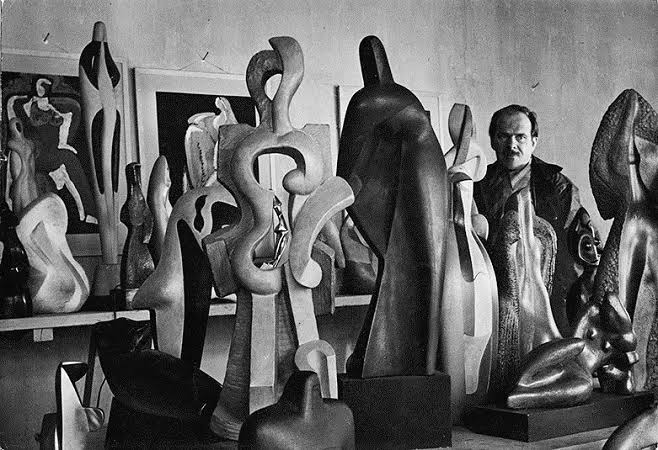
One of the features of Arkhipenko’s work was the use of space as a full-fledged element of the sculptural form. The voids and openings in his works were not simply the absence of material, but became part of the composition.
Various materials also played an important role in his work. Arkhipenko worked with glass, cement, wood, clay, plaster, papier-mâché and metal. He used not only bronze, but also steel and silver. His so-called sculptural paintings, which combined planar and volumetric elements, became a separate direction.
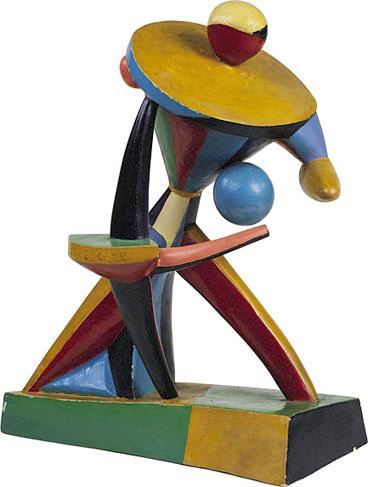
The sculptor also experimented with color. He returned bright colors to sculpture, referring, in particular, to the experience of ancient cultures. Arkhipenko said about this:
“You simply forgot – Egypt, Assyria and in my Ukraine (he says: “In my Ukraine”) too” (“by the way, they say that the Romans also painted sculptures in the beginning”).
His work included works inspired by the circus and theater. Among them are “Pierre Carousel” and the “Medrano” series, which used wood, glass, paint and metal.
Another direction of Arkhipenko’s search was archipentura – a construction made of metal strips that rotated and created the impression of movement. The sculptor himself linked the emergence of this idea to 1922 in Berlin. In 1928, archipentura was demonstrated at an exhibition at the Anderson Gallery in New York.
In Paris, Arkhipenko joined the artistic community, where he communicated with Pablo Picasso, Georges Braque, Fernand Léger, Amedeo Modigliani, Diego Rivera and Guillaume Apollinaire. His works were exhibited in various European cities.
Among the works of this period are “Boxers” from 1913, “Gondolier” from 1914 and “In the Café” from 1915. Apollinaire wrote an article about the new ways of artistic expression used by Arkhipenko.
During this period, the sculptor's works increasingly attracted the attention of the artistic community. His exhibitions were held in The Hague, Berlin and Paris. Mykola Voronyi wrote about Arkhipenko's principle: "Let's search further!"
The Ukrainian theme also remained present in his work and memories. Arkhipenko often mentioned Kyiv and Ukraine. Speaking about his childhood, he linked his own understanding of sculpture with the experience of observing two vases:
“I can imagine very well the circumstances under which this happened… My parents bought two vases for flowers. The two vases from the same store are exactly the same. I looked at them, these two objects… I wanted to put them close to each other. I did it. I put them side by side. And what did I see? An intangible, imaginary third vase, created by the emptiness between the two real vases… Only after many years, after many trials, did I realize this.”
The space between objects became one of the important motives of his creative approach.
Arkhipenko also emphasized the importance of symbols in art:
“The world would like the artist to lay out everything as if it were in the palm of his hand. So that the world could come and see everything without any effort. I think that in that case there would be no creativity, because the artist must create. The artist who creates also compels the viewer to create. He gives the viewer an impulse that pushes him, the viewer, according to the laws of universal motion. When you present a symbol to the viewer, he must begin to think creatively himself.”
Separately, he explained his own understanding of symbolism:
“You see, a symbol is something that has too much importance. Sometimes it is habitual, and we do not notice it. Look: when someone writes or speaks, this is also symbolism. We use words that are symbols… A cat plays with a piece of paper – this is also symbolism. For him, paper is a symbol of a mouse.”
“A symbol suggests, suggests, suggests feelings, a symbol exists three-dimensionally in space.”
In the 1920s, Archipenko continued to teach and organize art schools. Among the artists who were associated with his studies or were influenced by his work are Giacomo Manzu, Alberto Giacometti, Henry Moore, Alexander Calder, and Osip Tsadkin.
In 1924, Archipenko arrived in New York with his wife. His move to the United States marked a new stage in his life. That same year, Igor Grabar wrote to Moscow from New York:
“The Archipenko I met—by the way, a man of astonishing talent and vain boasting, though he has already stopped boasting—says that he wants to run away from here because there is nothing to do here.”
In the United States, Archipenko continued his exhibition and teaching activities. He worked in various cities, including Washington, Seattle, New York, Kansas City, and Chicago, and also made a lecture tour of the southern United States. In 1928, he became an American citizen.
In the following years, Arkhipenko continued to work with sculpture and experiment with materials and lighting. One of his developments was a sculpture illuminated from the inside. For this, he used Plexiglas, and the lamp was mounted in a pedestal.
On May 25, 1957, a concert was held in New York, during which Archipenko was greeted by the audience. After that, the bandurist and the girl performed a Ukrainian song:
“Oh, I would love to blow, only the deep ravine, oh, I would love to come, only the distant land…”
During the performance of the song, Archipenko cried, and everyone in the hall saw it.
During this period, his exhibitions continued to be visited by specialists, and the art press called him the greatest sculptor of the twentieth century.
Arkhipenko maintained contact with Ukrainian culture. He spoke Ukrainian, mentioned Kyiv, and offered his services for the creation of a monument to Taras Shevchenko in Washington. At the same time, he did not want to participate in the competition, offering to simply submit his project. He was refused.
Among the works of the later period, images of Saint Volodymyr and Taras Shevchenko are mentioned. The sculptor also repeatedly turned to the image of Shevchenko.
Oleksandr Arkhipenko died in New York on February 25, 1964. Three days before the burial, on February 25, he fell on the threshold of his studio and never got up again. He was not yet 77 years old.
On February 28, 1964, Alexander Porfirovych Archipenko was buried in New York at Woodlawn Cemetery in the Bronx.
Photo: Ukrainian People, L. Y. Kolosova
Author: Danylo Pievchev