


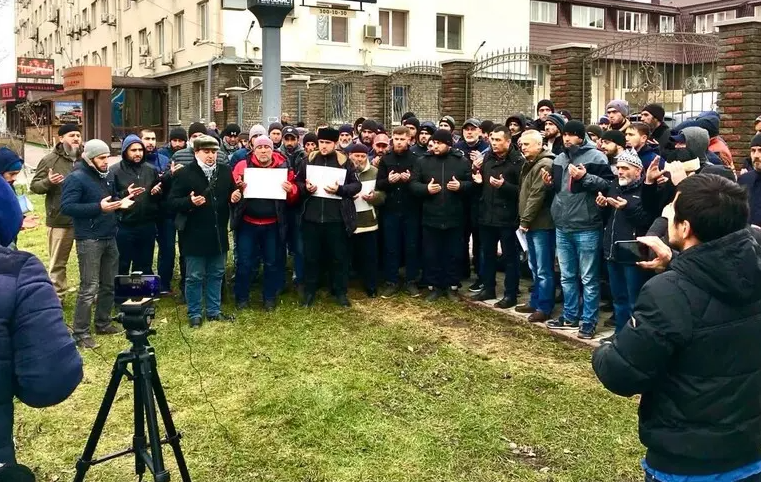
The Russian Federation has carried out another wave of repression against Crimean Tatars in temporarily occupied Crimea. This includes the inclusion of 137 Crimean Tatars associated with the human rights organization Crimean Solidarity in the list of so-called “foreign agents,” which effectively forced the movement to cease its activities.
The World Federation of Ukrainian Women’s Organizations has condemned Russia’s new wave of repression against Crimean Tatars associated with the human rights movement Crimean Solidarity. After activists, human rights defenders, lawyers, political prisoners and their family members were included in the Russian list of so-called “foreign agents,” the movement was forced to cease its activities. The People's Deputy of Ukraine, co-founder of the NGO “CrimeaSOS” Tamila Tasheva called this decision an act of pressure on the independent human rights movement in the occupied Crimea.
This was reported by the WFUWO, People's Deputy of Ukraine and co-founder of the NGO “CrimeaSOS” Tamila Tasheva.
“The World Federation of Ukrainian Women's Organizations most strongly condemns these next actions of the Russian Federation, aimed at breaking the will of the Crimean Tatar people,” the statement said.
As reported, on June 26, 2026, the UN Committee on the Elimination of Racial Discrimination published its conclusions, in which it noted that Russia had violated a number of provisions of the International Convention on the Elimination of All Forms of Racial Discrimination. It was about the targeted persecution of three Crimean Tatar lawyers who are engaged in the protection of human rights and who were anonymously marked as “X”, “Y” and “Z” for security reasons.
Exactly one month later, on July 26, 2026, the Ministry of Justice of the Russian Federation published a list of 137 Crimean Tatars associated with “Crimean Solidarity” who were recognized as “foreign agents”. The list included human rights defenders, public activists, current political prisoners, family members of political prisoners, as well as almost all lawyers who defend political prisoners.
Earlier, on July 21, the People’s Deputy of Ukraine and co-founder of the NGO “CrimeanSOS” Tamila Tasheva reported that the public human rights movement “Crimean Solidarity” was being forced to cease its activities, and its website and pages on social networks would no longer be updated. According to her, the reason was the organization’s inclusion in the register of “foreign agents.”
“This decision is an act of pressure by which the occupier is trying to isolate and discredit human rights defenders, as well as to intensify repression against the independent movement and our fellow citizens,” Tasheva wrote.
According to the deputy, for 10 years, Crimean Solidarity has communicated with people every day, supported them in conditions of searches, arrests and losses, documented the stories of the persecuted, helped the families of the detained, facilitated legal protection and spread the truth about the events in the occupied Crimea.
Tasheva also noted that many activists who helped victims of political repression have themselves repeatedly been fined and illegally persecuted, and some human rights defenders, journalists and volunteers are still in illegal detention.
“For years, they have been the only independent movement and a true voice of truth, a reliable support for the Crimean Tatar people and all citizens who have found themselves under severe pressure from the occupiers,” Tamila Tasheva emphasized.
She added that after the movement’s closure, hundreds of families of political prisoners, illegally imprisoned Ukrainian citizens, and thousands of people in occupied Crimea risk being left without vital support and legal protection.
“Russia continues to purposefully suppress any independent human rights movement. The terrorist state is terrified of the solidarity of ordinary people and the truth about its crimes,” Tasheva noted.
The SFZHO also noted that in Russia, the status of “foreign agent” is used as a tool of social repression to suppress views that contradict Moscow’s official line. The Federation emphasizes that this status actually legalizes persecution by the state.
“Persons recognized as “foreign agents” become objects of arbitrary arrests, refusals to obtain employment, public stigmatization – especially of their children – sudden and large-scale financial checks, as well as groundless detentions,” the statement notes.
According to the SFZHO, “Crimean Solidarity” was established in Crimea in April 2016 as a public human rights movement to protect victims of repression on ethnic, religious and political grounds in Russian-occupied Crimea.
The Federation recalled that after the illegal occupation of Crimea in 2014, the Russian Federation regularly adds the names of Crimean Tatar activists, journalists and human rights defenders to the official state “List of Terrorists and Extremists,” which is maintained by Rosfinmonitoring.
For ten years, Crimean Solidarity has been providing the world with information about the situation in occupied Crimea. At the same time, due to the threat of criminal prosecution after being assigned the status of a “foreign agent,” the organization, according to the statement of the Crimean Solidarity Organization, sees no other way out.
“All activities of the organization were suspended on July 26, 2026,” the statement said.
The SFUJO also noted that “Crimean Solidarity” categorically rejects all accusations of the Russian Ministry of Justice, which served as the basis for assigning the organization the status of a “foreign agent,” and calls them false.
The statement also recalls the deportation of the Crimean Tatar people on May 18, 1944, when, by order of Stalin, the Crimean Tatars were forcibly removed from Crimea. The SFUJO emphasized that the new wave of criminalization of the Crimean Tatars is a harsh reminder of those events.
After the declaration of independence of Ukraine in 1991, Crimea was internationally recognized as the territory of Ukraine. At the invitation of the Ukrainian government, about 300 thousand Crimean Tatars returned to their historical homeland.
In 2014, Russia illegally occupied the Crimean peninsula, after which the Crimean Tatars were again persecuted and some of them were forced to leave their homeland. Currently, according to the SFUZHO, about 200 thousand Crimean Tatars continue to live in the Russian-occupied Crimea.
“True human solidarity cannot be destroyed by any registers or bans. Therefore, we must continue to fight for each of our citizens and increase pressure on Russia on international platforms,” concluded Tamila Tasheva.
Photo: “Crimean Solidarity”
Author: Inna Mikhno